Yes. Under CPLR 321(a), an individual in New York can bring a personal injury lawsuit in person, without a lawyer. A corporation must appear by attorney except in some small claims matters, and a child's case runs through a parent or guardian. Once you hire a lawyer in the case, you can't act on your own without the court's consent.
Yes, you can represent yourself in a personal injury case, but doing so requires navigating complex legal procedures, filing deadlines, and rules of evidence without professional guidance. Representing oneself can be challenging, especially when negotiating with insurance companies or presenting damages in court. Self-representation can potentially reduce attorney fees, but it also raises the risk of lower compensation or even case dismissal due to mistakes.
At My Injury Pros, our experienced personal injury attorneys represent clients in car accident, slip and fall, and workplace injury claims. While you can represent yourself, navigating legal procedures, evidence, and insurance negotiations without guidance often puts your claim at risk. Our team provides trusted legal representation, expert advocacy, and personalized strategies to protect your rights and secure the compensation you deserve. Contact us today for a free consultation and take the first step toward a stronger, professionally supported personal injury claim.
In this blog, we explore the challenges, risks, and key steps involved in representing yourself in a personal injury case and help you decide whether self-representation is right for you.

Personal injury law is designed to protect individuals who have suffered harm due to the negligence or intentional actions of others. It covers a wide range of incidents, including car accidents, slip and falls, medical malpractice, and workplace injuries. The core principle is that if someone else’s actions, or failure to act responsibly, cause you injury, you are entitled to seek compensation for your losses, which can include medical expenses, lost wages, pain and suffering, and property damage.
When you are injured due to another party’s negligence, you have several rights under personal injury law. You are entitled to pursue compensation for both economic and non-economic damages, to be treated fairly during any legal process, and to have your case evaluated based on the facts and evidence.
Additionally, by seeking legal assistance from an experienced legal team, you can protect your interests and receive guidance in negotiating or litigating claims on your behalf. Understanding these rights and having professional support is essential to holding negligent parties accountable and securing the recovery you deserve.
Personal injury law is a branch of civil law that allows individuals to seek compensation through a personal injury lawsuit when they are harmed due to someone else’s negligence or intentional actions. At its core, personal injury law is grounded in tort law, which addresses civil wrongs and provides remedies for those who suffer injuries.
Negligence refers to someone not taking reasonable care, while liability implies legal responsibility for the harm caused. All of these procedures must be followed according to the correct civil procedure.
Personal injury law covers a variety of scenarios. These include car accidents caused by negligent driving, slip and fall accidents due to unsafe property conditions, and medical malpractice cases where healthcare professionals fail to meet accepted care standards.
Personal injury law also applies to defective products, workplace injuries, or assaults when proven negligence or liability exists. Grasping these concepts and procedures is crucial to identify valid claims and pursue the rightful compensation.
Yes, you can represent yourself in a personal injury case, but doing so comes with significant challenges. Without being well-versed in legal procedures, you may struggle against opposing counsel, risk missing deadlines, or even have your case dismissed. Negotiating with the defendant or their insurer can lead to a lowball offer if you lack guidance from a qualified expert.
Handling a case on your own also makes preparing for trial more difficult, from gathering evidence to presenting arguments effectively. While self-representation can save on attorney fees, the complexities of the legal system and the risks of undervaluing your claim often make hiring an experienced personal injury attorney the safer choice.
New York's rule fits in one sentence. CPLR 321(a) lets a party "prosecute or defend a civil action in person or by attorney." Three groups fall outside that freedom, and each catches people by surprise.
Where you file depends on the size of the claim. The New York City Civil Court hears money claims up to $50,000, and its small claims part goes up to $10,000. Injury claims above those limits are filed in Supreme Court. The steps below follow the CPLR there, and a self-represented plaintiff pays the same clerk fees a law firm would.
Add those numbers up. Index number, RJI, note of issue and a single motion come to $380 in clerk fees before you pay a process server, a court reporter or a doctor to testify.
The court system runs a self-help site, CourtHelp, which describes itself as help "when you don't have a lawyer" and includes DIY Forms for preparing court papers. For a broader walk-through of the stages, see how to file a personal injury lawsuit.
Small claims is the one setting where New York expects plaintiffs to show up alone. The ceiling depends on which court hears the case, and each statute measures it "exclusive of interest and costs."
| Court | Small claims limit | Source |
|---|---|---|
| Civil Court of the City of New York | $10,000 | NYC Civil Court Act § 1801 |
| City courts outside New York City | $5,000 | Uniform City Court Act § 1801 |
| Town and village justice courts | $3,000 | Uniform Justice Court Act § 1801 |
Each statute also requires a local connection: the defendant has to live, work or keep a business office within the city, county or municipality the court serves. Be honest about the numbers before you pick this route. Once medical bills, lost pay and pain and suffering add up to more than the limit, the claim no longer fits the statutory definition of a small claim, and the filing belongs in a higher court.
Inside New York City, a self-represented injury plaintiff can end up in one of three courts, and the choice changes much more than the cap on damages. Here is how they compare on the points that matter when you file alone.
| Point | Small claims part, NYC Civil Court | NYC Civil Court, regular part | Supreme Court |
|---|---|---|---|
| Most you can recover | $10,000 | $50,000 under NYC Civil Court Act § 202 | No dollar ceiling: "general original jurisdiction in law and equity" under N.Y. Constitution art. VI, § 7 |
| Cost to start | $15 for claims of $1,000 or less, $20 above that, with no summons; the clerk mails notice to the defendant (§ 1803) | $45 when the summons with proof of service, or the first paper, is filed (§ 1911(b)) | Index number $210 (CPLR 8018), RJI $95 |
| Procedure rules | The judge "shall not be bound by statutory provisions or rules of practice, procedure, pleading or evidence," with narrow exceptions (§ 1804) | The CPLR applies "as far as the same can be made applicable" (§ 2102) | The CPLR in full |
| Proving medical bills | An itemized bill marked paid is prima facie evidence of the reasonable value and necessity of the services (§ 1804) | No small claims shortcut | No small claims shortcut |
| Pretrial disclosure | Only by court order (§ 1804) | Available, through the CPLR | Available, through the CPLR |
| Jury | Jury trial requests are among the topics the clerk must explain (§ 1803(b)) | $70 jury demand fee (§ 1911(h)) | $65 jury demand fee under CPLR 8020(c) |
| Appeal | The claimant waives appeal except on the ground that "substantial justice has not been done" (§ 1807) | Notice of appeal fee $30 (§ 1911(f)) | Ordinary appeal rights |
One catch for anyone who files small hoping to keep things informal: under § 1805(b), the court can transfer a small claim to another part, where it proceeds "according to the usual practice and procedure applicable to other parts of the court."
Car crash lawsuits in New York carry a hurdle most other injury cases don't. When one covered person (a driver, passenger or pedestrian protected by no-fault coverage) sues another, Insurance Law § 5104(a) says there is "no right of recovery for non-economic loss, except in the case of a serious injury, or for basic economic loss." Pain and suffering depends on fitting the injury into one of the categories in § 5102(d), such as a fracture, significant disfigurement or a "permanent consequential limitation of use of a body organ or member."
That definition is where pro se car crash cases tend to stall. After issue is joined, any party may move for summary judgment under CPLR 3212, and a defendant can use that motion to argue your injury fits no category at all. Answering it means putting evidence in front of the judge that ties your injury to the words of a specific category, which in practice comes from your doctors' records and findings. How much it hurts, in your own words, is a different thing.
The rules changed in 2026. According to the New York Department of Financial Services' Insurance Circular Letter No. 3 (2026), Part EE of Chapter 58 of the Laws of 2026 took effect on May 26, 2026 and applies to actions commenced on or after that date. For those cases:
If you haven't sued yet and are still dealing with the insurers, our companion page on filing a personal injury claim without a lawyer covers the no-fault claim and the liability claim that come before any lawsuit.
The three-year filing deadline gets the attention. After filing, a self-represented case can be lost to plain delay. Three of these rules end a case without any ruling on the merits, and the fourth quietly gives up the jury.
Put each of those dates on a calendar the day you file. For procedure questions along the way, the court-based Help Centers offer "free information about the law and court procedure, to people who do not have an attorney." The court system is clear about their limits: "Help Center staff do not provide legal advice and cannot represent you."
After an injury, injury victims should first seek medical attention, even if the harm seems minor. Prompt treatment safeguards your health and creates a crucial record for any future legal services or claims.
Next, report the incident to the relevant parties, such as an employer, property owner, or law enforcement, depending on the situation. Carefully document everything. Take photos of the scene and your injuries, keep copies of medical records, and write down details about how the incident occurred and any witnesses present. The evidence you gather is essential for establishing the facts and strengthening your case if you pursue compensation.
Gathering evidence and maintaining thorough documentation after an injury is essential for supporting your personal injury claim. Important steps include taking photos of the accident scene, your injuries, and any property damage, as well as collecting eyewitness accounts from people who saw the incident. These pieces of evidence help establish how the injury occurred and who may be liable.
Equally important is keeping detailed medical records, medical reports, and receipts for treatments, medications, and related expenses. Organized documentation of all communications, bills, and reports strengthens your case and provides a clear timeline of your injuries and recovery. Proper evidence collection increases your chances of securing fair compensation for your damages.
Dealing with insurance companies after a personal injury can be challenging, as their goal is often to minimize payouts or even deny coverage. It is important not to admit fault or provide statements that could be used against you, and never sign a settlement agreement or any documents without fully understanding the terms.
It's important to communicate carefully with the insurance adjuster and keep records of all interactions to safeguard your rights. Maintaining documentation of all interactions proves beneficial, particularly when liaising with health insurance providers.
Always focus on documenting your injuries, medical treatments, and other damages to support your insurance claim. Consulting with a qualified lawyer before negotiating with the insurance company can help ensure that any settlement accurately reflects your losses, avoids undervaluing your case, and addresses situations where coverage might otherwise be denied.
In a personal injury case, damages and compensation are calculated based on the harm suffered and the liability of the at-fault party. Economic damages cover measurable financial losses, such as current and future medical bills, lost wages, and property damage, while non-economic damages address more subjective impacts like pain and suffering, emotional distress, and loss of enjoyment of life, especially in cases of a serious personal injury.
When determining fair compensation, the court or insurer considers the severity of the injury, its impact on daily life, ongoing care costs, and other factors like the degree of negligence involved. Accurate documentation of expenses, medical records, and evidence of long-term effects is essential for calculating the full scope of damages and ensuring that compensation fairly reflects the losses you’ve experienced.
Hiring an experienced personal injury attorney or law firm provides crucial advantages when pursuing a claim. They bring in-depth legal knowledge, understand the complex process of filing and litigating a case, and ensure you meet all deadlines, including the statute of limitations, while identifying the full scope of damages you may be entitled to, helping you secure fair compensation.
A skilled personal injury attorney also excels at negotiation, working with insurance companies and opposing parties to protect your rights and achieve a favorable settlement, while guiding you through evidence collection, paperwork, and case presentations. With professional representation, you increase your chances of navigating the legal system successfully and obtaining the compensation you deserve.
Self-representation doesn't have to be all or nothing. CPLR 321(d) also lets an attorney appear "for limited purposes." The lawyer files a notice of limited scope appearance that defines the job, and when the job is done, files a notice of completion that counts as withdrawal from the case. A self-represented plaintiff could, for example, hire counsel only to defend a deposition or to answer a summary judgment motion.
Moving the other way takes paperwork. Under CPLR 321(b), an attorney of record is changed either by filing a consent signed by the departing lawyer and signed and acknowledged by you, or by court order on motion. Until one of those happens, the rule in 321(a) still applies, and you can't act in person in the case without the court's consent. If you are interviewing lawyers for a limited role, these questions to ask a personal injury lawyer apply just as much.

Representing yourself in a personal injury case is legally possible, but it comes with significant challenges and risks. Self-representation requires navigating court procedures, meeting filing deadlines, gathering evidence, and negotiating with insurance companies; mistakes can lead to lower compensation, delays, or even dismissal.
Consulting a personal injury attorney can provide crucial guidance, protect your rights, and help ensure you receive fair compensation for your injuries. An experienced attorney can handle legal paperwork, gather and present evidence effectively, negotiate with insurance adjusters, and advocate for you in court. Even if you are considering self-representation, seeking at least an initial consultation can clarify your options and help you weigh your chances realistically.
Considering representing yourself in a personal injury case? At My Injury Pros, our skilled attorneys guide clients through complex claims, ensuring evidence, deadlines, and negotiations are handled correctly. Self-representation can put your compensation and the financial toll of your injuries at risk, but with expert legal advocacy, you can protect your rights and pursue every available remedy. Contact us today for a free consultation and secure the support your case deserves.
If you’re considering handling a personal injury case on your own, it’s important to understand both the challenges and responsibilities involved. This FAQ section addresses common questions about self-representation, helping you make informed decisions and prepare effectively.
Representing yourself can save on attorney fees and grant you full control over your case, but it often means navigating complex legal procedures without expert guidance, which can reduce your chances of a favorable outcome. Mistakes in filing, negotiation, or courtroom strategy can also lead to lower compensation or case dismissal.
To prepare, thoroughly research relevant personal injury laws, court procedures, and evidence requirements, and organize all medical records, accident reports, and documentation of damages. Practice presenting your case clearly, consider drafting legal pleadings carefully, and, if possible, consult an attorney for guidance on strategy or settlement offers.
Even without attorney fees, you may incur costs for filing fees, court transcripts, expert witnesses, medical records, and deposition expenses. Additionally, mistakes or weak negotiations could lead to receiving significantly less compensation than you might have with professional representation.
Common mistakes include missing filing deadlines, mishandling evidence, underestimating damages, and failing to follow court procedures. You can avoid them by carefully studying legal requirements, keeping thorough records, and seeking at least limited guidance from an attorney or legal aid resources.
No. CPLR 2103(a) allows papers to be served by "any person not a party of the age of eighteen years or over." A friend over 18 or a process server can do it, and service has to happen within 120 days of filing under CPLR 306-b.
$210 to buy the index number under CPLR 8018. Under CPLR 8020(a), a Request for Judicial Intervention adds $95, the note of issue $30, and each motion $45. Service, transcripts and expert fees come on top, and a motion to proceed as a poor person is free.
Yes, as the child's representative, but the court has a say in any settlement. CPLR 1201 says a child appears through a property guardian or, if there is none, a parent with legal custody. A settlement goes through a court motion, or a special proceeding if no suit was filed, under CPLR 1207, backed by the parent's affidavit that CPLR 1208 describes.
Yes, once the attorney of record is changed. CPLR 321(b) allows that by a consent signed by the departing lawyer and acknowledged by you, or by court order. Until then, CPLR 321(a) bars you from acting in person without the court's consent.
$10,000 in New York City, $5,000 in city courts elsewhere in the state, and $3,000 in town and village courts, each exclusive of interest and costs. The defendant must live, work or have a business office in the court's area.
Is Personal Injury Protection required in Texas? No, Texas drivers are not legally required to carry Personal Injury Protection (PIP) coverage as part of their auto insurance. Drivers in Texas can choose to reject PIP, so understanding this and the state’s minimum insurance requirements helps them make informed coverage decisions.
Wondering if Personal Injury Protection (PIP) is required in Texas? While PIP is optional, understanding its benefits and limits is crucial for covering medical expenses and lost wages after an accident. At My Injury Pros, our experienced personal injury attorneys guide Texas drivers through complex auto insurance laws to ensure they have the protection they need. Contact us today to get expert advice and safeguard your rights after an accident.
In this blog, we will explain whether Personal Injury Protection (PIP) is required in Texas, how it works, the process for opting out, its benefits and limitations, and what drivers need to know to make informed coverage decisions.

Personal Injury Protection (PIP) coverage is a type of auto insurance designed to cover medical expenses and lost wages if you are injured in a car crash, regardless of who is at fault. Its primary purpose is to provide immediate financial support for medical bills, rehabilitation costs, and essential services you may need while recovering from an accident, and it can complement liability insurance in covering costs related to personal injury claims.
PIP coverage is often linked to no-fault insurance, which allows you to receive benefits without proving another driver’s liability. The benefits and limits of PIP vary by state, so it’s important to understand how your state structures it within your auto insurance policy. Some states require PIP as part of no-fault insurance, while others make it optional, affecting the level of protection you receive after a car crash.
Understanding personal injury claims, PIP coverage, and how it interacts with liability insurance helps drivers know their rights and the financial protection available when injuries occur. Choosing and maintaining the right PIP coverage can help you avoid unexpected out-of-pocket expenses after an accident.
In Texas, Personal Injury Protection (PIP) coverage is an optional component of an automobile insurance policy that helps cover medical expenses, lost wages, and related costs if you are injured in a car accident, regardless of who caused it. Unlike some no-fault states where PIP is mandatory, Texas drivers can choose to accept or reject PIP, but under Texas law, insurance companies are required to offer PIP insurance.
PIP provides a safety net for immediate medical needs and can complement medical payments coverage or a liability claim, helping to reduce financial strain after an accident. Understanding your PIP benefits and their integration with your policy enhances your protection in the event of an unexpected crash.
Texas PIP coverage is subject to specific limits and regulations. For example, it typically covers up to $2,500 per person for medical and funeral expenses resulting from an auto accident.
Understanding your PIP benefits, reviewing your automobile insurance policy, and coordinating with your driver's insurance company ensures you know the level of protection available. Making informed choices about accepting or declining PIP can significantly reduce out-of-pocket costs after a crash.
Personal Injury Protection (PIP) is not required in Texas, meaning drivers are not legally obligated to carry it as part of their auto insurance policy. Under Texas law, insurance companies must offer PIP insurance, but drivers can choose to reject it in writing.
PIP provides coverage for medical expenses and lost wages regardless of who caused the accident, allowing drivers to receive benefits without needing to determine fault, which differs from many at-fault states. This optional nature sets Texas apart from no-fault states, giving drivers more flexibility in deciding their coverage levels on Texas roadways.
Although PIP is optional, Texas mandates minimum auto insurance requirements, including $30,000 for bodily injury liability per person, $60,000 per accident, and $25,000 for property damage. Understanding these requirements ensures drivers meet their legal obligations while deciding whether additional protection, such as PIP, is necessary to cover medical expenses, lost wages, and other costs after an accident. Choosing PIP can provide valuable financial support, even though the law requires it only to be offered, not purchased.
In Texas, drivers have the option to reject Personal Injury Protection (PIP) coverage when purchasing or renewing an auto insurance policy. Insurance companies are required by law to offer PIP, but you can choose to opt out by signing a written waiver.
This decision must be documented and submitted to your insurance provider to ensure that your PIP policy accurately reflects the rejection of coverage. In some cases, PIP benefits and additional coverage options may be mutually exclusive, so it’s important to understand how declining PIP could affect your overall protection.
The process of rejecting PIP is straightforward: your insurer will provide a form or written statement indicating that you decline this optional protection. By signing and returning the form, you acknowledge that PIP is not required and that you are responsible for any medical expenses, lost wages, or other costs from an accident that would otherwise be covered. Keeping a copy of the waiver ensures you have proof that you opted out.
While opting out can lower your monthly premium, it carries significant risks. Without PIP coverage, you may face out-of-pocket expenses for medical treatment or rehabilitation after a crash, regardless of fault. Adequate health insurance or additional coverage is recommended to avoid financial strain, as Texas laws do not require drivers to carry PIP. Carefully weighing potential savings against financial risk is essential before deciding to reject PIP.

When you are involved in an auto accident in Texas, claiming PIP allows the injured party to file a claim with their insurance company to cover medical expenses, lost wages, funeral services, physical therapy, and other related costs, regardless of who caused the accident. The first step is to notify your insurer promptly and provide details of the accident, including treatment received or anticipated, the vehicle involved, and any potential non-economic damages.
PIP claims are designed to provide quick financial support for immediate needs, ensuring that medical bills and essential expenses are addressed without waiting to determine fault. This helps injured parties access timely assistance and reduces financial strain while recovery is underway.
Once your claim is filed, the insurer's coverage is reviewed in accordance with your policy limits, and the company coordinates with healthcare providers to verify expenses. After approval, PIP can directly pay medical providers or reimburse you for out-of-pocket costs, cover a portion of lost wages, and provide support for other necessary services like funeral services or physical therapy.
The payout process is typically faster than other auto insurance claims because it focuses on immediate needs rather than assigning fault. This makes PIP a valuable tool for financial protection after an accident, helping the injured party address urgent medical and financial needs promptly.
While Personal Injury Protection (PIP) provides valuable coverage for medical expenses and lost wages, it comes with certain limitations that drivers should understand. In Texas, PIP covers up to $2,500 per person for medical and funeral expenses, meaning any costs exceeding this limit must be paid out-of-pocket or through other insurance, such as minimum liability coverage or the other driver’s policy.
These coverage caps, along with potential increases in insurance rates, can leave drivers responsible for significant expenses if they suffer severe injuries or require long-term medical care. Being aware of these limits helps drivers make informed decisions about their auto insurance and whether additional coverage is needed.
Additionally, PIP coverage does not apply in every situation. Common exclusions include injuries from intentional acts, accidents while driving under the influence, or injuries to non-occupants not listed in the policy. Understanding these limitations and carefully reviewing your Texas PIP coverage and claims process helps ensure you are prepared for scenarios where PIP may not provide financial support, allowing you to consider additional coverage if necessary.

Personal Injury Protection (PIP) is optional auto insurance in Texas that covers medical expenses, lost wages, and related costs, regardless of fault. Texas drivers aren’t required to carry PIP, but insurers must offer it, and it can be rejected in writing. Understanding its benefits, $2,500 per-person limit, and exclusions, like DUI or criminal activity, is essential for making informed coverage decisions.
Given the complexities of Texas auto insurance laws and the potential financial risks of accidents, consulting an experienced personal injury attorney can provide valuable guidance. A personal injury attorney can help you navigate insurance claims, understand your rights, and ensure you receive the maximum compensation available under your policy. Whether you choose to carry PIP or rely on other coverage options, professional legal advice can safeguard your interests after an accident.
Not sure if PIP is required in Texas? At My Injury Pros, our experienced car accident lawyers can help you understand your coverage and protect your medical and wage-loss rights. Take action with expert legal support to seek justice and compensation. Contact us today for a free consultation and experience a stress-free process.
Personal Injury Protection (PIP) can be confusing for Texas drivers, particularly when they are deciding whether to accept or decline this coverage. This FAQ section answers common questions to help you understand your coverage options and make informed decisions.
Personal Injury Protection (PIP) in Texas covers your medical expenses, lost wages, and essential household services after a car accident, regardless of who was at fault. It also provides benefits for your passengers and covers you in case you are injured while walking as a pedestrian.
Texas drivers are required to carry a minimum of $2,500 in Personal Injury Protection (PIP), but many opt for higher limits, such as $5,000 or $10,000, to ensure better financial protection. The appropriate amount of coverage depends on your medical costs, income, and the level of protection you desire in case an accident prevents you from working.
Personal Injury Protection (PIP) is not required in Texas. However, insurance companies are obligated to offer it, and you have the option to decline it in writing. It usually costs only a small amount each month, and the exact price varies based on your insurer and the coverage limits you choose.
Many people in Texas mistakenly decline Personal Injury Protection (PIP) without realizing its value in covering medical bills and lost income after an accident. To avoid potential issues, review your policy carefully and consult an attorney or insurance professional before opting out.
To file a personal injury lawsuit, start by seeking medical attention and documenting the injury and accident thoroughly. Next, gather all necessary documentation, including medical records, witness statements, and evidence of damages, and consult a personal injury attorney to draft and file the complaint with the court. The attorney will then help negotiate with insurance companies or represent you in court to secure fair compensation for your personal injury claim.
Navigating the complexities of filing a personal injury lawsuit can be challenging. At My Injury Pros, our experienced personal injury attorneys guide you through every step, from documenting your injury to negotiating with insurance companies. We ensure your rights are protected and work to secure the maximum compensation you deserve. Contact us today to get expert legal support and start your personal injury claim with confidence.
In this article, we will explain the step-by-step process of how to file a personal injury lawsuit, including key steps, necessary documentation, and tips for securing fair compensation.

A personal injury lawsuit is a legal action filed by an individual who has suffered harm or injury due to someone else's negligence or intentional actions. These lawsuits are designed to hold the responsible party accountable and provide compensation for damages such as medical expenses, lost wages, pain and suffering, and property damage.
The legal framework for personal injury cases typically falls under tort law, which governs civil cases and provides remedies to those harmed. In order to win, the injured person usually has to show that the defendant had a duty of care to them, breached that duty, and caused the injury directly.
Individuals may need to file a personal injury lawsuit in various situations, including car accidents, slip-and-fall incidents, medical malpractice, workplace injuries, or product defects. Filing a lawsuit allows victims to seek compensation when insurance claims are insufficient or when liability is disputed.
Personal injury lawsuits not only provide financial relief, but also help ensure that responsible parties are held accountable for their actions. Engaging an experienced personal injury lawyer can guide individuals through the complex legal process, from gathering evidence to negotiating settlements or representing them in court.
Personal injury law is a branch of civil law, also known as tort law, that allows individuals who have been harmed due to the negligence, recklessness, or intentional acts of another party to seek legal compensation. This area of law covers a wide range of incidents, including car accidents, slip-and-fall accidents, medical malpractice, workplace injuries, and defective products, all of which may lead to a successful personal injury claim.
At its core, personal injury law aims to ensure that victims are fairly compensated for their losses. These losses can include medical expenses, lost income, pain and suffering, and other damages resulting from the injury, all navigated through the personal injury lawsuit process.
The rights of an injured party are fundamental to personal injury law. Individuals have the right to file a claim against the party responsible for their injury and to pursue compensation for both economic and non-economic damages. They also have the right to legal representation, ensuring that their case is properly presented and their interests are protected. Additionally, injured individuals have the right to negotiate settlements, participate in mediation, or take their case to court if a fair resolution cannot be reached outside of litigation.
Personal injury law offers a number of important protections. It sets the standard of care that people should expect from others and gives victims the ability to hold those who act negligently or recklessly responsible. It also outlines a clear process for seeking compensation, including time limits for filing claims.
Personal injury law encompasses a wide range of cases where an individual suffers harm due to another party’s negligence or intentional actions. Victims can identify their rights and pursue appropriate legal action by understanding the different types of personal injury cases. Each type of case has unique characteristics, evidence requirements, and potential compensation outcomes, making it important to understand the distinctions before filing a claim.
Each type of personal injury case has unique characteristics that affect how claims are filed, proven, and compensated. While some cases rely heavily on physical evidence, others require expert testimony or detailed documentation of negligence. Understanding the distinctions helps victims take appropriate legal steps and maximize their chances of a successful claim.
In personal injury cases, establishing liability often revolves around the concept of negligence. Negligence occurs when an individual or entity fails to exercise reasonable care, resulting in harm or injury to another person.
Proving negligence is crucial because it forms the legal basis for holding the responsible party accountable and seeking compensation for damages such as medical bills, lost income, and pain and suffering. Without demonstrating negligence, a personal injury claim is unlikely to succeed in court. In a personal injury case, the following steps are usually taken to prove liability:

The first and most important thing to do after suffering a personal injury is to get medical help. It is very important to do this as soon as possible. Getting evaluated by a healthcare professional not only ensures your health and safety but also creates official medical records, which are essential evidence in any personal injury claim. Timely treatment can prevent complications and strengthen your case, even if injuries initially appear minor.
The next step is to carefully document the incident and gather evidence. This includes taking photographs of the injury and accident scene, collecting witness statements, and keeping records of any medical treatment, bills, or correspondence related to the injury. Detailed documentation helps establish how the accident occurred and the extent of your damages, which are key elements in proving liability.
Finally, it is important to inform relevant parties about the incident. Depending on the situation, this may involve notifying your employer, the property owner, or your insurance company. Reporting the injury promptly ensures that your claim is properly recorded and preserves your rights to pursue compensation. Taking these steps immediately after an injury lays the foundation for a strong and successful personal injury lawsuit.
Insurance companies play a central role in most personal injury lawsuits, as they are often responsible for compensating victims for damages under the policy of the at-fault party. Their goal, however, is typically to minimize payouts, which can lead to low settlement offers or attempts to deny claims. Understanding their role and the circumstances surrounding each case helps injured individuals approach negotiations strategically and protect their rights.
When dealing with insurance adjusters or the defendant's attorney, it is important to remain cautious and avoid making quick statements or accepting early offers. A well-prepared demand package, including all documentation of damages and medical evidence, is essential to support your claim and negotiate effectively.
Keep detailed records of your injuries, medical treatment, and expenses, and provide only factual information. Avoid admitting fault or downplaying your injuries, as adjusters may use such statements to reduce the compensation you receive and prevent a reasonable settlement.
Having legal representation is crucial in navigating interactions with insurance companies and civil court proceedings. An experienced personal injury attorney can effectively manage communication, negotiate equitable settlements, and safeguard all your rights. Legal guidance increases the likelihood of receiving full compensation and provides support in case the insurance company or defendant’s attorney refuses a fair settlement, making it an essential step in any personal injury claim.
In personal injury cases, we calculate damages to make up for both the financial and non-financial losses that the injured person has suffered as a result of the incident. This is based on the evidence we have. Economic damages cover tangible financial losses, such as medical bills, rehabilitation costs, lost wages, and property damage, while non-economic damages address intangible losses, including pain and suffering, emotional distress, and loss of enjoyment of life.
Fair compensation is determined by assessing the full impact of the injury on the victim’s life, including current and future financial needs, the severity of physical or emotional harm, and the circumstances of the case. Factors such as the extent of the injury, recovery time, long-term effects, and the degree of negligence by the responsible party are all considered when calculating a reasonable settlement or award for damages, whether through personal injury claims that settle or personal injury verdicts in court, even in small personal injury claims.
A personal injury attorney plays a vital role in protecting your legal rights and ensuring fair compensation. They evaluate the case, gather evidence, calculate damages accurately, and negotiate with insurance companies or opposing parties. With their expertise, an attorney helps maximize the compensation awarded, safeguarding the injured party’s rights and securing a financial recovery that reflects the full extent of the harm suffered.
Hiring an experienced personal injury attorney is crucial because navigating a personal injury claim can be complex and challenging. An attorney brings expertise in understanding the legal process of how to file a personal injury lawsuit, managing the discovery process, proving negligence, calculating fair damages, and negotiating with insurance companies.
A personal injury attorney ensures that all strict deadlines are met, that evidence is properly gathered, and that your legal rights are fully protected. By handling the legal intricacies, an experienced attorney increases the likelihood of securing maximum compensation in many personal injury claims and helps you focus on recovery without the stress of managing the case alone.
A personal injury attorney plays a critical role in guiding individuals through the personal injury claim process and exploring all available legal options. They help gather and organize evidence, evaluate the extent of damages, prepare a demand letter, and determine the appropriate court to file the claim.
Additionally, personal injury attorneys negotiate with insurance companies to secure fair settlements, ensuring that victims receive compensation that accurately reflects their medical expenses, lost income, and emotional distress. Their expertise helps prevent common pitfalls and strengthens the chances of a successful outcome.
When choosing the right personal injury lawyer, it is important to consider experience, specialization, and a proven track record in handling similar cases. Look for attorneys who offer clear communication, transparency about fees, and a commitment to advocating for their clients. By selecting the right attorney, you can gain a knowledgeable advocate who protects your rights, maximizes your compensation, and provides peace of mind throughout the legal process.

Filing a personal injury lawsuit involves seeking medical attention, documenting the incident, and gathering evidence. Next, you identify the responsible party, file a formal complaint, and negotiate with insurance companies while proving negligence, breach of duty, and resulting damages such as medical expenses, lost wages, and pain and suffering.
Navigating a personal injury lawsuit can be complex, which is why hiring an experienced personal injury lawyer is essential for accident victims. An attorney can guide accident victims through the legal process, handle communications with insurance companies, and ensure that each case is thoroughly prepared to maximize compensation. With professional support, accident victims can focus on recovery while having a skilled advocate to protect their rights and secure the compensation they deserve.
Wondering how to file a personal injury lawsuit and protect your rights? At My Injury Pros, our experienced attorneys guide you through every step of the personal injury claim process, from gathering evidence to negotiating with insurance companies. We work to ensure you receive the maximum compensation for your medical expenses, lost income, and pain and suffering. Contact us today to schedule a free consultation and get expert legal support and start your personal injury claim with confidence.
Here are answers to some of the most frequently asked questions about filing a personal injury lawsuit. This section covers key details on timelines, costs, common mistakes, and the role of an attorney to help guide you through the process.
To file a personal injury lawsuit, first seek medical attention, document the incident, gather evidence, and identify the responsible party. Then, file a formal complaint with the court, negotiate with insurance companies, and pursue litigation if a fair settlement cannot be reached.
The time you have to file a personal injury lawsuit is determined by the statute of limitations, which varies by state but typically ranges from one to three years from the date of the injury. Filing within this period is crucial, as missing the deadline can prevent you from pursuing legal compensation.
The costs of filing a personal injury lawsuit can include court filing fees, expert witness fees, medical record retrieval, and attorney fees. Many personal injury attorneys work on a contingency basis, meaning they are paid a percentage of the settlement or award only if you win the case.
Common mistakes include delaying medical treatment, providing inconsistent statements, and accepting early settlement offers without legal advice. These can be avoided by promptly seeking care, documenting everything accurately, and consulting an experienced personal injury attorney before agreeing to any settlement.
Having the right personal injury lawyers can give you peace of mind and make your legal journey less stressful, helping you achieve the results you expect from your case. However, if you feel like you cannot trust the personal injuary attorney you initially contacted, you have the right to switch to a new personal injury attorney or law firm. While it's not common, if you're not happy with your current lawyer, changing lawyers could help you get the compensation and justice you're after.
My Injury Pros will advocate for you and support you throughout your entire legal process. Our personal injury lawyers and their expertise are ready to handle your case, even if you require new representation. We'll ensure a smooth transition from the moment you decide to contact us through our free consultation. If you are feeling pressured and your old firm is letting you down, we will be your new law firm.
In this blog, we're going to talk about when it might be a good idea to switch personal injury attorneys, the reasons why you should change it, how to do it, and find new legal representation for your case.

Changing attorneys is a fundamental right that you have during civil proceedings, such as personal injury cases. This right allows you to switch attorneys at any stage, even in the middle of the case or the legislative process. Based on the principle that every person requires effective legal representation rooted in truth and confidence with the current attorney, any possible conflict that cannot be solved allows you to find a new personal injury lawyer.
Once you have decided to withdraw from your former attorney, you are required to follow specific steps to formalize your decision. It's crucial to ensure the correct paperwork is in place for the procedure and handed over to your new firm. Starting with notifying your current attorney about the decision, your new attorney can handle this communication, but you must hire them first before dropping the previous services. In most states, such as California, it is required to complete the paperwork and notify both legal firms to proceed with the switch, and then transfer the files to your new attorney to continue the case where it left off.
If your case has already reached litigation, the court's role is that the judge may dismiss the attorney switching if the litigation date is near or if there's a repetitive pattern of attorney changes during the trial. However, other cases that the court must decide involve a switch of personal injury attorneys, such as late-stage cases where the settlement agreement is already signed or the personal injury trial is close to final judgment.
Switching attorneys can lead to options for a better outcome in your case, especially if you are experiencing communication issues with your lawyer or are not fully prepared to face a complicated case. In situations like these, where you have lost confidence in your lawyer, switching personal injury attorneys is a solution that allows you to obtain the justice you are looking for.
Some main reasons that may be part of the decision to change your actual attorney involve different situations that make you lose trust in them. Once you start feeling misunderstood, the right choice is already in front of you. The legitimate reasons to switch personal injury attorneys usually are:

If you are ready to switch personal injury attorneys, how you should do it is crucial. Changing attorneys may seem like a simple task, but it requires a keen eye for details and adherence to state and court rules to ensure it is done correctly. Before you switch lawyers, you must consider specific points, such as reviewing your contract and the steps required to proceed with your case, and avoid delays.
It's necessary to take into consideration the contract of the previous attorney and the possible fee agreement you accepted when you hired them for their services. Most attorneys use contingency fees as their primary option for personal injury cases; in other words, the lawyer must win the case to obtain a percentage of the final settlement, typically ranging from 33% to 40%. Often, when you switch personal injury lawyers, both law firms split the fee arrangement you already signed. There are other split options, such as Quantum Meruit, which usually occur when an attorney is discharged without cause. In such cases, the attorney will only obtain compensation based on "as much as he deserves" for the work they did.
California answered the fee question for discharged lawyers in Fracasse v. Brent (1972) 6 Cal.3d 784. The California Supreme Court held that "an attorney discharged with or without cause is entitled to recover the reasonable value of his services rendered to the time of discharge." So the percentage in your first contract does not decide what the first lawyer gets. The value of the work done before you switched does.
The same opinion fixed the timing. On a contingency case, the first lawyer's claim "does not accrue until the occurrence of the stated contingency," which the court described as a recovery by settlement or judgment. If nothing is recovered, the court wrote, "the attorney will be denied compensation." You do not get a bill on the day you switch. The claim waits until the case ends.
One warning from the court cuts the other way. When a client fires a lawyer "on the courthouse steps" and then accepts a settlement that lawyer worked to obtain, the court said the facts could justify a finding that the entire fee was the reasonable value of the work. Changing lawyers right after a good offer comes in rarely lowers the total cost.
Your agreement with the replacement lawyer is a new contract, and Business and Professions Code section 6147 sets its minimum terms. It must be in writing, signed by both of you, with a duplicate copy handed to you when it is signed. It has to state the fee rate, how costs and disbursements affect the fee and your recovery, whether you could owe anything for related matters it does not cover, and (except in professional negligence claims against health care providers, where section 6146 caps the fee) that the fee is not set by law and is negotiable.
If a required term is missing, section 6147(b) makes the agreement voidable at your option, and the lawyer is then limited to a reasonable fee. Look for a clause saying whether the first lawyer's Fracasse claim comes out of the new lawyer's percentage or out of your share. That sentence decides who absorbs the cost of the switch.
Once you have decided to change lawyers, there are some steps to follow to complete the transfer successfully. Even if you think the procedure is going to be simple, it can stretch a little bit longer. For it to be done in due time, you will need to:
Once a lawsuit is on file in a California superior court, the court record has to show who represents you. Code of Civil Procedure section 284 lets the attorney be changed "at any time before or after judgment or final determination" in one of two ways: by the consent of both client and attorney, filed with the clerk, or by court order on the application of either one, after notice to the other.
The consent route runs through form MC-050, Substitution of Attorney, Civil (Without Court Order). It is a mandatory Judicial Council form, and its footer cites section 284(1), section 285 and rule 3.1362 of the California Rules of Court. Page one carries three consent signatures: yours, the former attorney's and the new attorney's. Page two is a proof of service by mail. Every party gets a copy, and the person who mailed them signs the proof. If you are representing yourself, the form says someone else must do the mailing.
Serving the other side matters more than it looks. Under section 285, written notice of the substitution "must be given to the adverse party," and "Until then he must recognize the former attorney." Until that notice goes out, defense papers can keep landing at your old lawyer's office. If the old lawyer refuses to sign, what remains is a court order under section 284(2).
| Item | What happens to it | Source |
|---|---|---|
| Your case file | Released to you promptly at your request: correspondence, pleadings, deposition transcripts, expert reports, exhibits and physical evidence, whether or not you paid for them | Cal. Rules of Professional Conduct, rule 1.16(e)(1) |
| Money paid in advance | Any part not yet earned or spent is refunded promptly | Rule 1.16(e)(2) |
| First lawyer's fee | Reasonable value of the work up to the discharge, payable only if there is a recovery | Fracasse v. Brent |
| Name on the court record | Changed by MC-050 with three signatures, or by court order | Code Civ. Proc. section 284 |
| Papers from the defense | Keep going to the former lawyer until written notice of the change is given | Code Civ. Proc. section 285 |
| A fee dispute | You can start fee arbitration, and once you do it is mandatory for the lawyer | Bus. and Prof. Code section 6200(c) |
| Your filing deadline | Keeps running; nothing in section 284 or on form MC-050 pauses it (see the California injury filing deadlines) | Code Civ. Proc. section 284; form MC-050 |

Switching attorneys during a case doesn't mean it will hurt your case, but it will include some situations, like potential delays and an adjustment period to continue with your case. It's essential to follow all the steps and to allow your new lawyer to handle most communication and arrangements with the previous attorney, so they can proceed from where the case left off. However, to minimize these potential delays, an early switch can be beneficial, ideally within 30 to 60 days of the litigation date.
Early switching can help avoid a lengthy period of understanding the case and reviewing all the essential information. A late switch won't directly harm your case, but it will require a period of review and preparation for the subsequent steps in litigation, which can be time-consuming. Selecting a personal injury lawyer is not an easy decision during a lawsuit. A skilled lawyer can significantly strengthen your case by leveraging their previous experience in similar cases, gaining a deeper understanding of complex issues, and efficiently presenting evidence and documents, leading to improved case performance.
Before hiring a new lawyer, you should ask critical questions about their success rates, fees, and methodology for cases like yours. Additionally, you should research key points that most law firms display on their websites. Starting with proven experience in personal injury claims and how those cases went. You can search for some case studies and the final settlement and outcome; even better if the case is similar to yours.
Most lawyers offer strong communication throughout the legal process with regular updates, letting you know every step they take to support and strengthen your cases. To make you feel comfortable, you can look at client reviews on their website or read about previous clients' online experiences. Another key indicator to consider when selecting a new lawyer is their availability to take on your cases and their commitment to assisting you throughout the legal process. Finally, understanding the fee structure they typically work with and how they communicate it to you is a factor to consider when looking for a new attorney.

Not every situation requires you to switch lawyers. There are moments when it is best to stick with your current lawyer, especially when misunderstandings or certain circumstances arise that do not necessitate a change of lawyers. Situations where you must consider sticking with your current lawyer include:
No matter which stage of your legal process you are in, if you don't feel comfortable with your lawyer, you have the right to seek more suitable representation. Working with the right lawyer can help you reduce the stress during this difficult time, and the support you are looking for to obtain a successful outcome will depend on your attorney relationship. If you are unhappy with your current attorney, evaluate the situation and your options to switch to a new one that will help you obtain the justice you deserve.
At My Injury Pros, our expert lawyers have your best interests in mind to support you and your case during the difficult times of changing attorneys. When your current attorney doesn't feel right, the best course of action is to contact us to help you achieve the compensation you are entitled to. Contact us today for a free consultation, and our expert attorneys will answer all the questions and explain to you the next steps you must follow to switch personal injury lawyers.
There won't be a chance to doubt when you are thinking of switching personal injury lawyers for your case. That's why we want to address the most common concern about switching attorneys and answer these questions to help you make an informed decision.
Once you decide to switch attorneys, there are clear steps to follow to transfer your case to the new lawyer. First, you must hire your new attorney and sign a retainer agreement with them. They will send a "stop work letter" to your current lawyer, formally notifying them of the termination. After that, both you and your attorneys must complete and file a Substitution of Attorney form with the court, which requires signatures from you, your former attorney, and your new attorney. Finally, your prior attorney is legally required to promptly turn over all case files, documents, correspondence, and evidence to your new attorney. This process typically takes one to three weeks, depending on the case's complexity and the level of cooperation between the attorneys.
The cost will depend on your fee arrangement. In contingency fee cases, typically, you won't pay anything additional because your previous and new attorneys will set a split agreement upon a percentage fee between themselves based on work performed. Still, you will have the obligation to pay your previous attorney for the work they already completed if you hired them on an hourly or flat fee basis. Most attorney changes in personal injury cases involve no extra cost to you, as the total contingency fee percentage remains the same.
No, you do not pay double fees in contingency cases. Your previous and new attorneys divide the single contingency fee percentage, which ranges from 33% to 40%, between themselves based on the amount of work each lawyer or law firm performed. The legal system ensures clients are not financially penalized for exercising their right to change representation.
Switching lawyers may delay your case, typically ranging from one to two weeks for simple cases to four to eight weeks for more complex cases. These delays may occur because your new attorney needs time to review case files, research legal issues, and develop a new strategy. You can minimize delays by hiring new counsel before terminating your current attorney, ensuring complete file transfers, and timing the change so as not to be near or immediately before trial.
Yes, you can switch lawyers even after your case has gone to court, though timing matters significantly. Changes during early court proceedings, such as the discovery phase or pretrial motions, are straightforward and involve minimal delays. However, if your trial date is within 30 to 60 days, judges will scrutinize attorney changes more carefully because they may disrupt court schedules. During the late stages, you will need to file a formal substitution motion, and your new attorney may need to request a continuance to prepare adequately. While judges have discretion to deny last-minute changes, most courts accommodate substitutions if you present a legitimate reason and make the request promptly, rather than as a delay tactic.
Lyft is one of the most widely used rideshare services, but can you sue Lyft for an accident? You can, but the arbitration clauses in their user agreements can complicate the process. You can challenge these clauses in some cases, particularly if the company was negligent in hiring or failed to enforce safety policies.
Have you been injured in a Lyft Accident? At My Injury Pros, we bring years of experience focused on handling rideshare car accident cases, including those involving Lyft. Our experienced rideshare accident lawyers skillfully handle complex insurance and legal hurdles to give your case the dedicated attention it deserves. Contact us today for a free consultation, and let us fight for the compensation you deserve.
This post will explain when and how to sue Lyft after an accident, including legal hurdles and the options you have.

Lyft is a rideshare service that connects passengers with drivers, but it does not directly employ those drivers. Because Lyft drivers are considered independent contractors, Lyft often avoids legal responsibility by distancing itself from the drivers' actions. However, in certain situations, such as negligent hiring or failure to enforce safety standards, Lyft may still share in the liability for your injuries.
There’s a key legal distinction between holding a Lyft driver accountable and suing Lyft itself. If the car accident was caused by driver error, claims are typically filed against the driver’s personal insurance policy or Lyft’s insurance policy, depending on whether the driver was using the Lyft app. Directly suing Lyft is more challenging and usually requires proof that the company’s negligence played a role in the crash.
Lyft provides insurance coverage based on the drivers' status at the time of the accident. When the driver is offline, only their insurance applies. For drivers who are online but haven't accepted a ride, Lyft provides limited liability coverage. Once a ride is accepted or a passenger is in the car, Lyft’s full commercial policy takes effect, including up to $1 million in coverage. This tiered system can significantly affect how a personal injury claim is handled.
After a Lyft car accident, you may question whether the company itself, rather than just the driver, can bear responsibility. The answer depends on how the accident happened and Lyft’s level of involvement. While drivers are independent contractors, there are cases where Lyft’s actions (or inactions) may expose them to legal liability.
Lyft can be held legally responsible for a rideshare accident under certain circumstances. For example, if Lyft fails to properly screen a driver with a history of reckless behavior or criminal conduct, the company may be liable for putting riders at risk. Another scenario is when Lyft does not provide the appropriate level of insurance coverage. Since rideshare companies are required to maintain specific levels of adequate insurance protections for both passengers and third parties, any failure to meet these standards could expose Lyft to personal injury lawsuits.
Liability may also arise if Lyft neglects key safety responsibilities related to driver training or vehicle oversight. While drivers typically use their cars, Lyft still has to enforce platform-wide safety protocols. If the company fails to ensure drivers are properly trained to operate the app, follow traffic laws, or meet minimum vehicle safety standards, it could be considered partially at fault for any resulting auto accidents. In these cases, injured parties may have grounds to sue Lyft for fair compensation in addition to or instead of the driver.
When the driver's negligence solely causes the crash, Lyft generally escapes liability. If the rideshare driver was speeding, distracted, or otherwise reckless, and Lyft properly vetted and insured the driver, then the blame typically falls on the individual driver, not the company. As long as Lyft followed legal requirements in screening and onboarding the driver, it is unlikely to be found directly responsible when an accident occurs.
Furthermore, if the legal claim solely targets the rideshare driver, Lyft typically stays out of the lawsuit. Without clear evidence that Lyft contributed to the accident, such as not providing proper insurance coverage or overlooking driver safety issues, the company is rarely named in the case. In these situations, the driver is treated as an independent contractor, and legal responsibility stays with them. Personal injury protection may still apply depending on the coverage available through the driver's or Lyft’s insurance policy.

If a Lyft driver caused an accident, you can sue the driver directly. Since Lyft drivers are classified as independent contractors and not employees, they bear personal responsibility for their actions behind the wheel. This distinction plays a key role in establishing liability and often shifts the legal focus from Lyft to the individual driver.
If the driver's negligence caused the crash, you may hold them personally accountable. This includes cases of reckless driving, speeding, or violating traffic laws. In these cases, your personal injury accident claim would typically go through the driver’s auto insurance or Lyft’s contingent coverage, depending on whether the driver was using the app at the time.
However, suing an individual driver comes with challenges. Many rideshare drivers have limited personal assets or insurance coverage, which can make it difficult to recover maximum compensation. If their insurance policy doesn’t cover the extent of your injuries, or if they were offline during the crash, you may face delays or reduced payouts. Working with an experienced Lyft accident attorney can help determine the best strategy to pursue the fair compensation you deserve.

If you're in an Uber or Lyft accident, your first concern should be your safety. Move to a safe location if possible and call emergency services to report the accident and request medical assistance. Once you're safe, report the incident through the Lyft app so the company has a record of what happened.
Next, begin collecting as much evidence as you can from the accident scene. Take clear photos of the Lyft vehicle and all other vehicles involved, visible bodily injuries, road conditions, and any property damage. Collect witness statements by speaking with witnesses and asking for their contact information. If law enforcement arrives, request a copy of the police report or take note of how to obtain one later. Evidence is crucial for any insurance or legal claim you may file.
Even if you feel fine, seek medical attention right away. Injuries may not show up immediately, and medical records will strengthen your case. Most importantly, consult an experienced Lyft accident lawyer who can protect your rights and handle communications with insurance companies. Be sure to document everything: your injuries, medical bills, lost income, and interactions with Lyft's insurance company. Maintaining thorough records is key to pursuing a successful claim.

If you're a Lyft accident victim and your damages aren't fully covered through insurance, or if the claims process stalls, you might consider taking your personal injury case to trial. You might sue if the driver's negligence led to the accident or if Lyft failed in its duties (like background checks or insurance).Additionally, you can seek compensation if you’re facing serious losses that aren’t being fairly compensated. You can pursue the compensation you deserve through legal action, not just what the insurer is willing to offer.
The first step is hiring an experienced car accident lawyer who understands rideshare accident laws. Your lawyer will assess your case, determine liability, and advise whether to start with an insurance claim or move straight to a lawsuit. Often, attorneys try to recover compensation through insurance first, but if that fails, they can file a formal lawsuit against the driver, Lyft, or both, depending on the circumstances.
If successful, your lawsuit may result in compensation for several types of damages. This includes coverage for medical bills from the accident, including future medical expenses. It also includes lost wages from missed work and non-economic damages like pain and suffering. A skilled Lyft accident lawyer will push for the maximum settlement possible and guide you through every step of the legal process.
If you're involved in a rideshare accident, filing a Lyft accident lawsuit isn’t always the first or best option. Lyft typically handles accident claims through its insurance provider. If the driver was logged into the app at the time of the crash, Lyft's insurance may cover injuries or damages, depending on the phase of the ride. This process often involves filing a claim directly with the insurer and providing supporting evidence like medical records and police reports.
One major advantage of pursuing a settlement instead of a personal injury lawsuit is speed. Settlements are usually quicker, less stressful, and less expensive than court cases. They allow you to recover compensation for your injuries, such as medical bills or lost wages, without the delays and uncertainty that come with prolonged litigation. Your attorney and the insurance company can often negotiate a fair settlement.
If a fair settlement can’t be reached, other options include mediation or arbitration. These out-of-court options involve a neutral third party helping both sides resolve the dispute. Mediation is collaborative and non-binding, while arbitration can be binding and more formal, almost like a simplified version of a trial. Both methods can help you avoid the courtroom while still seeking the compensation you deserve.

If you're injured in a Lyft car accident, you might be entitled to compensation for medical expenses, including emergency care, surgeries, or ongoing treatment. You can also recover lost income if the injury prevents you from working, as well as costs related to damaged personal property.
Additionally, many claims include compensation for pain and suffering. Pain and suffering compensation accounts for physical discomfort and emotional distress caused by the accident.
Every rideshare claim is different. While settlements range from several thousand to six or sometimes seven figures, the right outcome depends on your injuries, liability, and the coverage available. Talking to a qualified Lyft accident attorney can help you understand what your case might be worth.
You can file a lawsuit against Lyft if the company was directly negligent, such as failing to vet the driver properly, maintain adequate insurance, or enforce safety standards. However, most legal claims focus on the individual driver, particularly if their negligence while using the app led to the accident.
Because every Uber and Lyft accident case is unique, it's essential to consult a personal injury attorney who can evaluate the specific details of your case. They can determine who’s at fault and guide you on the best path to pursue compensation.
Have you been injured in a Lyft accident and are unsure who is responsible? At My Injury Pros, we use real evidence like app data and driver logs to build a robust case and fight for every dollar you deserve. You pay nothing unless we win. Contact us to get a free consultation today!
Have questions about your legal rights after a Lyft accident? This FAQ section covers the most common concerns about suing Lyft, liability, compensation, and what steps to take next.
Yes, you can sue Lyft directly in certain cases, but it often depends on factors like driver status, fault, and whether Lyft’s insurance or policies apply. An experienced car accident lawyer can help determine if suing Lyft is the most effective way to recover compensation.
If you're a driver and get into an accident, Lyft may temporarily deactivate your account while it reviews what happened. This review process can affect your ability to earn income until a decision is made.
Passengers are responsible for paying any damage or cleaning fees. Lyft facilitates the payment process through the app, collecting the fee from the passenger and reimbursing the driver once the claim is approved.
Lyft can be held responsible for accidents caused by its drivers, but liability depends on whether the driver was logged into the app and actively working at the time.
You typically have 2 years from the date of the accident to sue Lyft or a Lyft driver, but this deadline, known as the statute of limitations, can vary by state. Missing this deadline could result in losing your right to pursue compensation entirely.
Settling a Lyft accident case can take anywhere from a few months to over a year, depending on the case’s complexity and the extent of your injuries. Cases involving severe injuries or disputed liability often take longer to resolve.
If you believe Lyft's claims process is unfairly delayed or denied, you can escalate the matter by filing a complaint with consumer protection agencies. You can appeal the decision, provide more evidence, or consult a lawyer to explore legal options. Taking prompt action can improve your chances of achieving a favorable outcome.
Yes, but your compensation may be reduced due to shared fault or comparative negligence laws. The exact reduction will depend on your percentage of fault as determined by the evidence.
Liability coverage, including third-party liability coverage, varies based on the person’s role and the driver’s status in the app at the time of the crash. Different coverage limits may apply depending on whether the driver was waiting for a ride request, en route to pick up a passenger, or actively transporting one.
Yes, you can file a personal injury claim without a lawyer. However, having a lawyer greatly improves your chances of receiving fair compensation, even though it's not legally required.
With rideshare apps now a part of daily life, figuring out who’s liable for your injuries after an accident can get complicated fast. The liability for your injuries in a rideshare accident can fall on the Uber or Lyft driver, another at-fault driver, or the rideshare company itself. It depends on who caused the crash and whether the driver was actively using the app at the time.
Not sure who’s responsible for your injuries after a rideshare accident? At My Injury Pros, rideshare accident claims are one of our core practice areas. With our deep understanding of personal injury law and experience handling rideshare claims, we’ll guide you through every step, from filing insurance claims to pursuing legal action when necessary. Contact us today for a free consultation and let us fight for your rights!
This blog will break down who may be held legally responsible for your injuries after a rideshare accident, whether it’s the rideshare driver, another motorist, or the rideshare company itself.

With the rise of rideshare services like Uber and Lyft, more people are relying on these platforms for everyday transportation. However, only a few people know what happens when things go wrong. Unlike traditional car accidents, rideshare accidents involve multiple layers of liability, which can make it difficult to determine who’s responsible.
As rideshare services continue to grow, so does the importance of knowing your rights and how to protect them after an accident occurs. Whether you're a passenger, pedestrian, or another driver, identifying who’s legally responsible, be it the Uber or Lyft driver, a third-party driver, or even the rideshare company itself, is the first step in building a strong personal injury claim.
Liability means being legally responsible for something. If you're liable in a car accident, it means the law sees you as the person who caused the crash and must pay for the injuries or losses that resulted from it.
For example, if a rideshare driver runs a red light and hits another car, they may be liable for the damage and injuries caused. That means the Lyft driver's primary liability insurance or possibly Uber's insurance would have to cover the costs. Liability helps determine who pays and who is protected in legal situations.
When you're injured in a rideshare accident, figuring out who’s legally responsible is important because that determines who pays for your medical bills, lost wages, and other damages. If liability is not clearly established, insurance companies may deny your claim or offer far less than you deserve.
Understanding liability is key to protecting your rights and pursuing fair compensation. Keep reading to find out who might be responsible in your situation, whether it’s the rideshare driver, another motorist, or even the rideshare company itself.

Rideshare drivers, like anyone else behind the wheel, can make mistakes. Distracted driving, speeding, failure to yield, or reckless lane changes are all common causes of crashes. While it’s important not to assume blame without evidence, it’s equally important to recognize that the driver’s behavior may be a key factor in the Lyft accident.
Even if your Uber or Lyft driver did everything right, another driver’s negligence or reckless actions could still be to blame. Situations often involve shared liability. This means more than one person holds partial responsibility for the Uber accident. That’s why determining liability through police reports, witness statements, and legal support is so important.
In some cases, the rideshare company itself may bear some responsibility. This is known as corporate or vicarious liability. For example, in cases where Uber fails to screen a driver with a history of DUIs or ignores repeated safety complaints, it could be held accountable for negligent hiring or failure to enforce safety policies.
Rideshare companies have a legal duty to provide a safe service for the public. If a crash occurs because of poor oversight, app design flaws that encourage distracted driving, or failure to act on known driver risks, Uber or Lyft may be directly liable.
In situations where this is the case, Uber's commercial insurance policy may be used to provide insurance coverage to cover passenger injuries or damages.
Unlike traditional crashes between two private drivers, rideshare accidents usually involve multiple insurance policies, employer-employee questions, and app-based liability. Who’s responsible and what liability coverage applies can change based on what the driver was doing at the time of the accident. Whether or not the driver was logged into the app, waiting for a ride request, or actively transporting a passenger all affect which insurance applies and who may be legally responsible. These details make rideshare crashes far more complicated than traditional accidents.
Another key difference is the legal relationship between the driver and the rideshare company. Since most drivers are considered independent contractors and not employees, it can be harder to hold companies like Uber or Lyft directly accountable, unless there's evidence of corporate negligence or Uber app-related risks. That’s why rideshare cases often require deeper investigation, legal strategy, and specialized experience to sort out fault and get fair compensation.
Rideshare insurance can seem complicated, but it’s actually based on one simple factor: what the driver was doing at the time of the accident. Uber and Lyft break liability coverage into three ride phases, and each one comes with different levels of protection.
These phases are when the app is off, when the app is on and the driver is waiting for a ride request, and when the driver accepts a ride request and is conveying a passenger.
Understanding rideshare insurance is easier when you break it down by the driver’s activity. Here's a simple table that shows what rideshare insurance policies apply at each stage of an Uber or Lyft ride:
| Driver Status | Coverage Type | Who Provides Coverage | Coverage Details |
|---|---|---|---|
| App is OFF | Personal Auto Insurance | Driver’s personal insurer | Uber/Lyft provides no coverage in this phase. |
| App is ON (Waiting) | Limited Liability Coverage | Uber/Lyft (Contingent liability coverage) | Up to $50,000 per person, $100,000 per accident for bodily injury; $25,000 for property damage. |
| Ride Accepted / Passenger in Car | Full Commercial Coverage | Uber/Lyft | Up to $1 million in liability, plus uninsured/underinsured motorist coverage. |
This structure helps determine who pays and how much, depending on what the driver was doing at the time of the crash.
If an Uber driver causes an accident while not logged into the Uber app, they’re considered off-duty. This means the situation is treated like any other private car accident. In this case, the driver’s personal auto insurance policy is responsible for covering any injuries or damages since they were not operating under Uber or Lyft’s platform at the time of the crash.
Because the Uber driver isn’t actively working, the rideshare company typically bears no liability. Their commercial insurance policies only apply when the driver is logged in and either waiting for a ride, en route to a pickup, or transporting a passenger. That’s why identifying whether the app was active at the time of the accident is a crucial part of determining who’s responsible.
Negligence means someone acted carelessly and caused harm as a result. It doesn’t require intent, just a failure to act with reasonable caution. In a Lyft accident, negligence might look like a driver running a red light, texting while driving, or speeding. It can also involve the rideshare company if they failed to properly vet a dangerous driver.
Proving negligence is key to showing who’s at fault. The clearer the negligence, the stronger your case will be to pursue compensation.

Yes, you can sue Uber or Lyft directly, but it’s not always simple. These companies are structured to limit their liability, often by classifying drivers as independent contractors rather than employees. In many cases, your personal injury claim will be handled through liability insurance rather than a lawsuit against the company itself. However, if the rideshare company was grossly negligent in the rideshare accident, such as failing to properly screen a dangerous driver, you may have grounds to hold them directly responsible.
One major hurdle is the arbitration agreement you accept when signing up for Uber or Lyft. This clause often requires disputes to be handled privately instead of in court. While challenging arbitration is difficult, it’s not impossible, especially in serious injury cases or when public safety is at stake. A skilled attorney can review your case and determine the best path forward.
If you’ve been injured in a rideshare accident, you may be entitled to several types of compensable damages. This includes medical bills for emergency care, surgeries, medications, and ongoing treatment. If your injuries caused you to miss work, you can also claim lost wages and, in some cases, future loss of income if you’re unable to return to your job.
In addition to financial losses, you may be compensated for pain and suffering, which covers the physical and emotional impact of the accident. If any of your personal property, like your phone, bike, or vehicle, was damaged, you can also seek property damage compensation. Every case is different, but understanding what you’re owed is the first step toward a fair recovery.
If the rideshare vehicle had a mechanical issue like defective brakes, worn tires, or engine failure that contributed to the car accident, third-party liability may come into play. This means someone other than the drivers involved or the rideshare company could be held responsible for the crash. These types of Uber accident cases can be more complex because they require proving that the defect or poor maintenance directly caused the accident and that the responsible party was aware of or should have been aware of the issue.
At My Injury Pros, know how to uncover hidden causes behind rideshare accidents. This includes those that involve mechanical failures. Our team works with accident reconstruction experts and vehicle inspectors to trace liability beyond the obvious, ensuring every potential avenue for compensation is explored. If something was missed under the hood, our rideshare accident attorneys are ready to find it and fight for your rights.
A "backup driver" is not the same person as an Uber or Lyft driver using the app in their own car. The term usually means the human who sits in the driver's seat of a self-driving test vehicle, watches the road, and is expected to take over when the automated system gets it wrong. That person works for the company testing the technology, which changes who can be held responsible.
The case most people mean is the crash of March 18, 2018, at 9:58 p.m. in Tempe, Arizona. An automated test SUV operated by Uber's Advanced Technologies Group struck and killed a pedestrian crossing N. Mill Avenue outside a crosswalk. According to the National Transportation Safety Board's final report (NTSB/HAR-19/03, case HWY18MH010), the system detected her 5.6 seconds before impact but never classified her as a pedestrian, and the design relied on the operator to brake or steer.
The NTSB found the probable cause was the operator's failure to monitor the road "because she was visually distracted throughout the trip by her personal cell phone." Contributing causes on the company side were Uber ATG's inadequate safety risk assessment, ineffective oversight of vehicle operators, and the lack of adequate ways to deal with automation complacency, which the board traced to an inadequate safety culture. The report also faulted the decision to go from two operators to one, the impaired pedestrian's crossing, and Arizona's limited oversight of testing.
The criminal case was brought against the backup driver. On July 28, 2023, the Maricopa County Attorney's Office announced that she pleaded guilty to endangerment, a class 6 undesignated offense, and was sentenced to three years of supervised probation. A criminal plea does not decide a civil injury claim, but the record shows fault being shared between the person in the seat and the company running the program.
California addresses this in Vehicle Code section 38750. A test vehicle may be driven on public roads only by employees, contractors, or other people designated by the manufacturer, and the driver must be "seated in the driver's seat, monitoring the safe operation" of the vehicle and able to take immediate manual control. Before testing begins, the manufacturer must carry insurance, a surety bond, or self-insurance of $5,000,000. The statute treats a company that converts a car by installing self-driving technology as a "manufacturer," and it calls the person in the driver's seat the "operator."
The DMV's Article 3.7 testing regulations say the same thing in more detail: the test driver must be an employee, contractor or designee of the manufacturer, must follow the Vehicle Code in autonomous and conventional mode alike, and the proof of insurance must be kept in the test vehicle (Cal. Code Regs., tit. 13, sections 227.04, 227.14 and 227.32).
One more California rule matters to an injured person. Under Vehicle Code section 17151, an owner who lends a car to a permissive driver is liable only up to $15,000 per person and $30,000 per accident. That cap does not reach liability "arising through the relationship of principal and agent or master and servant." When the backup driver works for the testing company, a claim against the company is generally not held to those figures.
| Party | Why they may be liable | Evidence that usually matters |
|---|---|---|
| The backup driver | Their own negligence, such as looking at a phone or taking over too late | Inward-facing camera video, phone records, the moment of takeover |
| The testing company | It answers for its employee or agent, and for its own choices on training, staffing and oversight | Driver training records, how many operators were on board, safety policies |
| The company's insurer, bond or self-insurance | California requires $5,000,000 before testing starts | Proof of insurance carried in the test vehicle |
| The maker of the vehicle or the driving system | A product claim may be possible if the technology failed | Sensor and system data from the seconds before the crash |
| Other drivers, or the injured person | Comparative fault can reduce what is recovered | Police report, scene video, witness accounts |
The app-status insurance table earlier on this page describes a person driving their own car through the Uber or Lyft app. A company test vehicle on a test route, like the Tempe SUV, sits outside that framework, so the liability questions start with the testing company and its operator. For how fault is assigned among several parties in general, see who is liable in a personal injury case.

After an Uber accident occurs, your priority should be to call for help. Start by contacting 911 to report the crash and request medical assistance if needed. Once you're safe, gather evidence by taking photos of the scene, including vehicle damage, road conditions, license plates, and any visible bodily injuries. These images can serve as critical evidence later. Be sure to collect the names and contact information of everyone involved, including the driver, passengers, and any witnesses who saw what happened.
Even if you feel fine, it is important to seek medical attention as soon as possible to rule out any hidden injuries and create a medical record tied to the accident. Finally, save all receipts and documentation related to your medical treatment, transportation, and other expenses. These records will support your claim and help your attorney build a strong compensation case.
Hiring a lawyer after a rideshare accident can make all the difference in the outcome of your case. An experienced attorney knows how to identify all the potentially liable parties involved in a Lyft accident. This includes not just the rideshare driver, but potentially Uber or Lyft, other drivers, or even third parties like vehicle manufacturers. This ensures that no source of your fair compensation is overlooked.
Legal representation also takes on the burden of dealing with insurance companies, who often try to minimize payouts. With a lawyer on your side, you have someone negotiating on your behalf and pushing for the full value of your claim. From medical expenses to lost wages and pain and suffering, a skilled attorney works to maximize your compensation and protect your rights every step of the way.
Rideshare companies like Uber and Lyft have a legal duty to make sure that both their passengers and the public are safe. This includes thoroughly vetting drivers through background checks, enforcing safe driving standards, and maintaining functional, secure technology. When companies fail to meet these responsibilities, they can be held accountable for negligence, particularly if that failure results in preventable harm.
Unfortunately, many rideshare firms overlook this duty. They prioritize speed and expansion over passenger safety. In doing so, they expose their users to risks from underqualified or unsafe drivers, app glitches, or inadequate response protocols in the event of an incident. Holding these companies accountable is essential to ensuring safer experiences for everyone who uses or shares the road with rideshare services.

Uber accidents do not affect only passengers, they also affect pedestrians and cyclists, as they are often the most vulnerable victims on the road. Whether it’s a distracted Uber driver making a sudden turn or a Lyft vehicle pulling into a bike lane, these crashes can result in serious, life-altering injuries for people who weren’t even in the car.
It’s important to remember that all road users have rights, and that includes the right to pursue proper compensation if you're hurt by a rideshare vehicle. Pedestrians and cyclists who are injured by an on-duty rideshare driver may be covered by the rideshare company’s insurance, depending on the driver’s status in the app.
When a rideshare accident involves multiple parties, like an Uber driver, other motorists, and injured passengers, insurance layering determines the order in which different insurance policies apply. Typically, the at-fault driver’s personal insurance policy pays first. If that coverage isn’t enough to cover the damages, the rideshare company’s commercial insurance coverage may kick in. Whether the rideshare insurance policy kicks in depends on whether the driver was logged into the app or had an active ride.
This layered approach makes sure that there is a backup if one insurance coverage policy doesn’t fully cover the costs. However, it can also create confusion and delays in getting compensated. Understanding which insurance coverage policy applies and when it does is critical

When you ride with Uber, Lyft, or any other rideshare service, you have legal rights that protect you, even if you don’t see them spelled out in the app. One lesser-known right is that you can file a personal injury claim if you're hurt in an Uber accident, even if the rideshare driver wasn’t at fault. You also have the right to access Uber's liability insurance coverage if the driver was on an active trip when the crash occurred.
Another important right is the ability to challenge arbitration clauses in some situations. While most riders agree to settle their rideshare disputes privately through arbitration, certain legal circumstances, like those that involve gross negligence, can allow you to take your personal injury lawsuit to court. Additionally, you have the right to report unsafe behavior or vehicle conditions directly to the rideshare company and expect a proper investigation. Knowing these rights can make a big difference in how you respond if something goes wrong during your ride.
Navigating a rideshare accident claim can feel overwhelming, but you don’t have to figure it out alone. Between medical bills, insurance issues, and legal questions, having the right support can make all the difference. Every case is unique, and since rideshare laws can be complex, it’s important to speak with a qualified Uber accident lawyer who can give you advice tailored to your situation. The right legal guidance can help you protect your rights and pursue the full compensation you deserve.
Injured in an Uber accident and unsure what you’re owed? At My Injury Pros, we understand that every rideshare case is different, and so is the compensation you may be entitled to. With personal injury law being one of our core practice areas, we have deep experience in rideshare claims. Our team is here to uncover every eligible damage. We don’t just file claims, we fight to make sure you’re fully covered and never left guessing. Contact us today for a free, personalized case review.
Determining liability in a rideshare accident can be complex, as multiple parties may be involved. This section will address common questions about who may be held legally responsible for your injuries and how liability is typically established in these cases.
You should report the crash to local law enforcement, the rideshare company (like Uber or Lyft), and your insurance provider as soon as possible.
Yes, Uber and Lyft are required to respond to accident reports submitted through their apps and may be involved in the claims process if their insurance coverage applies.
Yes, you may still receive compensation even if you were partly at fault, depending on your state's comparative negligence laws.
You should not accept an insurance offer without first consulting a personal injury attorney, as initial offers are often lower than what you may be entitled to.
Yes, but the claim usually runs against the driver and is paid by insurance Uber or the driver must carry. In New York outside New York City, the law requires at least $1.25 million in coverage from the moment a driver accepts a trip. Uber itself can be sued directly only on narrower grounds, such as its own negligence.
Ride-sharing services like Uber have become increasingly popular worldwide due to their convenience, affordability and easy app-based access. However, with more vehicles on the road, accidents involving ride-share drivers have also risen.
In an Uber accident, responsibility can fall on the Uber driver, another driver or even Uber itself. This all depends on who was at fault and whether the driver was actively using the Uber app at the time. Knowing your legal rights after an accident is important because it ensures you're not taken advantage of while seeking fair compensation.
Were you injured in an Uber car accident and unsure of what to do next? At My Injury Pros, we understand how overwhelming it can be to figure out who’s responsible, whether it’s the Uber driver, another motorist, or even Uber itself. Rideshare accident cases involve unique legal challenges, but our experienced team knows how to navigate them and fight for the compensation you deserve. Contact us today for a free, no-obligation consultation and let us help you take the right legal action.
This blog will explain when and how you can sue Uber after an accident, who may be held responsible, and what your legal options are as a passenger, a driver, or a third party.

Uber’s business model categorizes its drivers as independent contractors, rather than employees. This means that Uber does not directly hire or manage drivers the way traditional employers do. Instead, drivers use the Uber app to connect with passengers and are considered independent contractors, not employees. Uber drivers are responsible for their vehicle expenses, work hours, and tax filings. While this setup provides drivers with flexibility, it also limits Uber’s liability and legal obligations in the event of accidents or misconduct.
This independent contractor status plays a major role in determining liability coverage during a lawsuit. If an accident happens, Uber often tries to distance itself from legal responsibility by arguing that the driver, not the company, is at fault. However, there are situations where Uber can still be held liable, especially if the Uber driver was logged into the app and in transit with a passenger. Uber also maintains commercial insurance during active rides, with limits that vary by state (in New York outside New York City, the legal minimum is $1.25 million), which can come into play depending on the timing and circumstances of the crash.
It’s important to understand the difference between suing the driver directly and suing Uber. If the Uber driver was offline or not using the app when the accident occurred, the victim usually has to file a claim against the driver’s personal insurance policy. But if the Uber driver was actively on a ride or en route to pick someone up, Uber’s insurance coverage may apply, and in certain cases, the company itself could be named in a lawsuit. Knowing this distinction is key to pursuing legal action after an Uber accident.
New York wrote the rideshare insurance rules into Vehicle and Traffic Law § 1693. The statute sets minimums for two periods, and the period depends on what the driver was doing in the app at the moment of the crash. A "prearranged trip" starts when the driver accepts the ride request, continues while the passenger is in the car, and ends when the last passenger gets out (VTL § 1691(6)). So a driver heading to a pickup is already on a trip.
| Driver's status | Minimum coverage required in New York (outside NYC) |
|---|---|
| App off | No rideshare minimum under § 1693; the driver's own auto policy is the starting point |
| Logged on, waiting for a request | $75,000 per person and $150,000 per accident for bodily injury or death; $25,000 for property damage; plus no-fault coverage under Insurance Law article 51 (§ 1693(2)(a)) |
| Trip accepted through drop-off | $1,250,000 per occurrence for bodily injury, death and property damage; no-fault coverage; and $1,250,000 in supplementary uninsured/underinsured motorist coverage (§ 1693(3)(a)) |
The coverage can come from the driver's policy, from a group policy Uber maintains, or a mix of the two. Two subsections answer the "who pays first" question directly. If the driver's own insurance has lapsed or does not provide the required coverage, Uber's group policy must cover the claim "beginning with the first dollar" and defend it (§ 1693(5)). And Uber's group coverage cannot be made to wait for the driver's personal insurer to deny the claim (§ 1693(6)).
A related point for riders: an insurer may not put a mandatory arbitration clause in a policy issued under § 1693 (§ 1693(13)). That rule is about the insurance policy. It is separate from the arbitration clause in Uber's terms, covered below.
Everything in the table above is outside the five boroughs. The rideshare article does not authorize a TNC driver to pick up a passenger for a prearranged trip "in a city with a population of one million or more" (VTL § 1700(2)), and § 1693(12) says the section imposes no financial responsibility requirements on vehicles for hire in such a city. The definition of a TNC vehicle excludes New York City for-hire vehicles (§ 1691(1)(c)(iv)).
In the city, Uber operates under the Taxi and Limousine Commission. The TLC lists Uber and Lyft as High-Volume For-Hire Services, a license category created by Local Law 149 of 2018 for TLC-licensed bases that dispatch more than 10,000 trips a day. Uber's own driver insurance page lists its rideshare certificates for "New York (excluding NYC)" and says drivers who use a licensed for-hire vehicle "must have your own commercial insurance to drive with Uber." After a crash in the city, the insurance questions start with that vehicle's commercial policy, not with § 1693.
After a rideshare accident, you can claim financial compensation for medical bills. This usually covers hospital visits, surgeries, medications, and ongoing treatment. If you sustained serious injuries that prevent you from working, you may also be entitled to damages for lost wages and reduced future earning capacity.
In addition, victims can pursue compensation for pain and suffering, which covers both physical and emotional distress. Property damage, such as broken personal items or vehicle repairs, may also be included in your claim depending on the circumstances.
Both rideshare periods in § 1693 require coverage that satisfies article 51 of the Insurance Law, New York's no-fault system. No-fault pays "basic economic loss" up to $50,000 per person, which covers medical expenses, lost earnings up to $2,000 a month for up to three years, and other reasonable expenses up to $25 a day for one year (Insurance Law § 5102(a)). Lost-earnings payments are reduced by 20 percent under § 5102(b).
Which policy pays no-fault depends on where you were. Insurance Law § 5103(a)(1) covers "persons, other than occupants of another motor vehicle" under the policy on the vehicle involved, which takes in the Uber's passengers and pedestrians it strikes. If you were driving or riding in another car, you look first to that car's own coverage.
No-fault limits lawsuits between covered people, too. Under § 5104(a), you cannot recover non-economic loss, such as pain and suffering, unless you have a "serious injury." The definition in § 5102(d) includes death, dismemberment, significant disfigurement, a fracture, loss of a fetus, and permanent or significant limitations of use of a body organ, member, function or system. Economic loss above what no-fault pays can still be claimed from the at-fault driver.
While bringing a case against Uber can be challenging, there are specific situations where the company itself may be held legally responsible. Whether it’s due to driver negligence while on the app or failures in Uber’s hiring or safety policies, understanding when you can hold the company itself accountable is key to building a strong legal case.
You can sue Uber directly when the company engages in gross negligence that shows a disregard for the safety of passengers. A common example is when Uber fails to properly vet a driver's status, such as checking for a criminal record or a history of reckless driving. If that rideshare driver causes harm, Uber may be held liable for knowingly putting users at risk by allowing a dangerous person to operate on their platform.
Technology can also expose Uber to liability if flaws in its app contribute to an Uber vehicle accident. For example, GPS failures that send drivers down unsafe routes, app glitches that interfere with navigation, or constant notifications that lead to distracted driving may form the basis of a personal injury claim. In these cases, you may be able to file a lawsuit against Uber directly for design flaws or system issues that created unsafe driving conditions.
Uber may be sued for emotional trauma or secondary damages when a rideshare experience results in mental distress, anxiety, or PTSD. These claims often arise after assaults by drivers or highly traumatic accidents. If it can be shown that Uber’s policies or negligence contributed to the incident, the rideshare company may be held accountable not just for physical harm but for emotional suffering as well.

Not all Uber-related accidents are the same. Each type can affect who’s liable and what kind of settlement you may be eligible for. Whether you're a passenger, another driver, or even a pedestrian, the circumstances of the crash are important. We'll break down the three most common types of Uber-related accidents and what they mean for your legal options, so that you’ll know when to take action and when to reach out to My Injury Pros for a free consultation.
If you were injured while riding as a passenger in an Uber, you're typically covered under the company's insurance policy. Uber's trip-period liability coverage applies from the moment the driver accepts the ride request until the last passenger gets out; in New York outside New York City, that coverage must be at least $1.25 million. Injuries can range from minor bruises to severe trauma, but regardless of severity, you may be entitled to recover compensation for medical bills, lost wages, and more. Uber's coverage does not wait for the driver's personal policy to run out: in New York, if the driver's own insurance has lapsed or does not provide the required coverage, Uber's group policy must pay from the first dollar of the claim.
Whether you're a pedestrian or another driver, being in an accident involving an Uber vehicle can be complex. If the Uber driver was logged into the app and either on a trip or en route to pick someone up, Uber’s commercial insurance may apply. However, you must prove fault to determine who pays. This could include reviewing police reports, traffic cams, and driver behavior.
As an Uber driver, your coverage depends on your status in the app at the time of the crash. If you’re offline, only your insurance applies. If you're online and waiting for a ride, Uber offers limited liability coverage. Once you accept a ride request or have a passenger in the car, Uber’s full commercial policy, including liability and uninsured motorist coverage, comes into effect.
Drivers have a benefit source that riders do not. The New York Black Car Operators' Injury Compensation Fund, created by Chapter 49 of the Laws of 1999 under Executive Law article 6-F, provides workers' compensation to drivers dispatched by its member bases. The Fund lists high-volume for-hire vehicle bases and transportation network companies among the bases whose drivers are eligible, and its member list showed "Uber USA LLC." and "Lyft, Inc. (non NYC TLC)" as of October 27, 2026.
The Fund's FAQ says coverage applies to injuries on a job dispatched by a member base. It does not pay for damage to your car, and it does not cover your passengers. Wage benefits are figured at two-thirds of your average weekly wage, subject to the state maximums, and are not paid for the first seven days of disability unless it lasts more than 14 days (claimant benefits). A workers' compensation claim through the Fund and a claim against another driver who caused the crash are separate matters.
Our attorneys are also admitted in New Jersey, where rideshare coverage was set by the Transportation Network Company Safety and Regulatory Act, P.L.2017, c.26. As enacted, section 10 of that law requires primary coverage of at least $50,000 per person, $100,000 per incident and $25,000 for property damage while a driver is logged on and available, plus personal injury protection. During a prearranged ride the minimum rises to $1,500,000 in liability coverage and $1,500,000 in uninsured and underinsured motorist coverage. Under section 10(j), the TNC and the driver may not assert New Jersey's "limitation on lawsuit" option in a suit arising from a prearranged ride.

After an Uber accident, your priority should be to seek immediate medical attention, even if you don’t feel seriously injured at the moment. Some injuries may not show symptoms immediately, and having medical records early on helps strengthen any future claims.
Once you’re safe, gather evidence from the scene where the crash occurred. Document the time of the accident and take photos of the cars, road conditions, and any visible bodily injuries. If there are witnesses, gather their names and contact information, as they may be key to proving what happened.
Next, it’s important to report the incident to both Uber and local law enforcement. Uber has a system in its app for reporting accidents, and a police report adds an official record of the event. Ultimately, seek legal help from a personal injury attorney who has experience handling rideshare cases. These accidents can involve complicated insurance issues and liability questions, so having a legal expert on your side can make all the difference in getting the settlement you deserve.
One detail worth asking for at the scene: New York requires a rideshare driver to carry proof of the rideshare coverage, in addition to the regular insurance card, and to produce both when an insurance card must be shown by law if the driver was logged on or on a trip (VTL § 1693(9)). Uber's insurance page gives riders and third parties their own online forms for reporting a crash.
Most coverage disputes in a New York rideshare claim come back to one question: at the moment of the crash, was the driver offline, logged on and waiting, or on a trip? The rideshare article of the Vehicle and Traffic Law, which applies outside New York City, gives people involved in a crash a few ways to pin that down.
New York allows a driver's personal auto insurer to exclude all coverage while the driver is logged on or providing a prearranged trip, including liability, no-fault and uninsured motorist coverage, and an insurer that uses the exclusion has no duty to defend those claims (§ 1695(1), (4)). The company has to warn drivers in writing, before they accept a trip, that their own policy might not cover them while logged on (VTL § 1694). If a personal insurer does defend or pay an excluded claim, it can seek contribution from the other insurers covering that driver (§ 1695(5)). A denial letter from the personal carrier is a reason to look at the app status, not the end of the claim.
Hypothetical illustration: a rideshare driver rear-ends your car in Albany at 6:40 p.m. The driver's personal insurer denies the claim under its rideshare exclusion. The log shared under § 1695(6) shows the driver logged on at 6:05 p.m. with no trip accepted, which places the crash in the logged-on period and its $75,000/$150,000/$25,000 minimums. Had the log shown a trip accepted at 6:35 p.m., the $1,250,000 trip-period minimum would apply instead. If the case goes to court, the same records can be sought in discovery.
Injured in an Uber accident? Contact My Injury Pros today for a free consultation and let our team of experienced attorneys fight to get you the settlement you deserve.
Filing a lawsuit against Uber can be challenging due to the arbitration clause buried in its terms of service, which most users agree to without realizing it. This clause most time requires disputes to be resolved through private arbitration instead of a court. It limits transparency and your right to a jury trial. Although there are exceptions, arbitration can slow the legal process and make it harder to hold Uber publicly accountable for your injuries.
We read Uber's U.S. Terms of Service (marked "Last modified: 8/12/2026") on October 1, 2026. Section 2 requires account holders to resolve claims against Uber "on an individual basis in binding arbitration," and it lists "incidents or accidents resulting in personal injury or death to you or anyone else" in connection with use of the services. Under section 2(a)(5), it also reaches claims by "guest riders," people for whom you requested a ride.
Section 2(b) carves out three kinds of claims: individual claims in small claims court, individual claims of sexual assault or sexual harassment connected to the services, and certain intellectual-property claims. The clause is framed as an agreement between Uber and the person who accepted the terms, plus that person's guests and others claiming through them. It does not name pedestrians or occupants of other vehicles who never used the app. Whether a court enforces it in a given case depends on the facts.
Uber also uses strong legal defenses and often argues that its drivers are independent contractors to avoid liability. Backed by a well-funded legal team, the company works to shift blame and minimize payouts through its limited liability policy. On top of that, injured parties must navigate strict filing deadlines, as if you wait too long to act, you could lose the right to sue entirely.
In New York, most personal injury lawsuits must be started within three years under CPLR 214(5), with exceptions listed in the statute. Lyft claims raise many of the same questions; see our page on suing Lyft after an accident.

Taking Uber to court involves complex legal issues, from navigating arbitration clauses to proving the company's liability. An experienced attorney understands the specific challenges of Uber accident cases and can guide you through every step. They make sure your rights are protected and that you don’t settle for less than you deserve.
A personal injury lawyer will gather evidence, interview witnesses, obtain police reports, and analyze Uber’s app data to build a strong case. An attorney will also deal with Uber's insurance company and negotiate a fair settlement. Most personal injury lawyers work on a contingency fee basis, so you pay nothing upfront and only owe legal fees if you win or settle.
Yes, it’s possible to initiate legal action against Uber, but whether you have a valid case depends on several factors, like who was at fault, whether the driver was logged into the app, and the specifics of the accident. Uber often shields itself from direct liability by classifying drivers as independent contractors, so the details matter.
Legal advice early on can make a big difference in the outcome of your case. If you’ve been injured, make sure to document everything. Take photos, get witness information, file a police report, and seek medical care right away. The sooner you act and consult a lawyer, the stronger your case will be.
Think you might have a case after an Uber accident? At My Injury Pros, we’ll help you understand your rights, deal with Uber’s insurance, and fight for the settlement you deserve. Let’s get you the help you need. Contact us today for a free consultation!
Sometimes. Most claims are brought against the at-fault driver and paid by the rideshare insurance § 1693 requires. A claim against Uber itself needs a theory aimed at the company, such as its own negligence. For a closer look at the company's role, see whether Uber is responsible for accidents.
$1.25 million during a trip, outside New York City, and $75,000/$150,000/$25,000 while logged on and waiting (VTL § 1693(2)(a), (3)(a)).
Yes, at the trip level. New York defines a prearranged trip as beginning when the driver accepts the request (VTL § 1691(6)), so the $1.25 million minimum applies from that point, not only once you are in the car.
No. If the driver's own coverage has lapsed or falls short, Uber's group policy must pay "beginning with the first dollar of a claim" (VTL § 1693(5)), and its coverage cannot depend on the driver's insurer first denying the claim (§ 1693(6)).
No. VTL § 1700(2) does not authorize rideshare pickups in a city of one million or more, and the TLC licenses Uber in the city as a High-Volume For-Hire Service. Drivers there use licensed for-hire vehicles with their own commercial insurance.
Yes. § 1693 requires the rideshare coverage to satisfy article 51 of the Insurance Law, the no-fault statute. No-fault pays basic economic loss up to $50,000 per person under Insurance Law § 5102(a).
Only if you have a "serious injury" as Insurance Law § 5102(d) defines it, such as a fracture or significant disfigurement. Section 5104(a) bars recovery of non-economic loss between covered persons without one. Our car accident claims page covers the wider claim process.
If you are a rider who accepted Uber's terms, the terms say yes for claims against Uber, with exceptions for small claims court and sexual assault or harassment claims. The clause does not name pedestrians or people in other cars who never used the app. Claims against the driver are a separate matter.
Three years in most cases, under CPLR 214(5). The statute lists its own exceptions, so the date of the crash matters from day one.
If you've been injured due to another party's negligence, whether in a car accident, slip and fall, or medical malpractice incident, you have the right to seek compensation. Personal injury cases are important because they help victims recover financial losses, medical expenses, and compensation for pain and suffering. However, filing a claim in California is not a walk in the park due to legal procedures, insurance negotiations, and the potential for litigation. In the Inland Empire, a personal injury lawyer in Moreno Valley can take these steps off your plate.
Settlements are the most common resolution, offering a quicker and more predictable outcome, while verdicts which are often decided by a judge or jury, can lead to higher compensation but involve greater risk and uncertainty. On average, personal injury settlements in California range from $15,000 to several million dollars, depending on the case type and circumstances. For example, serious injuries, such as traumatic brain injuries or wrongful deaths, often result in higher payouts, especially when liability is clear.
At My Injury Pros we have a team of personal injury attorneys who understand the complexities of California law and know how to maximize your payout. Our attorneys have helped countless injury victims recover the compensation they deserve, whether through strategic negotiations or winning in court. So, don't hesitate to contact us today for a free consultation.
In this post, we'll cover the differences between verdicts and settlements, what influences compensation amounts, and how you can maximize your payout.

Personal injury cases in California can be complex, and the final amount depends on a lot of factors that must be considered. For this reason, it is important that you understand how verdicts and settlements work because they determine whether you'll face a drawn-out court battle or receive a quicker resolution through negotiation. With this in mind, let's look into what personal injury verdicts and settlements are.
A personal injury verdict is the final decision made by a judge or jury in a courtroom trial. If your case goes to trial, both sides present their arguments, evidence, and witness testimony. Then, depending on the circumstances, either a jury or a judge will determine who is at fault and how much compensation, if any, you’re entitled to receive.
California follows a jury trial system, meaning most personal injury cases that go to trial are decided by a group of jurors. However, in some cases, a judge alone may rule on the outcome. Trials can be lengthy, costly, and unpredictable, which is why many injury victims prefer to settle before reaching this stage.
Additionally, there are pros and cons to taking a case to trial. The biggest advantage is the potential for a higher payout if the jury rules in your favor. However, the downside is that trials take time, legal fees can add up, and there's no guarantee of winning. If you're considering litigation, it'll be better to understand what the process entails.
On the other hand, a personal injury settlement is an out-of-court agreement between the injured party and the at-fault party (or their insurance company). Instead of going to trial, both sides negotiate a compensation amount that fairly covers medical bills, lost wages, pain and suffering, and other damages.
Settlements are the most common resolution for personal injury cases because they save time and money while providing certainty. Unlike a trial, where the outcome is in the hands of a judge or jury, a settlement gives both parties control over the final agreement.
In addition, while settling can be beneficial, there are drawbacks. The main advantage is that you avoid the risk of an unfavorable trial outcome. However, the downside is that settlements are often lower than potential trial verdicts. All things considered, the key to securing a fair settlement is strong negotiation and legal representation.
When pursuing a personal injury claim, one of the biggest decisions you’ll face is whether to settle or take your case to trial. The choice between a verdict and a settlement impacts not only the amount of compensation you receive but also the time, costs, and risks involved in the process.
The main distinction between a verdict and a settlement is how the case is resolved. A verdict is reached through trial, while a settlement is negotiated outside of court.
A verdict carries uncertainty; you might win big or walk away with nothing. A settlement, on the other hand, provides certainty because both sides agree to the amount. In many cases, settlements lead to lower compensation compared to verdicts, but they are quicker and cost less in legal fees. Trials tend to be expensive and time-consuming, whereas settlements allow for a faster resolution.
The amount awarded in a personal injury verdict depends on the severity of injuries, liability, and other factors. While there is no fixed "average," personal injury verdicts in California can range from tens of thousands to millions of dollars, typically from $15,000 to $1.6 million, especially in cases involving catastrophic injuries or wrongful death.
Serious injuries like traumatic brain injuries, spinal cord damage, and wrongful death tend to result in higher verdicts because of the long-term impact on the victim’s life. When liability is clear and the damages are significant, juries often award larger compensation amounts.
California has seen some major personal injury verdicts in recent years. In some cases, juries awarded millions of dollars to injured victims due to severe injuries, corporate negligence, or egregious misconduct. These cases highlight how jury decisions can impact compensation, especially when large corporations or insurance companies are involved.
For example, in April 2023, a Riverside jury awarded a monumental $2.28 billion verdict to Jane Doe in a sexual assault case. This sum included $836 million in damages and $1.444 billion in punitive damages, underscoring the jury's stance against the defendant's egregious conduct of prolonged sexual abuse and molestation. The legal arguments focused on the defendant's malicious and oppressive behavior which caused serious injury to the victim.
Another is when a Sacramento County jury delivered a $34.9 million verdict to Debra and Bill Hackett in December of 2014. The case involved a semi-truck accident that resulted in Debra's paralysis, highlighting the substantial compensation juries may award in catastrophic injury cases. The case centered on life-altering physical injuries, with arguments highlighting the trucking company's negligence and failure to adhere to safety standards.
Settlement amounts in personal injury cases vary widely because no two cases are exactly alike. Factors like the severity of injuries, medical expenses, lost wages, pain and suffering, and liability disputes all play a role in determining compensation. A minor injury with clear liability may settle quickly for a lower amount, while a catastrophic injury case, such as one involving a severe traumatic brain injury or wrongful death, can lead to multi-million-dollar settlements.
Additionally, the strength of evidence, quality of legal representation, and willingness to go to trial can all impact the final payout. Below is a breakdown of the typical settlement ranges for different types of personal injury cases in California.
| Case Type | Low Settlement | High Settlement |
|---|---|---|
| Car Accidents | $15,000 | $1,500,000 |
| Slip and Fall | $20,000 | $500,000 |
| Medical Malpractice | $100,000 | $3,000,000 |
| Workplace Injuries | $30,000 | $1,200,000 |
| Product Liability | $50,000 | $5,000,000 |
| Wrongful Death | $50,000 | $10,000,000 |
| Dog Bites | $5,000 | $250,000 |
| Nursing Home Abuse | $100,000 | $3,000,000 |
| Pedestrian Accidents | $10,000 | $1,000,000 |
| Bicycle Accidents | $15,000 | $1,200,000 |
| Truck Accidents | $25,000 | $3,000,000 |

Determining the value of a personal injury settlement in California is not a one-size-fits-all process. Each case is unique, and several factors influence how much compensation a victim can receive. Insurance companies and attorneys assess these factors to negotiate a fair settlement that covers financial losses, pain and suffering, and future damages.
One of the biggest factors affecting settlement value is the severity of the injuries. Minor injuries, like sprains or bruises, typically result in lower settlements. In contrast, catastrophic injuries from a motor vehicle accident, such as traumatic brain injuries, spinal cord damage, or amputations, lead to much higher compensation due to extensive medical costs and long-term effects.
Another critical factor is the impact on the victim’s quality of life. If an injury prevents someone from working, requires ongoing medical care, or significantly alters their daily activities, the settlement amount increases to account for lost wages, medical expenses, and diminished earning capacity. Additionally, pain and suffering (both physical and emotional) play a role in determining the final payout.
Liability also plays a crucial role. California follows a comparative negligence system, meaning that if the injured party is partially at fault, their compensation may be reduced. For example, if a jury determines that a plaintiff is 20% responsible for an accident, their total settlement will be reduced by 20%. Cases where liability is clear-cut often lead to higher settlements, while disputed liability can lower the final amount or lead to trial. To add, in cases of DUI or reckless driving, if the defendant driver was clearly at fault, the settlement amount may be significantly higher.
Finally, we can't fail to leave out the quality of legal representation. A qualified attorney protects you from insurers who bring low settlement offers to the negotiating table. They will help you file a personal injury lawsuit, especially if you're involved in a serious personal injury case or a wrongful death case. It makes a huge difference when you have a skilled and qualified lawyer by your side to take you through the process and get you a higher payout.
Over the years, several personal injury cases in California have resulted in multi-million-dollar settlements, especially in cases involving severe injuries or corporate negligence. For example, cases against large corporations for defective products or hazardous conditions have led to record-breaking payouts.
The caseof Grimshaw v. Ford Motor Co. in 1978 involved a defective fuel system in the Ford Pinto, which led to a fiery crash and life-threatening injuries. The jury initially awarded $125 million in punitive damages and $2.8 million in compensatory damages. Although the punitive damages were later reduced to a $3.5 million settlement, this case set a precedent for holding manufacturers accountable for product safety.
Another example was when David Yaffee was awarded $3,299,455after he was injured in a car accident in 2015 when his vehicle was rear-ended by a truck driven by Joseph Skeen, an employee of KLS Transportation, Inc. Yaffee experienced significant pain and medical issues following the accident, leading to multiple medical treatments, including surgeries and ongoing pain management.
Furthermore, in some cases, settlements include confidentiality agreements, preventing the injured party from disclosing details about the case or the final payout amount. These agreements are common in high-profile cases where companies want to protect their reputation.
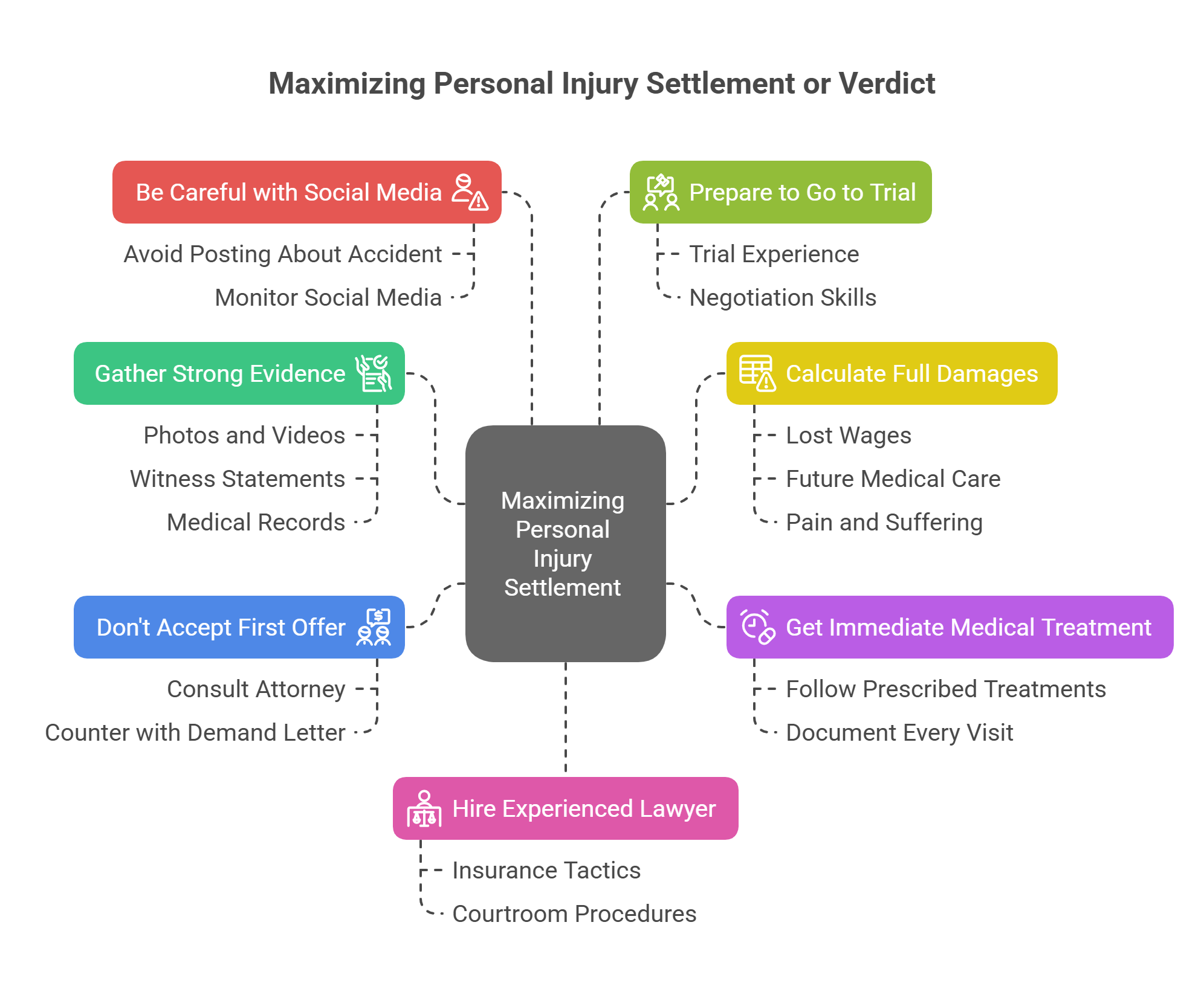
If you’ve been injured due to someone else’s negligence, securing the highest possible compensation is important for covering medical bills, lost income, and future expenses. Insurance companies and opposing parties will often try to minimize payouts, so taking the right steps can significantly impact your settlement or verdict. Here’s how to maximize your compensation and ensure you receive the justice you deserve.
The foundation of a strong personal injury case is compelling evidence. The more proof you have, the harder it is for insurance companies to dispute your claim. Immediately after the accident, take photos and videos of the scene, your injuries, property damage, and any contributing factors (such as slippery floors or defective products). Collect witness statements, obtain a copy of the police report, and secure medical records that document the extent of your injuries. Keeping a personal injury journal detailing your pain, recovery, and limitations can also strengthen your claim.
Seeking medical care right away is not just important for your health, it also protects your case. Insurance companies may argue that a delay in treatment means your injuries weren’t serious. Even if you don’t feel immediate pain, see a doctor as soon as possible. Follow all prescribed treatments, attend follow-up appointments, and document every visit. If your injuries require ongoing care, such as physical therapy or surgery, make sure to get detailed prognosis reports to demonstrate the long-term impact on your life.
Many injury victims underestimate the true cost of their damages. A fair settlement should cover more than just immediate medical expenses; it should also account for lost wages, future medical care, reduced earning capacity, pain and suffering, and emotional distress. If your injury affects your ability to work, a vocational expert may be needed to assess lost future earnings. Also, an experienced attorney will help calculate the full extent of your damages, ensuring you don’t settle for less than you deserve.
Insurance companies often start with lowball offers, hoping you’ll settle quickly before realizing the true value of your claim. Their goal is to pay as little as possible, not to be fair. Never accept an initial offer without consulting a personal injury attorney. Negotiation is key and countering with a well-documented demand letter can significantly increase your payout. If the insurance company refuses to negotiate fairly, being prepared to take the case to trial can pressure them into offering a higher settlement.
In today’s digital world, anything you post online can be used against you. Insurance adjusters and defense attorneys monitor social media to find anything that could weaken your claim. A seemingly innocent post about a vacation or a gym visit could be twisted to suggest your injuries aren’t as severe as you claim. To protect your case, avoid posting about your accident, injuries, or activities until your case is fully resolved.
While most personal injury cases settle before trial, being ready for litigation puts you in a stronger position during negotiations. Insurance companies know which attorneys are willing to fight in court and which ones will settle for less. If they believe you’re prepared for trial, they may offer a higher settlement to avoid the risk of a large jury verdict. With this in mind, working with an attorney who has trial experience can significantly impact how much compensation you receive.
The most important step in maximizing your settlement or verdict is hiring the right attorney. A skilled personal injury lawyer understands insurance tactics, negotiation strategies, and courtroom procedures, giving you the best chance at securing the highest payout possible. So, before hiring an attorney, you need to ask the right questions to ensure you choose someone with the experience and track record to handle your case effectively.
At My Injury Pros, our experienced personal injury lawyers are committed to taking you every step of the way through the process and securing the compensation you deserve. So, contact us today to start your free consultation.

What remains a fact is that it is difficult, and can even become overwhelming, to handle a personal injury claim on your own. When you are dealing with insurance companies, legal deadlines, and complex negotiations, you need a personal injury lawyer who will help you out with the process. A skilled lawyer not only fights for the maximum compensation but also ensures your rights are protected throughout the legal process.
One of the first things a personal injury attorney does is evaluate the true value of your case. This involves analyzing medical expenses, lost wages, future treatment needs, pain and suffering, and any permanent disabilities. Unlike insurance adjusters, who aim to pay out as little as possible, an attorney will fight to ensure you receive compensation for both economic and non-economic damages. If liability is disputed, they will gather strong evidence, including accident reports, witness statements, and expert opinions, to prove fault and maximize your payout.
After evaluating your case, your lawyer will handle all communications with the insurance company, calculate your full damages, and factor it into the settlement demand. Most cases settle out of court but your attorney will push for the highest possible offer, using strong evidence and legal strategies. Lastly, if the insurance company refuses to offer fair compensation, your lawyer will be ready to take the case to court, where juries often award higher amounts.
Furthermore, one of the biggest advantages of hiring a personal injury lawyer is that most work on a contingency fee basis, meaning you don’t pay unless they win your case. This arrangement benefits injury victims because it removes financial barriers to getting legal help. It also means your lawyer has a strong incentive to fight for the highest possible compensation since their payment depends on the outcome. While there are pros of hiring a personal injury lawyer, there are also cons. Some cons you should note are the length of time for a resolution to be met, loss of direct control and decision-making of the case, and the risk of hiring an inexperienced and unprofessional attorney.
Your understanding of personal injury verdicts and settlements in California is important if you're seeking fair compensation after an accident. While verdicts result from court trials and carry uncertainty, settlements offer quicker, more predictable resolutions. Compensation amounts vary based on factors like injury severity, liability, and financial losses, with high-profile cases often leading to multi-million-dollar payouts.
Additionally, maximizing your compensation requires strong evidence, continuous medical treatment, careful negotiation, and legal expertise. A skilled personal injury attorney plays an important role in evaluating case value, handling negotiations, and fighting for the best possible outcome. They often offer their services on a contingency fee basis, meaning no upfront costs for you. If you've suffered an injury, consulting an attorney can significantly improve your chances of receiving the full compensation you deserve.
Don’t let insurance companies pressure you into a lowball settlement, because you deserve fair compensation for your medical bills, lost wages, and pain and suffering. At My Injury Pros, we have the experience and expertise to handle your case and secure the compensation that you deserve. Contact us today for a free case evaluation.
The timeline varies based on the complexity of the case, but most personal injury settlements take anywhere from a few months to over a year. Cases with severe injuries, disputed liability, or large compensation amounts tend to take longer.
If settlement negotiations fail, your case may proceed to litigation and trial, where a judge or jury will decide the outcome. However, settlements can still be reached at any stage before a final verdict.
If you disagree with the jury’s verdict, you may have legal options, such as filing a post-trial motion or seeking an appeal, but appeals are limited to specific legal errors.
Yes, but only if there were legal errors, misconduct, or issues with how the trial was conducted. Appeals don’t reexamine the facts of the case but focus on whether the law was applied correctly.
A good settlement fully covers medical expenses, lost wages, pain and suffering, and future damages, ensuring you are financially secure after the accident. The best settlements reflect the true value of your case based on evidence and legal strategy.
Most settlements are paid in a lump sum or structured payments over time. Lump sums provide immediate funds, while structured payments offer long-term financial security.
Car accident settlements in California typically range from $15,000 to over $1,500,000, depending on factors like injury severity, liability, and insurance coverage. Cases involving catastrophic injuries often result in higher payouts.
Whiplash is a soft tissue neck injury that is caused by a sudden back-and-forth motion. It often results from rear-end car accidents. Understanding whiplash settlement values is important because compensation can vary widely based on injury severity, medical treatment, and liability, and this can help victims pursue fair financial recovery.
The average whiplash settlement amount in California falls between $5,000 and $20,000 for typical soft tissue injuries, while more serious cases fall between $30,000 and $100,000 or more. Severe or chronic whiplash cases, especially those that involve nerve damage or extended treatment, can push settlements well beyond $100,000. Sometimes, settlements can reach hundreds of thousands of dollars.
Wondering how much your whiplash injury claim might be worth in California? At My Injury Pros, we understand that no two whiplash cases are the same, and neither are their settlement values. Whether you're dealing with mild neck pain or long-term complications, our experienced personal injury attorneys will help you understand your rights, gather strong evidence, and fight for the compensation you deserve. Don’t settle for less. Contact us today for a free consultation!
This blog will break down the average whiplash settlement in California, what factors influence payout amounts, and how you can estimate the value of your claim.

Whiplash is a neck injury that occurs when the head is suddenly and forcefully thrown backward and then forward, straining the muscles, tendons, and ligaments in the neck. It’s most commonly associated with rear-end car accidents, but can also result from physical assaults, sports injuries, or falls. This rapid motion puts intense pressure on the cervical spine and causes soft tissue damage that may not be noticed immediately.
People who suffer from whiplash often experience a range of symptoms that can develop within hours or days after the incident. Common signs include persistent neck pain, dizziness, headaches, and stiffness or reduced range of motion in the neck.
The severity of a whiplash injury depends on several factors. The speed of the collision plays a major role, as higher speeds typically cause more intense force and damage. The type of vehicle involved can also affect outcomes, as larger or heavier vehicles may cause a more violent impact. Additionally, the age and overall health of the victim influence recovery, with older individuals or those with pre-existing neck or spine conditions being more vulnerable to severe, long-lasting effects.
The average whiplash settlement in California can vary widely based on the severity of the injury. Whiplash victims with short-term pain and minimal treatment typically settle between $2,500 and $10,000. Moderate injuries that involve ongoing medical care or longer recovery times may range from $10,000 to $50,000. For severe or chronic whiplash, especially with nerve damage or permanent disability, settlement negotiations can exceed $50,000 to $100,000 or more, depending on the long-term impact.
There’s no fixed amount for a whiplash settlement because every case is unique. Factors like medical expenses, lost wages, insurance coverage, and who was at fault all affect the final payout. That’s why comparing your situation to someone else’s can be misleading. A professional legal review is essential to understand what your specific claim is worth.
Whiplash settlements in California are typically calculated using either the multiplier method or the per diem method to estimate pain and suffering damages. The multiplier method adds up your economic damages (like medical bills and lost wages) and multiplies that total by a number usually between 1.5 and 5 based on the severity of the injury. The per diem method assigns a daily dollar value to your pain and suffering, then multiplies it by the number of days you experienced symptoms. Both approaches aim to fairly compensate victims for the physical and emotional toll of a whiplash injury.
For example, if your medical bills and lost wages total $10,000 and your injury is considered moderate, a multiplier of 3 may be used to bring your total settlement to around $30,000. Under the per diem method, if you assign $150 per day to your discomfort and recovery lasts 90 days, your pain and suffering damages would be $13,500, which would then be added to your economic losses. Calculations are mostly adjusted based on case-specific factors like liability, treatment consistency, and long-term effects.

Factors that affect whiplash settlement amounts in California include the severity of the injury, the cost of medical treatment, the impact on daily life, and who was at fault. These several factors help determine how much compensation a victim may be entitled to.
The seriousness of a whiplash injury plays a major role in settlement value. Mild whiplash may result in lower settlements, often a few thousand dollars. However, moderate to severe cases, especially those involving nerve damage or prolonged treatment, can lead to significantly higher payouts. Cases with more severe whiplash injuries, like chronic pain or long-term effects, often receive greater compensation due to the lasting impact on daily life and earning ability.
Medical diagnosis strongly influences the strength of your claim. Detailed doctor notes, MRI results, and ongoing treatment records help prove the seriousness of the injury and justify higher settlements. Without solid medical documentation, insurers may argue the injury is minor or unrelated to the accident.
Medical expenses from a whiplash injury can include ER visits, X-rays or MRIs, physical therapy, chiropractic care, and medications for physical pain, all of which add up quickly. Thoroughly documenting the cost of your medical treatment through bills, treatment records, and doctor’s notes not only proves the extent of your injury but also strengthens your claim for higher compensation. In more serious cases, you may also be entitled to future medical costs for ongoing medical treatment, specialist visits, or long-term pain management.

Missing work due to a whiplash injury can significantly increase the value of your claim. This is because it highlights both immediate lost wages and potential reduced future earning capacity if the injury affects your ability to perform your job long-term.
Insurance companies consider how much income you’ve already lost and whether ongoing limitations could impact your future earnings. To support this part of your claim, it’s essential to document all time missed from work, keep pay stubs, and maintain clear communication with your employer about your injury and recovery timeline.
Pain and suffering refers to the physical discomfort and emotional distress a person experiences as a result of an injury like whiplash injury. It includes not just the pain itself, but also anxiety, sleep disturbances, reduced quality of life, and other mental or emotional impacts. Unlike medical expenses, this damage is harder to quantify, so courts and insurers use tools like the multiplier method or per diem method to estimate a fair value.
The multiplier method applies a number (typically 1.5 to 5) to your total economic damages, depending on the severity of your pain. The per diem method assigns a daily dollar amount for each day you suffer, from the date of the injury to maximum recovery. To strengthen your case, it's important to always document your symptoms through a pain journal, follow-up visits, and updates from your doctor. This consistent record helps to support the seriousness of your suffering and helps justify higher compensation.
Determining who was at fault for an accident is critical to any whiplash injury claim, especially under California’s comparative negligence rule. This legal principle allows multiple parties to share responsibility for an accident, and any compensation awarded is reduced by the percentage of fault assigned to the injured person. For example, if you're found 20% at fault for a rear-end collision and awarded $50,000, your settlement would be reduced to $40,000 to reflect your share of the blame. On I-880 and I-680, fault is often disputed. A personal injury attorney in Fremont can collect the evidence early.
To establish fault and protect your claim, it’s essential to gather solid evidence, starting with a police report, which provides an official account of the accident and may indicate who was at fault. Witness statements also plays a valuable role in confirming events, especially when the drivers involved give conflicting stories. These sources of evidence can significantly impact how much fault is assigned to each party, and, in turn, how much compensation you can recover.

Insurance coverage limits represent the maximum amount an insurance company will pay for damages under a specific policy. These limits can cap what you’re able to recover in a personal injury claim, especially if the at-fault party carries only the minimum required coverage. If your damages exceed the at-fault driver’s policy limits, you may be left covering the remaining costs out of pocket unless other options are available.
In California, the minimum liability insurance requirements are $15,000 for injury or death to one person, $30,000 for injury or death to more than one person, and $5,000 for property damage. These amounts are often too low to cover serious injuries like whiplash with extended treatment. That’s why having uninsured/underinsured motorist (UM/UIM) coverage on your policy is crucial. It can help bridge the gap if the other driver’s insurance isn’t enough or if they don’t have coverage at all.
Personal injury lawyers are skilled negotiators who understand how to push back against lowball offers and build strong cases that demand appropriate compensation. In California, car accident attorneys use their legal expertise of state-specific laws, insurance tactics, and legal procedures to argue for maximum payouts, especially in complex or disputed whiplash claims. Their experience allows them to present medical evidence, lost income, and pain and suffering in a way insurers can't easily dismiss.
Attorneys for personal injury cases mostly work on a contingency fee basis, meaning you pay nothing unless they win your case. By consulting a lawyer early, you ensure proper documentation from the start, avoid common mistakes, and get strategic legal advice tailored to your situation. This proactive approach often leads to faster, higher settlements and better protection of your legal rights.
To maximize your whiplash injury settlement, it's important to seek immediate medical attention after the accident even if symptoms seem minor at first. Prompt treatment not only ensures proper care but also creates official medical records that support your claim. Keep detailed documentation of your recovery, including a pain journal, medical bills, treatment notes, and any time missed from work. These records help prove the extent of your suffering and financial losses, which directly impact the value of your settlement.
Avoid accepting early settlement offers from insurance companies, because they often aim to minimize payouts before the full scope of your injury is clear. Instead, work with an experienced personal injury attorney who can accurately assess your case, negotiate with insurers on your behalf, and help you recover the maximum compensation. A lawyer will also ensure that all deadlines are met and that your case is backed by strong evidence, positioning you for the best possible outcome.

You should consider hiring a California lawyer for your whiplash claim if your symptoms persist for more than a few weeks or if the injury interferes with work, daily activities, or long-term health. It's also time to call an attorney if the insurance adjuster offers a lowball settlement, denies your claim outright, or delays payment without any clear explanation. These are common tactics used to reduce whiplash settlement payouts, and without legal support, you risk settling for far less than you deserve.
A personal injury lawyer can help you build a strong case by gathering medical records, negotiating with insurers, and proving liability, especially if the other party is disputing fault. They understand how to assess the full value of your damages, including future medical care and pain and suffering, and will fight to maximize your final settlement amount. Most importantly, hiring an attorney can relieve stress and make sure you're not taken advantage of during the claims process.
The average settlements for whiplash in California depend on factors like the severity of the injury, medical expenses incurred, lost wages, and clear documentation. Pain and suffering are often calculated using the multiplier or per diem method, and strong evidence like police reports and medical records can boost your whiplash claim.
Legal representation can make a big difference, especially if you suffered severe injuries or the insurer is disputing your whiplash claim. Legal guidance helps you build a stronger case and pursue the fair settlement you’re entitled to. At My Injury Pros, we know how to fight for full fair compensation. Let us help you take the next step. Contact us today to get a free case evaluation!
Whiplash claims in California typically settle within a few months to over a year, depending on injury severity, insurance negotiations, and whether liability is disputed. Rear-end cases often settle faster than people expect. A personal injury lawyer in Santa Clarita can give you a realistic range.
Yes, you can still claim whiplash in California even if symptoms appeared days after the accident, as delayed onset is common with soft tissue injuries.
Yes, you can receive compensation for pain and suffering from whiplash in California, especially if the injury impacts your daily life or requires ongoing treatment.
While not required, hiring a lawyer for a whiplash lawsuit greatly increases your chances of securing fair compensation, especially in complex or disputed cases.
Typical symptoms of whiplash include neck pain, stiffness, headaches, dizziness, fatigue, and limited range of motion.
Slip and fall incidents in grocery stores often occur due to hazards such as wet floors or misplaced items. They can often lead to serious injuries. Understanding potential legal outcomes is crucial, as these cases can be challenging for individuals to prove without clear evidence of negligence.
The average settlement for a slip and fall in a grocery store ranges from $10,000 to $50,000. Slip and fall settlements depend on the severity of the injury and evidence of store negligence. More serious cases involving long-term medical care or permanent injury can result in higher payouts.
Have you or a loved one been injured in a slip and fall at a grocery store and aren’t sure what your case might be worth? At My Injury Pros, our experienced team of personal injury attorneys is dedicated to helping injury victims understand their rights, navigate complex claims, and pursue the compensation they deserve. With a strong track record of successful outcomes and client-focused service, we’re here to guide you every step of the way. Contact us today for a free consultation!
This post explores the average settlement amounts for slip and fall accidents in grocery stores and the key factors that influence compensation.

A grocery store slip and fall accident occurs when a customer or visitor loses their footing due to hazardous conditions within the store, which causes a fall and potential injury. Freshly mopped floors without warning signs, wet floors, spilled food or beverages left uncleaned, and cluttered or obstructed aisles commonly cause these incidents. Poor lighting, uneven flooring, or loose mats can also contribute to these dangerous situations. Because grocery stores have to maintain safe premises for their customers, when they fail to address or warn about these hazards promptly, it can lead to premises liability.
Injuries from slip and fall accidents in grocery stores can range from minor to severe. Victims can suffer sprains, broken bones, and in more serious cases, spinal injuries, concussions, or other head trauma. These injuries can lead to significant medical bills, lost wages, and long-term pain. Legally, such cases often hinge on proving negligence under premises liability laws. This means showing that the store knew or should have known about the hazardous condition and failed to take reasonable steps to fix it or warn customers.
The national average payout for grocery store slip and fall cases ranges from $10,000 to $50,000 and depends on the severity of the injury and the strength of the evidence proving negligence. Minor injury claims, such as sprains or bruises that require minimal medical treatment, often settle on the lower end of that range. In contrast, moderate injuries like fractures or torn ligaments that involve physical therapy or time off work may push settlements toward the higher end. These payouts aim to cover medical bills, lost wages, and pain and suffering.
In cases that involve major injuries such as traumatic brain injuries, spinal damage, or permanent disability, settlements can exceed $100,000 or more, especially when lifelong care or extensive treatment is needed. For example, a customer who suffers a hip fracture requiring surgery and long-term rehabilitation may receive a significantly higher settlement than someone with a minor ankle sprain. These higher payouts reflect the lasting impact of the injury, future medical expenses, and the emotional toll on the victim’s quality of life.
| Injury Severity | Estimated Settlement Amount |
|---|---|
| Minor Injuries | $2,000 – $15,000 |
| Moderate Injuries | $15,000 – $50,000 |
| Severe Injuries | $50,000 – $200,000+ |
| Catastrophic Injuries | $250,000 – $1,000,000+ |
Slip and fall settlement amounts are largely based on the severity and type of injury sustained. More serious injuries like broken bones, head trauma, or spinal damage result in higher compensation than minor bruises or sprains. This is because they require more intensive treatment and have a longer recovery time.
Another key factor is the cost of medical expenses, both current and anticipated. This includes emergency care, surgeries, physical therapy, medications, and any ongoing or future treatment. In addition, victims can recover damages for lost wages during recovery and loss of earning capacity if the injury affects their ability to work long-term.
Non-economic damages like pain and suffering are also considered and are often calculated based on the intensity and duration of physical and emotional distress. Also, if the injured person is partially at fault (e.g., ignoring warning signs), their claimed damages may be reduced by their percentage of fault.

Legal responsibility for a slip and fall in a grocery store often begins with the store owners and managers because they have a duty to maintain a safe environment for customers. They are responsible for routine inspections, staff training, and making sure that potential hazards are addressed promptly. If they fail to uphold these duties and someone is hurt as a result, they may be held liable. Additionally, employees can be held responsible if their careless actions directly lead to an accident.
In some cases, third-party contractors, like cleaning companies hired by the store, may also share liability. If a cleaning crew leaves a floor wet without proper signage or fails to follow safety protocols, and that directly causes a fall, they can be held accountable. Determining who is responsible often depends on who had control over the area and the circumstances at the time of the incident.
To hold the grocery store liable, a victim must prove negligence. This means showing that the responsible party owed a duty of care, breached that duty, and caused harm. This includes demonstrating that the store knew or should have known about the dangerous condition and failed to fix it or warn customers. Strong evidence, like surveillance footage, photos, incident reports, and witness statements, is critical to help prove fault and strengthen a claim.
Sometimes, comparative negligence comes into play if both the injured person and the store share fault. For example, if the customer ignored visible warning signs or was distracted while walking, a court might reduce their compensation by their percentage of fault. Even in these situations, an experienced attorney can help build a case to ensure fair treatment and maximum possible recovery.

After a slip and fall in a grocery store, the first thing you should do is notify the incident immediately to the store manager or a store employee. Make sure an incident report is filled out and request a copy for your records. This official documentation is important for linking your injury to the specific time and location of the accident.
Next, snap photos and videos of the scene where you fell, including any hazards like wet floors, spilled products, or lack of warning signs. If anyone witnessed the fall, gather their names and contact information because they may be able to provide statements that support your claim. Then, seek medical attention right away, even if your injuries seem minor. Prompt treatment creates a medical record that connects your injuries directly to the fall, which can be vital when establishing your case.
Finally, avoid giving recorded statements to insurance adjusters without first speaking to a lawyer. These statements can be used against you, even if made innocently. Hiring an experienced personal injury attorney makes sure you have someone who can gather critical evidence, communicate with the store’s insurance company, and fight for the full compensation you deserve. Having skilled legal representation increases your chances of a successful and fair outcome.
A personal injury lawyer can play a crucial role in maximizing your slip and fall settlement by thoroughly investigating the incident and gathering key evidence. This includes collecting surveillance footage, witness statements, accident reports, and medical records to build a strong case proving the grocery store’s lack of due care. With legal expertise, an attorney can identify details that a victim might overlook and make sure that all documentation supports the highest possible claim value.
Additionally, an experienced slip and fall attorney will handle negotiations with insurance companies. Your attorney can push for fair compensation that fully covers medical bills, lost wages, and pain and suffering, and if the insurer refuses to settle reasonably, they can file a lawsuit and represent you in court. This legal pressure often motivates stores to offer higher settlements and helps you receive the compensation you truly deserve.

The timeline for settling a slip and fall claim can vary widely and range from a few months to over a year. Straightforward cases with clear liability and minor injuries may resolve quickly through negotiation, while more complex claims that involve serious injuries or disputed fault can take significantly longer.
Several factors can affect how long a case takes to settle. They could include the cooperation of the grocery store or its insurer, the complexity of the case, and any court-related delays if the claim goes to litigation. Cases that involve extensive medical treatment or multiple parties often require more time to gather evidence, assess damages, and negotiate a fair settlement.
Slip and fall accidents in grocery stores can lead to serious injuries and significant financial burdens. Understanding the average settlement amounts, how claims are calculated, and what steps to take after an incident can greatly improve your chances of receiving fair compensation.
If you’ve been injured, it’s important to act quickly by reporting the incident, gathering evidence, and seeking medical attention. Most importantly, consult an experienced personal injury attorney who can protect your rights and help maximize your settlement.
Injured in a grocery store slip and fall and unsure what to do next? At My Injury Pros, we have the experience to fight for the compensation you deserve and guide you every step of the way. Let us help you get back on your feet. Contact us now for a free case evaluation!
Yes, larger chain grocery stores often have greater financial resources and insurance coverage, which can result in higher compensation payouts for slip and fall injuries compared to smaller businesses.
The average Walmart slip-and-fall settlement typically falls between $15,000 and $45,000, though severe cases with strong evidence can yield much higher awards.
Yes, you can sue a grocery store for slipping and falling if you can prove that the store’s negligence caused the hazardous condition that led to your injury.
You typically have two to three years from the date of the slip and fall to file a claim, depending on your state's statute of limitations.
© 2026 My Injury Pros | All Rights Reserved |
Powered by GLP Marketing