
Typically, individuals have two years from the date of a truck accident in California to file a lawsuit for injuries sustained in the incident. Property damage claims have a three-year deadline, while accidents involving government vehicles require you to file a formal administrative claim within six months. Trucking companies only have to keep some federal driving records for six months, so evidence can disappear long before any deadline passes.
At My Injury Pros, founder Steven P. Nassi has spent nearly 25 years representing injured people. Our personal injury attorneys take truck accident cases in California and track both the two-year lawsuit deadline and the six-month government claim deadline. If you get hit by a big delivery truck, schedule a free case evaluation, and we can tell you when the deadline is for your claim.
This article explains each California deadline after a truck crash, the exceptions that pause the clock, and the faster evidence clocks.
What Is the California Truck Accident Filing Deadline?
California's statute for injury cases is Code of Civil Procedure section 335.1, and it allows two years to sue. That rule covers a personal injury lawsuit against the truck driver, the trucking company, and any other private defendant. Most personal injury claims in the state run on the same clock, which is why truck accidents and car accidents share the base rule.
The California Code handles different losses in different ways. Each kind of injury, along with damage to property and death, has deadlines to meet, and adding that this is for a public defendant shortens those deadlines too. The first thing to figure out is which clock matters for recovery of compensation rights.
When the Two-Year Clock Starts
The statute of limitations starts when the claim accrues, and for a crash injury, that is usually the accident date. A wrongful death claim runs from the date of death instead, which can be days or weeks after the collision. There is an exception that allows starting dates to slip if something comes up later that turns out to be an injury. This exception is based on the delayed discovery rule.
What Happens When the Deadline Passes?
After the statute of limitations has run out, the defendant can use that as a defense. When that happens, California courts generally dismiss claims filed after the period ran out. Severity doesn't affect the math, so filing a serious injury one week late gets judged the same as a sprain.
That said, it's better to check with a lawyer about whether missing a date constitutes something serious rather than assuming it's disastrous right away. Tolling for minors or incapacity, the delayed discovery rule, or a granted late claim against a public entity can keep a case alive. Without one of those exceptions, the claim is usually barred for good.
Deadlines for Property Damage and Wrongful Death Claims
A single truck crash often produces three kinds of loss. The injured person has medical costs, the car is wrecked, and sometimes a family loses someone. California gives each of those its own statute.
Property Damage Claims Have Three Years
Code of Civil Procedure section 338 gives three years for "injuring goods or chattels," which includes vehicle damage. The same rule applies to personal belongings inside the car too, like phones, tools, or a child's car seats. An insurer can settle claims for property damage quickly, but injury claims follow their own two-year timeline independently.
Wrongful Death Claims After a Fatal Truck Crash
Section 335.1 also covers "the death of" a person, so families get two years from the date of death. Code of Civil Procedure section 377.60 names those who may bring the claim. That group includes a surviving spouse or domestic partner, children, certain dependents, or the personal representative of the estate.
How California Truck Accident Deadlines Compare
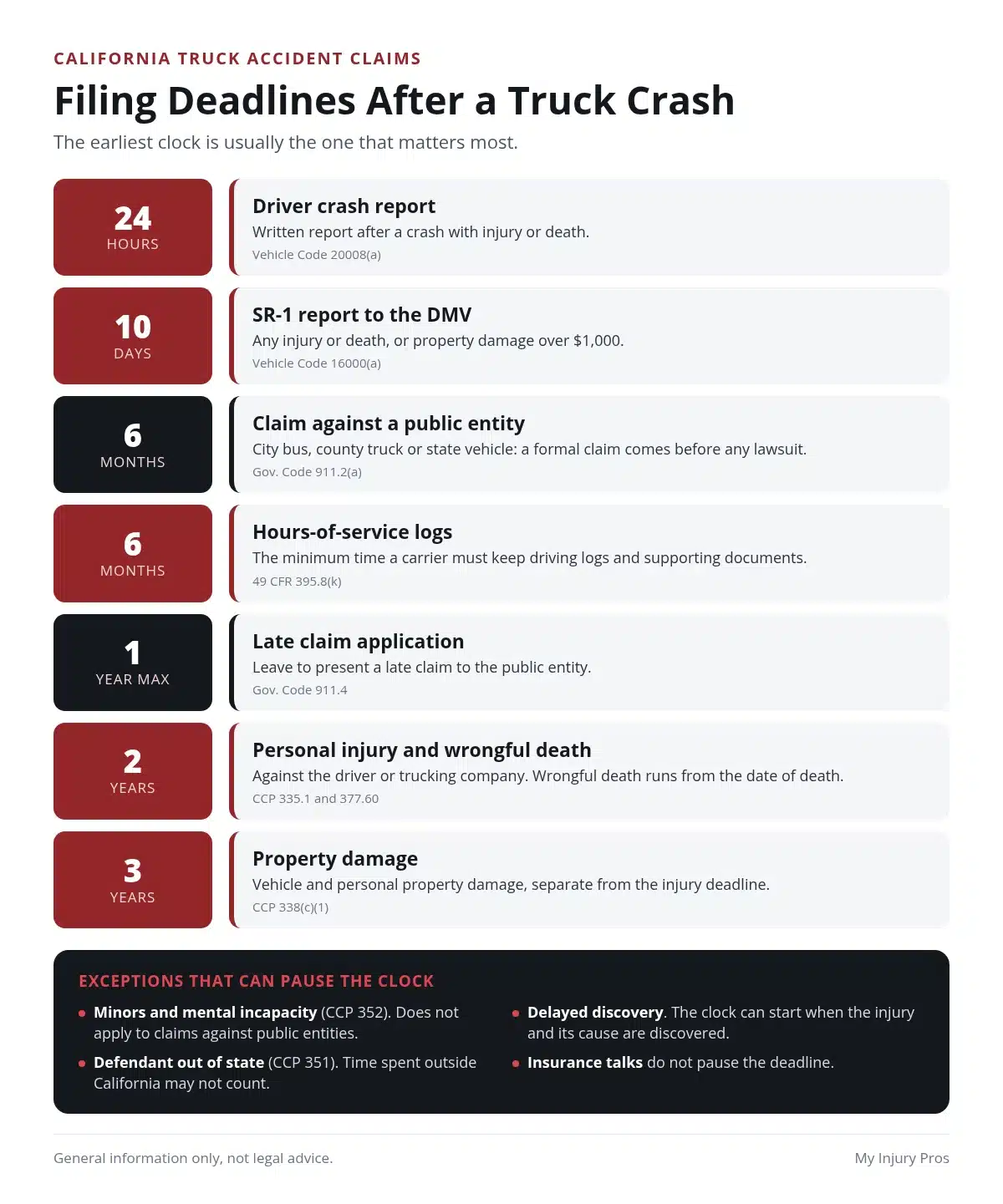
One crash starts multiple clocks ticking, and they don't all stop at the same time. The list below lists the main deadlines under California law along with the statute behind each one. Make plans based on the earliest date you have; whatever deadline comes first is one that you can't afford to miss.
| Claim or Task | Deadline | When the Clock Starts | California Law | Exceptions or Notes |
|---|---|---|---|---|
| Personal injury lawsuit against the driver or trucking company | 2 years | Accrual, usually the accident date | CCP 335.1 | Minors and incapacity (CCP 352), delayed discovery, defendant out of state (CCP 351) |
| Wrongful death lawsuit | 2 years | Date of death | CCP 335.1 and 377.60 | Who may sue is set by section 377.60. |
| Property damage, including damage to vehicles and personal property. | 3 years | Accident date | CCP 338(c)(1) | Runs separately from the injury deadline |
| Claim against a public entity for death, injury, or personal property damage. | 6 months | Accrual | Gov. Code 911.2(a) | Minor tolling under CCP 352 does not apply. |
| Late claim application to a public entity | Reasonable time, no more than 1 year. | Accrual | Gov. Code 911.4 | Board acts within 45 days (Gov. Code 911.6) |
| Lawsuit after a government claim is denied | 6 months after written notice, or 2 years without notice | Notice date or accrual | Gov. Code 945.6 | The board has 45 days to act (Gov. Code 912.4). |
| Court petition following denial of late claim | 6 months | Denial date | Gov. Code 946.6 | Filed in superior court |
| Driver's written crash report | 24 hours | Crash | Veh. Code 20008(a) | Injury or death crashes, excluding common carrier vehicles |
| SR-1 report to the DMV | 10 days | Crash | Veh. Code 16000(a) | Any injury or death, or property damage over $1,000 |
Filing Deadlines for Claims Against a Government Entity
Crashes involving buses that operate in cities, dump trucks, or vehicles belonging to Caltrans follow different sets of rules. They originate from the California Government Claims Act (Government Code section 810). Some older articles refer to this as the California Tort Claims Act, but it is the same law and courts now use a newer name for it.
A public entity includes the state, counties, cities, districts, and any public agency. Under Vehicle Code section 17001, an employer is liable when its employee who is negligent drives a government vehicle on the job. A suit against the government employee personally is also barred if the claim against the agency is barred.
The Six Month Claim Deadline
Government Code section 911.2 sets a claim deadline of six months for deaths, personal injuries, and damage to personal property. The formal claim must list the date, place, and circumstances, plus a general description of the injury and the employees involved, if known. Claims against a state agency go to the Department of General Services with a $25 fee or a fee waiver request.
No lawsuit can be filed until the government agency acts on the claim or lets it lapse. The board has 45 days to respond, and silence counts as a rejection. After a written rejection notice, Government Code section 945.6 allows six months to sue, or two years from accrual if no proper notice is given.
The quick timeline of events after a crash involving a public vehicle is why many accident victims contact lawyers right away. Six months goes quickly when someone is still in medical treatment.
A City Bus Crash Example
Here is a hypothetical, offered only to show how the dates interact. On March 3, 2026, a city bus and a delivery truck both strike a driver at the same crossing. The claim against the city must be presented by early September 2026.
Suppose that on October 20, 2026, the city sends out a written rejection letter. The lawsuit against the city was due to come up about six months later; that would be late April of 2027. The deadline of two years against this private trucking firm will not lapse until March 2028.
The government defendants set an earlier deadline here, far away from that. Someone who has been waiting for the insurance company of the trucking company to wrap up their conversation missed out on winning the city claim months earlier.
Late Claim Relief Under Government Code 911.4
A missed claim for six months isn't necessarily the end of things. Under Government Code section 911.4, a claimant can request permission from the agency to submit a late claim. The request must be made within a reasonable timeframe and never more than one year after the accrual happens. The application should explain why there is a delay and also include the proposed claim attached.
Under Government Code section 911.6, they have 45 days to make a decision. It must grant the application for mistake, inadvertence, surprise, or excusable neglect if the entity was not prejudiced. Minority, physical or mental incapacity, and death during the claim period are also grounds.
If the board says no, Government Code section 946.6 will allow people to petition the superior court within six months of the denial. Before contacting any law offices regarding a delayed claim, gather the denial letter and every date that you have. After one year has passed from when a late claim should have been submitted, that window generally closes.

Exceptions That Can Pause or Extend the Deadline
Some truck accident victims get a longer period of time beyond the usual two years. The exceptions below are real but narrow, and each one depends on facts that should be documented early. A personal injury statute of limitations can look simple until one of them comes up.
Minors Injured in a Truck Crash
Code of Civil Procedure section 352 pauses time when the injured person is under the legal age. In California, that age is 18, so a child's two years usually start on their 18th birthday.
The problem is that section 352 doesn't apply when there are claims against public entities or public employees. A child who gets hurt by a city bus still faces the six months before filing a claim. The minor's route is a late claim application, which the board must grant when the child was a minor for the whole claim period.
Mental Incapacity
Section 352 also suspends deadlines when the person who is injured lacks the legal ability to make decisions. The condition must exist at the time the claim arises, which is typically the day of the accident. After a traumatic brain injury occurs, mental incapacitation is important because people can't handle their affairs for months.
For government claims, the one-year late claim period does not count time when the person was mentally incapacitated without a guardian or conservator. Incapacity during the claim period is also a ground the board must accept.
The Delayed Discovery Rule
California courts apply a delayed discovery rule, which starts the clock when a person discovers, or reasonably should have discovered, the injury and its cause. Most crash injuries are obvious on the accident date, so this rule is often unhelpful in a collision case. It comes into play when a harm truly surfaces later, and a reasonable person could not have found it sooner. People who rely on something should initiate legal action very close to the latest possible date because timing will be disputed.
When the Defendant Leaves California
Code of Civil Procedure section 351 does not include time spent outside the state as time served. Courts have limited that rule for defendants engaged in interstate commerce, which describes many trucking companies. Don't assume that carriers from another state buy additional time. A California lawyer can look into whether an exception applies specifically to a certain defendant.
Truck Evidence Deadlines That Run Before the Filing Deadline
Truck accident claims differ from car accident claims in one practical way. Federal rules tell carriers how long to keep records, and some periods are much shorter than the filing deadline, which matters in cases this serious. In 2024, the Insurance Institute for Highway Safety tallied 5,340 fatalities from large truck accidents; this accounted for roughly 14% of all traffic deaths in the US. Sixty-two percent of people who died were in cars and other passenger vehicles, not in trucks.
Who Can Be Liable in a Commercial Truck Collision
In a commercial truck collision, the truck driver is only one of the possible liable parties. The trucking company and the owner or lessor of the trailer may share fault. So can the shipper that loaded the cargo, a maintenance shop, or a parts maker. When a public vehicle or an employee is involved, you can add a government agency.
The at-fault party is not always the at-fault driver, and each defendant can have its own deadline. Personal injury lawyers usually name every company that touched the truck, then narrow the list as records come in.
Records a Trucking Company Can Discard
This table shows the shortest amount of time federal regulations require carriers to keep important records. Once those dates have passed, a company is allowed to dispose of records unless someone has given notice that there is a claim against them.
| Trucking Record | Minimum Retention | Federal Rule |
|---|---|---|
| Hours-of-service logs and supporting documents | 6 months from receipt | 49 CFR 395.8(k) |
| Inspection, repair and maintenance records | 1 year, plus 6 months after the vehicle leaves the carrier's control | 49 CFR 396.3(c) |
| Negative drug and alcohol test results | 1 year | 49 CFR 382.401 |
| Positive test results and test refusals | 5 years | 49 CFR 382.401 |
| Accident register | 3 years after each accident | 49 CFR 390.15(b) |
| Driver qualification file | Length of employment plus 3 years | 49 CFR 391.51(c) |
The six months of driving logs are the most significant. Those logs show whether drivers exceeded the limits on hours of service before the crash. Federal rules also require post-accident alcohol and drug testing "as soon as practicable" after certain serious crashes, and those results belong in the file too.
Why a Preservation Letter Goes Out Early
A preservation letter informs the carrier in writing that a claim will follow soon and asks that important evidence be kept safe. It usually names ELD data, dashcam video, dispatch messages, the truck's maintenance file, and the driver's records. Once a company realizes that litigation is likely, destroying evidence can have serious consequences. The court may penalize the company or let the jury hear about the missing evidence. Sending the letter in the first few weeks, well within the six months, is an inexpensive way to safeguard the case.
How to Protect a Truck Accident Claim Before the Deadline
Following a truck accident, legal processes proceed on multiple tracks simultaneously. These steps follow roughly the order most people face them, and each one feeds the truck accident lawsuit that may follow.
Get Medical Treatment and Keep Your Medical Records
Get medical care first, even if the pain seems to be tolerable right there. The medical reports and bills from that visit form the basis of your personal injury claim. They also fix the date the injury was known, which matters if anyone argues about when the clock started.
Report the Crash to Police and the DMV
Handle crash reports from collisions in California within days of when they happen. Vehicle Code section 20008 insures drivers of vehicles other than regular carriers who are involved in crashes resulting in injury or death. That driver must, within 24 hours after the accident, make or cause to be made a written report of the accident. The report should go to the California Highway Patrol or, if inside a city, to either the CHP or the city police department.
The same statute treats common carrier vehicles differently. The owner or driver must report to the CHP on or before the 10th day of the month following the accident. So a truck operating as a common carrier may be on a monthly reporting schedule, while the other driver still has 24 hours.
Vehicle Code section 16000 requires an SR-1 report to the DMV within 10 days. If there was any injury whatsoever, if someone died, or if there was $1,000 worth of damage to any person, then that counts too. Ask for copies of the police reports as soon as they are available, because they name witnesses and the carrier.
Notify the Insurance Company Without Admitting Fault
Then open the insurance claim, but do not admit fault or guess about speed and distance. Under California's fair claims regulations, an insurance company must acknowledge a claim within 15 calendar days of notice. Within 40 calendar days of proof of claim, it must either accept or deny the claim or send written notice explaining why it needs more time.
Insurance claim deadlines are different from yours, and having an open insurance claim doesn't delay the statute of limitations. That remains true regardless of how long the adjuster takes.
Identify Every Liable Party and Any Government Defendant
After that, list anyone who may share some of the blame for this situation. Check whether a city bus, county truck, or other public vehicle was involved, because that single fact triggers the six-month claim. The USDOT number on the side of the cab identifies which company owns the truck.
Send Preservation Letters for Truck Records
Send preservation letters to the carrier and any other entity that has related records. Make sure to have those hours of service logs done before that six-month window closes. A letter sent in month seven may reach a company that has already purged its logs.
Calendar the Earliest Deadline and File on Time
Finally, write down every clock that applies, including the claim, the lawsuit, property damage, and any late claim option. File the formal claim or the truck accident lawsuit before the earliest one. Negotiations with an insurance company don't stop once you file a complaint, and they continue for many cases even after that.
How Settlement Negotiations Interact With the Filing Deadline
Talking with an insurance company does not stop the clock, even when the adjuster sounds cooperative. Practically speaking, someone who has a deadline that's near or has already passed is in a weaker bargaining position. The insurer knows the claim may soon be worth nothing in court, and offers tend to reflect that.
A well-documented file helps shift things back in favor of the injured party. Adjusters use records of lost wages, income lost from time missed working, medical expenses, and future care costs as numbers they can work with. A clear demand package turns those records into a figure the insurer has to answer.
Injury severity, coverage limits, and fault drive semi-truck accident compensation far more than the calendar does. What timing controls is whether the claim still has room for negotiation towards getting an equitable settlement at all.
Ready to Protect Your Truck Accident Claim Before the Deadline Passes?
California allows two years for injury and wrongful death claims, three for property damage, and six months for a public entity claim. Trucking records can be purged in as little as six months, which is shorter than any of those deadlines. Taking action early preserves your legal rights and keeps every avenue open for getting fair compensation.
Our personal injury lawyers work on a contingency fee, so you pay no attorney fees unless we recover compensation for you. Contact us today for a free evaluation of your case before the deadline for your claim runs out.
Frequently Asked Questions
Steven P. Nassi has spent close to 25 years answering timing issues for people who have been hurt. Personal injury cases after truck crashes often involve the same recurring issues. The answers given below follow California law as currently written, but remember that every case has different specific dates.
How Long Do I Have to File a Truck Accident Lawsuit in California?
For a personal injury or wrongful death claim, the deadline is generally two years under Code of Civil Procedure section 335.1. When someone gets injured, the clock usually starts ticking on the day of the accident, and if someone dies, then the countdown begins on the day that person dies.
Is the Deadline Different if a City Bus or Government Vehicle Hit Me?
Yes, a formal claim must usually be presented to the public entity within six months under Government Code section 911.2. A lawsuit follows only if the claim is denied.
Does the Insurance Claim Stop the Statute of Limitations?
No, opening an insurance claim or negotiating with an adjuster does not pause the deadline to file a lawsuit.
What if I Missed the Six-Month Claim Deadline?
You may apply to the agency for leave to present a late claim within one year of the accident under Government Code section 911.4. If the agency denies it, you can file a court petition within six months of the denial.
Can a Minor File a Truck Accident Claim After Turning 18?
Against private defendants, yes, because California generally pauses the two-year clock until the injured person turns 18. Claims against a public entity do not get that pause, so a late claim application is the usual route.
Is There a Separate Deadline for Vehicle Damage?
Yes, property damage claims, including damage to the car and personal property inside it, generally have three years under Code of Civil Procedure section 338.
Can I Still Sue if the Trucking Company Is Based Outside California?
As long as you file the case in time. Don't rely on extra time due to being out of state because courts have restricted this for businesses that do business across different states.
Disclaimer. The information here on the blog is general and meant for informational use only; please do not consider it as legal advice. Reading this content does not establish any attorney-client relationship. Laws and regulations vary by jurisdiction and may change over time, so you should consult a qualified personal injury attorney for advice regarding your specific situation. Past examples, case studies, or hypothetical scenarios are illustrative only and do not guarantee similar results.