

Short answer
Two sets of numbers decide a pedestrian claim, and neither is an average. First, fault share: $100,000 in damages with the pedestrian 20 percent responsible leaves $80,000, because California uses pure comparative negligence (Li v. Yellow Cab Co.). Second, the clock: two years from the injury under CCP 335.1, and six months to present a claim against a public entity under Government Code 911.2.
Pedestrian accident settlements in California can vary significantly from one case to another. There is no guaranteed or standard settlement amount because every pedestrian accident involves different circumstances. Factors such as injury severity, medical expenses, lost income, liability, insurance coverage, and the long-term physical and emotional impact can all affect compensation.
If you’ve been injured in a pedestrian accident, My Injury Pros can help you understand your legal options, handle the insurance process, and build your personal injury claim while you focus on recovery. Led by Managing Partner Steven Nassi and Partner Natalie Nassi, the firm brings decades of legal experience to personal injury cases and offers free consultations with no fees unless they win. Contact My Injury Pros today to discuss your pedestrian accident and learn what steps you can take next.
In this guide, we’ll explain how pedestrian accident settlements are determined in California and what damages you may be able to recover. We’ll also cover the settlement process and what to consider before accepting an offer.
What Is a Typical Pedestrian Accident Settlement in California?
There is no single typical pedestrian accident settlement in California that can reliably tell you what your case is worth. Two people can be hit by a car in similar circumstances but receive very different settlement amounts because their injuries, medical treatment, financial losses, liability, and available insurance coverage may be completely different.
A pedestrian with minor injuries and a relatively quick recovery may have far fewer losses than someone who suffers a traumatic brain injury, spinal cord injury, or permanent disability. The severity and lasting effects of the injury can make a significant difference in the value of a personal injury claim.
Serious injuries may involve ongoing medical treatment, future medical expenses, time away from work, reduced earning capacity, and significant physical or emotional effects. California Courts recognise medical bills, lost wages, ongoing treatment, emotional harm, and future problems from an injury as losses that may be considered in a personal injury case.
What Factors Affect Pedestrian Accident Settlements?
Once you understand why there is no single settlement amount for every pedestrian accident, the next question is what actually determines the value of a claim. Several factors can come into play, including the severity of the injuries, the cost of medical care, lost income, pain and suffering, who was responsible for the accident, and the evidence available to support the claim.
Severity of the Injuries
The severity of the injuries is often one of the most significant factors in a pedestrian accident settlement. A person who suffers minor injuries and recovers quickly may have very different losses from someone who requires hospitalization, surgery, rehabilitation, or long-term medical treatment.
Serious injuries such as traumatic brain injuries, spinal cord injuries, or permanent disabilities can have effects that continue long after the accident itself. If an injury requires future medical care, limits a person’s ability to work, or makes everyday activities more difficult, those long-term effects may also be considered when evaluating the claim.
Medical Expenses
Medical expenses can add up quickly after a pedestrian accident, particularly when the injured person needs emergency treatment, hospital care, medication, rehabilitation, or specialist care. The claim may involve more than the medical bills already received if doctors expect additional treatment or care in the future.
Keeping medical records and bills organized can help show the extent of the treatment and the financial losses connected to the accident. California Courts specifically identify medical bills, ongoing treatment, and future problems from an injury as losses that may be considered in a personal injury case.
Lost Income and Earning Capacity
An injured pedestrian may also lose income when an accident prevents them from working during recovery. The financial impact can be greater if the injury results in permanent work restrictions or prevents the person from returning to the same type of job. Future earning capacity can therefore be an important part of a claim involving serious or lasting injuries. For example, someone who can no longer perform the physical duties required by their occupation may face a longer-term financial impact than someone who misses only a few days of work.
Pain and Suffering
Not every loss from a pedestrian accident comes with a receipt or invoice. Physical pain, emotional distress, loss of enjoyment of life, and the lasting effects of an injury can also be relevant when evaluating non-economic damages. The impact may be particularly significant when an injury changes how someone lives, works, sleeps, exercises, or spends time with family and friends. California law recognizes non-economic losses such as pain, suffering, inconvenience, mental suffering, and emotional distress in personal injury actions.
Liability and Evidence
The value of a pedestrian accident claim also depends on how clearly liability can be established. Evidence showing driver negligence, uninsured motorist, the circumstances surrounding the collision, and whether the pedestrian may have contributed to the accident can all affect how the claim is evaluated.
Evidence can include the police report, medical records, photographs, and videos from the accident scene, witness statements, and available traffic camera footage. California Courts recommend keeping evidence such as photographs, medical bills, doctor reports, witness statements, and police reports because these records can help support a personal injury claim.
Insurance coverage is another important consideration even when the evidence strongly supports an injured pedestrian's claim, the amount and type of available insurance coverage can affect how much compensation may ultimately be recovered. This is why settlement value should be evaluated based on the complete circumstances of the accident rather than injury severity alone.
How Does Negligence Affect a Pedestrian Accident Settlement?
Negligence is essentially a failure to act with the level of care that a reasonably careful person would use in a similar situation. In a pedestrian accident, this could mean a driver was distracted, speeding, failed to yield to a pedestrian, ran a red light, or drove while impaired, and that conduct contributed to the collision.
California also follows a pure comparative negligence system, which means an injured person can generally still recover compensation even if they were partly responsible for an accident. However, the amount recovered can be reduced according to the pedestrian’s percentage of fault, so determining who was responsible and by how much can become an important part of a pedestrian accident claim.
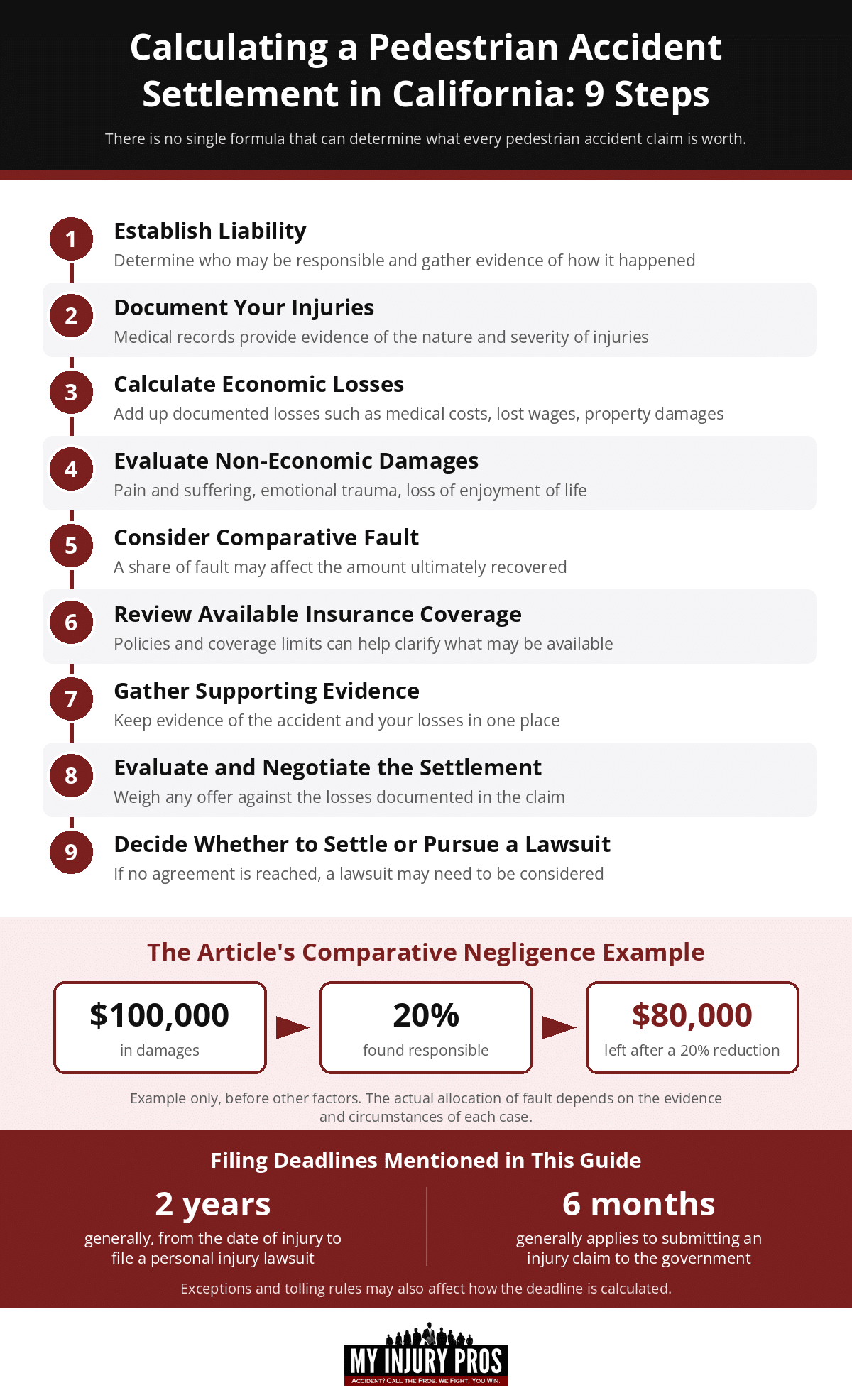
For example, imagine an injured pedestrian has $100,000 in damages but is found to be 20% responsible for the accident. Under comparative negligence, the pedestrian’s recovery could be reduced by 20%, leaving $80,000 before considering any other factors that could affect the claim. The actual allocation of fault depends on the evidence and circumstances of the individual pedestrian accident case.
Who May Be Liable for a Pedestrian Accident?
Determining who may be liable for a pedestrian accident is not always straightforward. Depending on how the accident happened, the responsible party could be a negligent driver, the vehicle owner in certain circumstances, an employer when an employee was acting within the scope of employment, or even multiple parties who contributed to the accident. Government entities may also be involved in certain cases, such as when a dangerous condition on public property contributes to the accident.
Identifying the responsible party depends on the specific facts and evidence surrounding the accident. Police reports, medical records, photographs, witness statements, and other evidence can help establish what happened and who may be legally responsible for the resulting injuries and losses.
What Damages Can You Recover After a Pedestrian Accident?
If you were injured in a California pedestrian accident, you may be able to recover fair settlement for both the financial losses caused by the accident and the physical and emotional effects of your injuries. The damages available in a pedestrian accident claim depend on factors such as the severity of your injuries, your medical treatment, lost income, and the evidence supporting your losses.
Economic Damages
Economic damages cover losses that can generally be supported through medical bills, employment records, receipts, and other documentation. They may include medical expenses, rehabilitation, future medical care, lost wages, and loss of future earning capacity when an injury affects your ability to work or earn the same income. Other reasonable financial losses connected to the pedestrian accident may also be considered when they can be documented.
The financial impact can be significant, particularly when a pedestrian suffers severe injuries that require long-term treatment. Caltrans reported that between 2008 and 2017, 7,502 pedestrians were killed and 17,860 sustained serious injuries in California crashes, illustrating the potential severity of pedestrian collisions.
Non-Economic Damages
Non-economic damages address losses that do not come with a straightforward bill or receipt. They may include pain and suffering, emotional distress, loss of enjoyment of life, and other physical or emotional effects that result from the injury. The extent of these damages can depend on the nature of the injury, how it affects your daily life, and the circumstances of your pedestrian accident case.
Caltrans also provides ongoing pedestrian crash information through its Road Safety Data Resources, which includes data on fatal and serious injury crashes and allows users to examine crash characteristics across California.This broader data can help show the serious consequences pedestrian collisions can have, although it does not determine the value of any individual pedestrian accident claim.
How Can You Calculate a Pedestrian Accident Settlement Step by Step?
There is no single formula that can determine what every pedestrian accident claim is worth. Instead, the potential value is developed by looking at the evidence, financial losses, injuries, liability, and how the accident has affected the person's life.
Step 1: Establish Liability
Start by determining who may be responsible for the accident and gathering evidence that helps explain how it happened. Police reports, photographs, witness statements, collect witness contact information, traffic footage, and other available evidence can help establish liability.
Step 2: Document Your Injuries
Medical records provide important evidence about the nature and severity of your injuries. Your diagnosis, treatment, recovery, permanent limitations, and potential need for future medical care can all be relevant when evaluating a pedestrian accident claim.
Step 3: Calculate Economic Losses
Add up the financial losses that can be supported with documentation, including medical costs, lost wages, rehabilitation costs, property damages, future medical expenses, and other accident-related costs. Keeping medical bills, receipts, employment records, and other financial documents organized can make these losses easier to establish.
Step 4: Evaluate Non-Economic Damages
A pedestrian accident can affect much more than your finances, particularly when it causes severe injuries or lasting limitations. Pain and suffering damages, emotional trauma, loss of enjoyment of life, and changes to your daily activities may all be considered when evaluating the broader impact of the injury.
Step 5: Consider Comparative Fault
California follows a comparative negligence system, so the circumstances surrounding each person's conduct can matter when determining recovery. If the pedestrian or another party is found partially responsible for the accident, that allocation of fault may affect the amount ultimately recovered.
Step 6: Review Available Insurance Coverage
The amount of compensation that can ultimately be recovered may also depend on the insurance coverage available to the responsible party or parties. Reviewing the applicable policies and coverage limits can help clarify what resources may be available to compensate the injured pedestrian.
Step 7: Gather Supporting Evidence
Keep the evidence connected to both the accident and your losses in one place. This can include medical records, medical bills, photographs, police reports, witness information, employment records, insurance documents, and other evidence that supports your pedestrian accident case.
Step 8: Evaluate and Negotiate the Settlement
Once the damages and supporting evidence have been established, an insurance company's settlement offer can be evaluated against the losses documented in the claim. If the offer does not adequately account for the damages and the available evidence supports a higher amount, negotiations may continue.
Step 9: Decide Whether to Settle or Pursue a Lawsuit
Not every pedestrian accident claim is resolved through settlement negotiations. If the parties cannot reach an agreement, the injured person may need to consider filing a lawsuit and presenting the case through the California court system.
Pedestrian Accident Settlement vs. Lawsuit: What's the Difference?
A pedestrian accident settlement and a lawsuit are not necessarily competing choices from the beginning. In many pedestrian accident cases, settlement negotiations can continue even after a lawsuit has been filed, and the parties may reach an agreement before the case ever goes to trial.
For pedestrian accident victims, reaching a settlement can provide a way to resolve the claim without going through a trial. However, if the insurance company does not offer fair compensation or liability remains disputed, a California pedestrian accident lawyer may recommend pursuing the claim through litigation based on the circumstances.
Filing a lawsuit does not automatically mean the case will go to trial. Settlement discussions can continue throughout the litigation process, and many pedestrian accident claims may still be resolved through an agreement before a judge or jury hears the case.
How Long Does a Pedestrian Accident Settlement Take?
There is no fixed timeline for a pedestrian accident settlement. The length of the process depends on factors such as the severity of the injuries, the length of medical treatment, disputes about liability, the number of parties involved, insurance coverage, and the pace of negotiations. Cases involving more severe or catastrophic injuries may take longer because the full extent of medical expenses, future treatment, lost wages, and permanent limitations may not be known right away. Liability disputes can also add time, especially when the driver denies responsibility or the parties disagree about fault under California's pure comparative negligence rule.
Insurance coverage and negotiations can further affect how long a pedestrian injury claim takes. If a lawsuit is filed, discovery and court schedules may extend the process, although filing a lawsuit does not automatically mean the case will go to trial. The seriousness of pedestrian collisions in California is reflected in recent state data. In 2023, 1,106 pedestrians were killed in traffic crashes statewide, according to the California Office of Traffic Safety, which reported an 8.8% decrease from 2022.
What Should You Do After a Pedestrian Accident?
If you are involved in a pedestrian accident, your priority should be your health and safety. Taking a few practical steps afterward can also help protect your pedestrian injury claim and preserve important evidence. Seek medical attention as soon as possible, even if your injuries initially seem minor. Report the accident to the appropriate authorities, photograph the scene and your injuries, and collect contact information from anyone who witnessed what happened.
Keep your medical records, bills, and other expense records organised, and preserve photographs, videos, accident reports, and other evidence related to the collision. Medical records, photographs, witness information, and accident reports can help document what happened and support the losses involved in a personal injury claim.
Be careful about making statements that could be interpreted as admitting fault, particularly when the circumstances are still being investigated. Speaking with an experienced personal injury attorney can help you understand your options and what steps may be appropriate for your California pedestrian accident case.
What Is the Statute of Limitations for a Pedestrian Accident in California?
If you are considering compensation after a California pedestrian accident, timing matters. California statute of limitations generally gives you two years from the date of injury to file a personal injury lawsuit, but that general deadline does not apply to every situation.
Claims involving government entities can have different requirements and much shorter deadlines, including a six-month period that generally applies to submitting an injury claim to the government. Exceptions and tolling rules may also affect how the deadline is calculated, depending on the circumstances.
The applicable deadline can depend on the details of your case, so do not assume the standard two-year period applies to your pedestrian injury claim. Speaking with an experienced attorney early can help you understand the deadline that may apply and avoid waiting until it is too late. Pedestrian cases in Silicon Valley work the same way, and a San Jose personal injury attorney can confirm your filing window.
Can a Pedestrian Receive Compensation If They Were Partially at Fault?
Yes, California follows a pure comparative negligence rule, which means a pedestrian may still recover compensation even if they were partly responsible for the accident, although their percentage of fault can reduce the amount they receive. For example, if a pedestrian is awarded $100,000 but is found to be 20% at fault, the recovery could be reduced by 20%, leaving $80,000. The percentage of responsibility is based on the specific facts and evidence surrounding the accident.
Determining fault is not always straightforward. Evidence such as photographs, witness statements, accident reports, traffic footage, and other records can help prove liability and establish how much responsibility each party may have.
What Happens If the Insurance Company Offers a Settlement?
An insurance company's first settlement offer does not necessarily reflect the full value of a pedestrian injury claim. Before accepting, review what the offer is intended to cover and whether it accounts for your current medical expenses, future medical care, lost income, future earning capacity, and pain and suffering.

The evidence supporting liability should also be considered, particularly if there is a dispute over who caused the accident. A California pedestrian accident attorney can review the offer alongside the medical records, accident evidence, and documented losses to help you understand what the proposed settlement covers.
Signing a settlement agreement can have significant consequences because it may require you to give up the right to seek additional compensation for the same accident. This is especially important when more severe injuries may require ongoing treatment or result in future financial losses that are not yet fully known.
What Can a Pedestrian Accident Lawyer Do?
A California pedestrian accident lawyer can help you understand your legal options and handle the different parts of a pedestrian accident claim. Their role may include investigating the accident, gathering evidence, identifying potentially liable parties, and communicating with insurance companies on your behalf. East Bay pedestrians hurt in a crosswalk can ask an Oakland personal injury lawyer how these claims usually go.
An attorney can also review your medical expenses, lost income, and other documented losses when evaluating your claim. When appropriate, they may negotiate with the insurer and prepare the case for litigation if a fair resolution cannot be reached.
A lawyer can also explain important deadlines, including the statute of limitations and any requirements that may apply to your particular case. California pedestrian accident attorneys may work on a contingency fee basis, meaning their fees are generally tied to the outcome of the case rather than requiring an upfront legal fee.
What Should You Know Before Accepting a Pedestrian Accident Settlement?
There is no universal settlement amount for a pedestrian accident claim, as its value can depend on your injuries, medical expenses, lost income, liability, evidence, and insurance coverage. Before accepting an offer, consider whether it covers your current and future losses and understand your legal options and deadlines.
My Injury Pros helps personal injury clients investigate accidents, gather evidence, communicate with insurance companies, and evaluate the full extent of their damages before a claim is resolved. The firm’s team includes Managing Partner Steven Nassi and Partner Natalie Nassi, and My Injury Pros offers free consultations and hands-on legal representation. If you have been injured in a pedestrian accident, contact My Injury Pros for a free consultation to discuss your legal options.
Frequently Asked Questions
Still have questions about pedestrian accident settlements in California? Below, we answer common questions about compensation, liability, insurance coverage, and filing deadlines.
How Are Pedestrian Accident Settlements Calculated in California?
Settlement value depends on your injuries, medical expenses, lost income, pain and suffering, liability, evidence, and available insurance coverage. There is no universal formula for calculating a pedestrian accident settlement.
What Is the Average Pedestrian Accident Settlement in California?
There is no reliable statewide average for pedestrian accident settlements because every claim is different. More severe injuries generally involve greater losses than minor injuries.
What Factors Affect a Pedestrian Accident Settlement?
Injuries, medical expenses, lost wages, liability, evidence, and insurance limits can all affect a settlement. Future medical care and earning capacity may also be considered.
Can I Get Compensation If I Was Partially at Fault?
Yes, California follows a pure comparative negligence rule, so you may still recover compensation if you were partly at fault. Your compensation can be reduced according to your percentage of fault.
How Long Does a Pedestrian Accident Settlement Take?
There is no fixed timeline because medical treatment, liability disputes, negotiations, and insurance coverage can affect the process. Most pedestrian accident cases are resolved through settlements rather than trials.
What Damages Can I Recover After a Pedestrian Accident?
You may recover damages for medical expenses, future medical care, lost wages, loss of earning capacity, pain and suffering, and emotional distress. The damages available depend on the circumstances and evidence of your claim.
What Happens If the Driver Doesn't Have Enough Insurance?
Insurance policy limits can restrict how much compensation you recover from the at-fault driver's policy. Uninsured or underinsured motorist coverage may provide another potential source of compensation.
Should I Accept the Insurance Company's Settlement Offer?
You should understand what the offer covers before accepting it. Signing a settlement can prevent you from seeking additional compensation later.
Do I Need a Lawyer for a Pedestrian Accident?
You are not required to hire a lawyer for every pedestrian accident claim. A California pedestrian accident lawyer can help when liability, damages, or insurance coverage are disputed.
What Is the Deadline to File a Pedestrian Accident Lawsuit in California?
California generally allows two years to file a personal injury lawsuit, but exceptions and different deadlines may apply. Government claims can have shorter deadlines and additional requirements.
Disclaimer: The information provided in this article is for general informational purposes only and does not constitute legal advice. Every legal matter is different, and the information in this article may not apply to your specific situation. For advice about your individual circumstances, speak with a qualified attorney.