A personal injury lawsuit begins when an individual suffers harm due to another person's negligence and chooses to pursue compensation. Typically, the process entails filing a claim, collecting evidence, negotiating with insurance, and potentially proceeding to court if a settlement remains elusive. It can take months or even years, so having clear documentation and a knowledgeable lawyer by your side makes a big difference.
Ever wondered how a personal injury lawsuit actually works? At My Injury Pros, our experienced team of personal injury lawyers guides clients through every step, from filing a claim to negotiating settlements or representing you in court. We combine deep legal knowledge with personalized support to protect your rights and maximize your compensation. Contact us today for a free consultation and let us help you navigate your case with confidence.
In this blog, we will walk you through the steps, timeline, and key requirements of a personal injury lawsuit in a clear and easy-to-understand way.

A personal injury lawsuit is a legal case that happens when someone is harmed because of another person’s actions or negligence by a negligent party. In simple terms, it is a way for the injured person or injured party to ask a court for help in getting monetary compensation for their losses.
This type of case falls under civil law, meaning it focuses on resolving disputes between individuals or organizations in civil court rather than punishing a crime. Legally, it begins when the injured person files a claim or legal claim stating that another party is legally responsible for their injury and should be held accountable.
There are also different types of personal injury claims that fall under this legal process. Common examples include car accidents, slip and fall incidents, workplace injuries, medical malpractice, and defective product claims involving product liability.
Each claim type follows the same basic idea: the plaintiff must show that the defendant’s actions caused harm and resulted in damages, including economic and non-economic damages. While many cases settle before reaching court through alternative dispute resolution, a personal injury lawsuit provides a structured way to seek compensation and recover losses when needed.
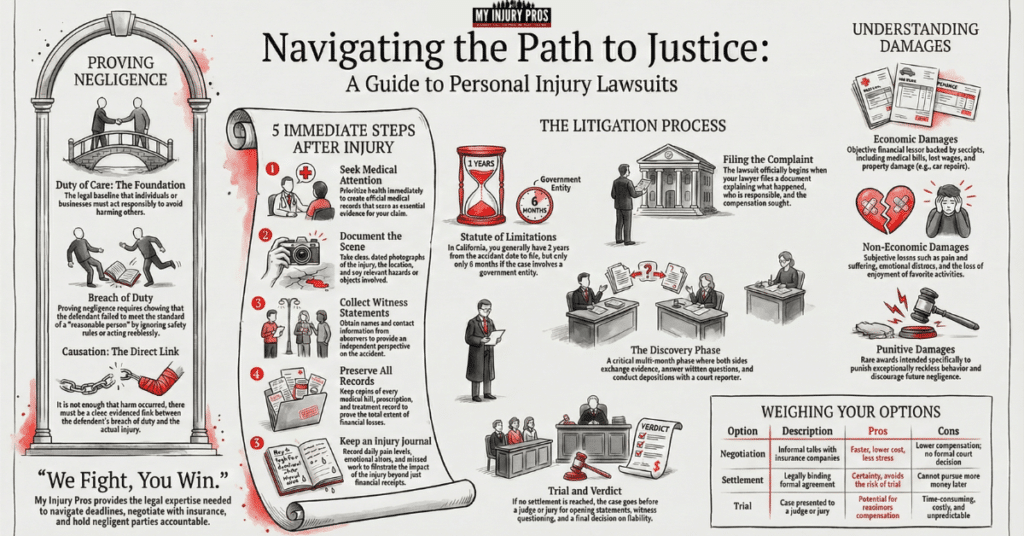
Proving negligence in a personal injury case might seem complicated, but it follows a clear process under legal representation. It’s about showing someone failed to act responsibly, and that failure caused harm by an at-fault party. Understanding the steps makes it easier to see how liability is established and who is legally responsible. Let’s break down the key methods used to prove negligence using all the evidence.
Duty of care means a person or business must act in a way that avoids harming others and follow traffic laws where applicable. Everyone owes this duty in different situations, like drivers to other drivers or doctors to patients. It sets the baseline for what’s considered responsible behavior and who may be legally responsible.
A breach of duty happens when someone fails to meet that standard. This could be ignoring safety rules or acting recklessly. Courts look at what a reasonable person would have done in the same situation.
Causation shows that the breach directly caused the injury or damage. It’s not enough that harm occurred; there must be a clear link to the action. Evidence like medical records, photos, and witness testimony helps make this connection.
To prove negligence, you show all three elements: duty, breach, and causation. Collecting solid evidence at each step strengthens your case, including police reports where available. When done carefully, these steps clearly establish liability.

With over 26 million emergency department visits in the U.S. each year for unintentional injuries, it’s clear that accidents are common, and the impact can be serious. Taking the right steps immediately afterward can make a big difference if you decide to pursue a personal injury claim or understand the role of a state-mandated insurance program.
Acting quickly protects your health and helps preserve crucial evidence that supports your case. To ensure proper documentation after an injury, we recommend following the key steps below.
Your health comes first. Even if the injury seems minor, seeking medical treatment ensures you receive proper care and creates official medical records. These records can later serve as essential evidence to support your claim.
Take clear photographs of the injury, the location where it happened, and any relevant objects or hazards involved, including where the accident happened. Visual evidence can help establish the circumstances of your injury. Keep these photos organized and dated for reference.
If anyone saw what happened, ask for their names and contact information. Try to get a brief written or recorded account of what they observed, especially from accident victims nearby. Witness statements provide an independent perspective that strengthens your case.
Keep copies of all medical bills, prescriptions, and treatment records related to your injury. This documentation helps to prove the extent of the plaintiff's injuries. Organized records make it easier for your lawyer to build a strong case.
Write down how the injury affects your daily life, including pain levels, emotional stress, and missed work. Detailed notes can help illustrate the impact of the injury beyond just medical bills, including emotional harm. This personal account can be a powerful piece of evidence in court or settlement demand negotiations.
If you’ve been injured in California, it’s important to know that there’s a time limit for filing a personal injury lawsuit, called the statute of limitations. For most personal injury cases, you generally have two years from the date of the accident to file a claim in court or begin the trial process. Missing this deadline can prevent you from pursuing compensation, even if your case is strong, so acting promptly is key.
Certain situations have different rules. For example, if your injury involves a government entity, like a city or state agency, the deadline is usually six months, and special notice must be given through a demand letter before filing a lawsuit.
Furthermore, if the injury wasn’t discovered immediately, California law allows for a “discovery rule,” which can extend the deadline in some cases. These exceptions can get tricky, which is why consulting an experienced attorney early is so helpful.
Keeping track of deadlines protects your right to file and gives your attorney time to gather evidence, talk to witnesses, and build a strong case with all the evidence. Even if you’re uncertain about whether your situation qualifies as a personal injury claim, contacting My Injury Pros sooner rather than later helps you secure compensation. A knowledgeable lawyer can guide you through the process and provide proper legal representation to make sure your case stays on track.
Many personal injury cases go better when you contact a lawyer right away. For instance, someone injured in a rear-end car accident received full coverage for medical bills and lost wages after documenting their injuries and calling a lawyer within days, supported by a clear insurance claim.
In a separate case, another person quickly reached out after a dog bite and received settlements that covered their medical costs and time off work through a fair settlement. Acting fast, keeping records, and having an experienced attorney on your side can make a big difference in your case.
The personal injury lawyer process follows a clear sequence of events, even though it may feel overwhelming at first. It usually begins with a consultation, where your lawyer reviews your case and explains your legal options.
If the case cannot be settled early, it moves into litigation, which is the formal court process of resolving a dispute. At this stage, your lawyer prepares the case by gathering evidence, identifying the responsible party, and building a strong claim on your behalf.
The lawsuit officially starts when your lawyer files a complaint in court. This document explains what happened, who is responsible, and what compensation you are seeking from the other party. After the defendant responds, the case enters the discovery phase, which is one of the most important parts of the process known as the discovery process.
During discovery, both sides exchange information, collect evidence, and ask questions through tools like documents, written questions, and depositions with a court reporter. This phase can take months or longer because it helps both sides understand the strengths of the case and prepare for what comes next.
If no settlement is reached after discovery, the case moves forward to trial. At trial, both sides present their evidence, question witnesses, and make arguments through opening statements before a judge or jury. The court then decides whether the defendant is responsible and how much compensation should be awarded after jury deliberation. While many personal injury cases settle before this stage, the full process ensures that you have a structured path to seek justice and hold the other party accountable.

Understanding the different types of compensation, also called damages, can make a big difference when you’re trying to figure out what your case is worth. Economic damages are the most straightforward because they cover actual financial losses and economic and non-economic damages.
Think of things like medical bills, lost wages from missing work, or the cost of fixing your car after an accident, including property damage. These are backed by receipts and records, so they’re easier to calculate and often form the foundation of your claim.
But not all losses come with a receipt. Some affect how you feel and live every day. That’s where non-economic damages come in. These cover pain and suffering, emotional distress, and the ways your injury may have changed your daily life, including physical pain and emotional harm. Maybe you can’t enjoy your favorite activities anymore, or you’re dealing with ongoing stress. Those experiences matter, even if they’re harder to put a number on.
In rare situations, punitive damages may also apply. These are meant to punish especially reckless or harmful behavior by a negligent party and discourage it from happening again. When damages are calculated, factors like the seriousness of your injury, your recovery, and how your life has been affected all come into play, along with financial losses. Understanding this process helps you see the full picture and why your case truly matters.
Traffic accidents are one of the most common causes of personal injury. Data from California reveals that motor vehicle crashes injured over 200,000 people in a recent year. Workplace injuries are also a frequent source of claims, with California employers reporting more than 344,000 non-fatal workplace injuries and illnesses annually. These numbers show just how easily accidents can happen and why documenting your injury is so critical.
When it comes to a personal injury claim, deciding how to pursue compensation can feel overwhelming. You don’t have to go to court right away; there are several ways to resolve a case, each with its own benefits and trade-offs. Understanding the differences between negotiation, settlement, and trial can help you make an informed decision and work with your attorney to choose the best path for your situation.
An experienced attorney plays a key role in guiding you through a personal injury case and protecting your rights from start to finish. We always remind clients, "It’s not just about money but about accountability and getting your life back on track.”
Legal situations can be complex, especially when you are dealing with injuries, paperwork, and deadlines at the same time, making an initial consultation important. This is where proper legal advice and strong representation become important, often through trusted personal injury law firms.
A skilled attorney understands the law, explains your options clearly, and helps you avoid mistakes that could affect your case. They also handle the legal process for you, so you can focus on recovery instead of stress.
One of the biggest advantages of having an experienced attorney is their expertise in personal injury law. They know how to assess your case, gather evidence, and determine the full value of your claim, including future costs and damages, supported by all the evidence.
Their negotiation skills are also critical, especially when dealing with insurance companies that may try to offer less than you deserve through the insurance claims process. A lawyer can push for a fair settlement and is prepared to take the case further if needed. Without this level of expertise, it is easy to undervalue your claim or miss important details.
Beyond expertise and negotiation, a personal injury lawyer provides ongoing legal support throughout your case. They manage communication, handle documents, and represent your interests in court if the case goes to trial with strong legal representation.
This kind of representation ensures that your case is presented clearly and professionally in civil court, giving you a better chance of a positive outcome. Ultimately, an experienced lawyer can affect your case's outcome and your compensation.
Understanding the steps involved in a personal injury lawsuit is essential for navigating the legal process with confidence. From filing your claim to reaching a settlement or proceeding to trial, each stage requires careful attention to detail and expert guidance through the lawsuit process.
By consulting a personal injury attorney, you can familiarize yourself with the process. You can also better advocate for your rights, understand the entire process, and pursue the compensation you deserve.
Curious about what happens after filing a personal injury lawsuit? My Injury Pros helps you understand the entire process, from gathering evidence to navigating negotiations or court proceedings. Our skilled attorneys provide clear guidance and strong advocacy to protect your interests. Reach out today for a free consultation and get the support you need to move forward confidently.
If you still have questions about how a personal injury lawsuit works, these frequently asked questions can help. They provide simple answers to help you better understand the process.
Filing a personal injury lawsuit starts with speaking to a lawyer and investigating your case. Your lawyer then files a complaint, both sides go through the discovery phase, and the case may settle or proceed to trial.
The timeline can vary depending on the complexity of the case and whether it settles early or goes to court. Some cases resolve in a few months, while others can take a year or more to reach a final outcome.
You are not required to have a lawyer, but having one can make a big difference in your case. A lawyer provides legal advice, handles negotiations, and helps you pursue fair compensation.
You may receive compensation for medical expenses, lost wages, and property damage. In some cases, you can also recover damages for pain, suffering, and emotional distress.
Yes, you can still file a claim even if you were partly at fault for the accident. Your compensation may be reduced based on your level of responsibility, depending on the laws in your state.
Disclaimer: The information provided on this blog is for general informational purposes only and does not constitute legal advice. Reading this content does not create an attorney-client relationship. Laws and regulations vary by jurisdiction and may change over time, so you should consult a qualified personal injury attorney directly for advice regarding your specific situation. Past examples, case studies, or hypothetical scenarios are illustrative only and do not guarantee similar results.
In California, you typically have two years from the date of your injury to file a personal injury claim, so it’s important not to wait too long to take action. There are some exceptions, like if your injury wasn’t discovered right away, if a minor is involved, or if your claim is against a government entity, which often comes with a much shorter deadline. If you miss the filing window, you could lose your chance to recover compensation, no matter how strong your case is.
Wondering how long you have to file a personal injury claim in California? At My Injury Pros, our experienced team of personal injury attorneys helps you navigate the statute of limitations so you don’t miss critical deadlines. We provide clear guidance on exceptions and ensure your rights are protected every step of the way. Contact us today to get expert advice and take the first step toward securing the compensation you deserve.
In this blog, we will break down the statute of limitations for personal injury cases in California, including key deadlines, important exceptions, and what happens if you miss your chance to file.

According to traffic collision data, every year in California, tens of thousands of people are injured in car accidents, and over 300,000 workers experience nonfatal workplace injuries. These numbers show just how common personal injuries are, making it essential to understand your rights and deadlines for filing a claim.
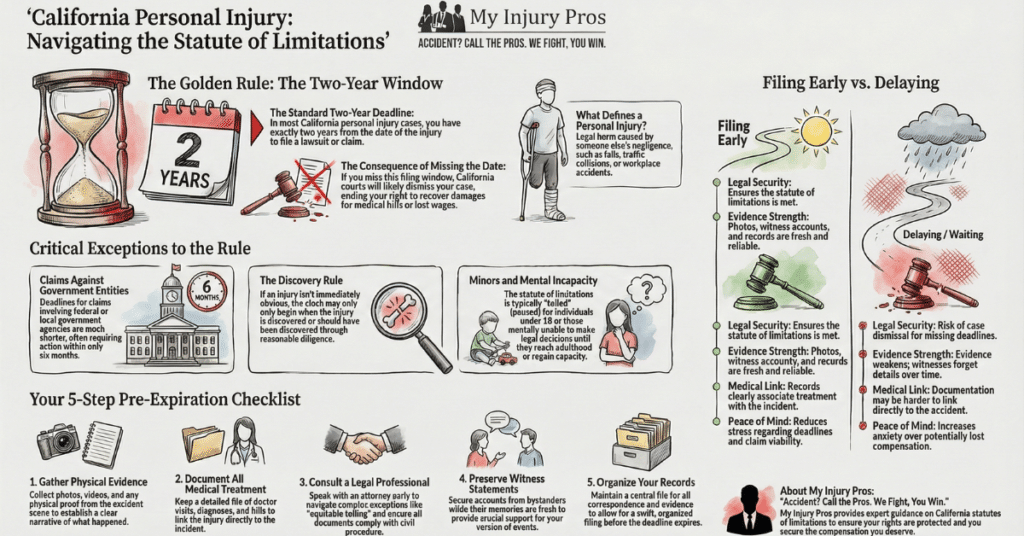
The statute of limitations is simply the deadline you have to file a personal injury claim in California or file a lawsuit under California law. In most cases, you have two years from the date of your injury, known as the two-year statute, to take action. If you miss this deadline, you could lose your legal right to seek compensation or bring a legal claim. That’s why it’s important to understand your timeline and act early before the limitations deadline.
California state law sets clear time limits for personal injury cases under California law and the California personal injury statute. A personal injury means harm caused by someone else’s negligence, like a car accident or a fall, and may involve an accident victim or the injured party.
The clock usually starts on the day you’re injured; however, in some cases, it may start later if the injury isn’t discovered right away with reasonable diligence. Claims involving a federal government agency often have shorter deadlines. Occasionally, the deadlines for government claims can be as little as six months.
Understanding these deadlines is important because filing too late can stop your case before it even begins or prevent you from filing a lawsuit. Courts take these time limits seriously, and missing them can mean losing your chance to recover damages or bring a legal claim.
Acting early also helps you gather evidence, including reliable evidence, while it’s still fresh and before witness memories fade. Filing on time gives you the best chance of moving forward with your claim and seeking damages.
The statute of limitations is the deadline you have to file a personal injury claim in California or file a lawsuit under California law. In most cases, you have two years from the injury date, known as the two-year statute, to take action. Filing within this timeframe allows California courts to hear your case. However, if you miss the deadline, the court may dismiss your case, potentially affecting your legal rights.
Missing the deadline can have serious consequences for your claim. You could lose your legal right to sue or file a lawsuit, even if you have strong evidence. Courts typically reject cases filed beyond the deadline and may decline to consider the lawsuit. This means you may no longer be able to recover compensation or seek compensation for your injuries.
Some exceptions can change how the deadline works under California law and the California statute. For example, the time limit may be paused in certain circumstances if the injured party is a minor. In other cases, the clock may start when the injury is discovered instead of when it happened or when the injury occurs, based on reasonable diligence. These exceptions can provide additional time, but they vary based on specific circumstances.

Exceptions to the statute of limitations are situations where the usual deadline is adjusted or paused under California law and the California statute. While most personal injury claims must be filed within two years, the time frame can change depending on certain circumstances.
Exceptions exist to make things fair when someone cannot act right away or take civil actions. For example, equitable tolling may pause the deadline if you are pursuing another legal option in good faith and taking legal action.
Some common exceptions apply to minors and individuals with mental incapacity under California law. If you are under 18, the time limit is usually paused until you become an adult, allowing the injured party time to file a lawsuit later. The same applies if someone is mentally unable to make legal decisions, depending on specific circumstances. These rules help protect people who cannot take action immediately after an injury or the underlying accident.
Another key exception is the discovery rule, which applies when an injury is not obvious right away. In these cases, the time limit starts when the injury is discovered or should have been discovered with reasonable diligence. This provides you a chance to take action, including a personal injury action, even if symptoms appear later. Overall, these exceptions show that the law considers real-life situations when applying deadlines and how limitations exist.
An attorney helps you understand personal injury laws and filing deadlines in California. The statute of limitations can be confusing, especially since different rules apply to cases like medical malpractice or wrongful death, including wrongful death claims.
A personal injury attorney in California will clarify your time limits and guide you through the process step by step, assisting you in building a legal claim. Working with a personal injury lawyer early helps you stay organized and avoid missing important deadlines. Get support from a knowledgeable attorney.
Attorneys also assist you in filing and managing your case in accordance with civil procedure. They prepare and submit documents promptly, ensuring compliance with legal requirements for your personal injury lawsuit. Before witness memories fade, they gather and preserve important evidence, including reliable evidence, to prevent its loss or deterioration over time. In addition, they handle communication with insurance companies and protect your rights.
A lawyer also provides clear legal advice and consultations, sometimes even a free consultation. They can explain exceptions like tolling or the discovery rule and how they apply to your situation. They make sure you file your claim before the deadline expires. Having an attorney improves your chances of staying on track and successfully moving forward with your case.
Traffic collisions and workplace accidents rank among the leading causes of serious injuries in California. In 2024, government data shows that private industry employers reported over 344,000 nonfatal injuries, while fatal work injuries totaled 439. Figures from this data highlight the real impact these accidents can have on the lives of victims.
If you sustain injuries due to another party’s negligence, California law permits you to seek compensation for your losses. Economic damages cover actual costs like medical bills, lost wages, rehabilitation, and property damage, and they are easy to calculate.
Non‑economic damages compensate for pain and suffering, emotional distress, or loss of enjoyment of life. They’re less tangible but just as important. Knowing the types of damages you can recover helps you understand your claim and estimate how much you might receive. Acting early and keeping good records strengthen your case.
Taking appropriate steps before the statute of limitations expires is crucial for preserving your personal injury claim. We regularly remind our clients, "Photos, medical records, and witness statements are the backbone of any personal injury claim." Acting promptly ensures you have strong evidence, proper documentation, and professional guidance to support your case. Here’s a simple checklist to keep you on track:
Collect photos, videos, and any physical proof related to your injury or accident. This evidence helps establish what happened and strengthens your claim.
Keep detailed records of all doctor visits, diagnoses, and treatments. Accurate medical documentation shows the extent of your injuries and links them to the incident.
Speak with an experienced personal injury attorney as soon as possible. Legal guidance ensures you understand deadlines, exceptions, and how to prepare your claim effectively.
Reach out to anyone who saw the accident and note their accounts. Witness testimony can provide crucial support and back up your version of events.
Keep all evidence, bills, and correspondence in one place. Having an organized file makes it easier for your attorney to build a strong case before the deadline.
When it comes to filing a personal injury claim in California, timing can make all the difference. Acting quickly can help preserve evidence, secure medical documentation, and ensure you don’t miss the statute of limitations. On the other hand, there are situations where waiting, under certain exceptions, might give you more time to act. Understanding the trade-offs between filing early and delaying can help you make informed decisions about your claim.
| Factor | Filing Early | Delaying / Waiting |
|---|---|---|
| Legal Security | Filing promptly ensures you meet the statute of limitations and avoid losing your right to sue. | Waiting risks missing the deadline, which can result in the court dismissing your case entirely. |
| Evidence Strength | Evidence is fresh: photos, witness accounts, and medical records are more reliable. | Delayed claims may weaken evidence, witnesses may forget details and records may be harder to obtain. |
| Medical Documentation | Medical records are up-to-date and clearly linked to the injury, supporting your claim. | Later documentation may be less clear or harder to associate directly with the incident. |
| Exceptions/Flexibility | Early filing generally avoids the need to rely on exceptions like the discovery rule or tolling. | In some cases, exceptions (minor mental incapacity, delayed injury discovery) may extend your timeline, giving you more time to file. |
| Legal Guidance | Engaging an attorney early allows for strategic planning and timely filing. | Waiting may limit options or make the case harder to manage, even with an attorney. |
| Peace of Mind | Taking action early reduces stress and uncertainty about deadlines and claim viability. | Delaying can cause anxiety about missing deadlines or losing compensation. |
Understanding the statute of limitations for personal injury in California is crucial to safeguarding your rights. By acting within the two-year timeframe, you can ensure your claim is heard and potentially secure the compensation you deserve. If you're facing the complexities of a personal injury case, don't hesitate to seek expert legal guidance.
Not sure how much time you have to file a personal injury claim in California? At My Injury Pros, we make understanding the statute of limitations simple and stress-free. Our team can guide you through exceptions and deadlines so you don’t risk losing your right to compensation. Reach out today and let us help you protect your claim with confidence.
Here are some frequently asked questions to help you better understand personal injury claims and legal deadlines. These simple answers cover key concerns you may have.
The statute of limitations is the deadline you have to file a personal injury claim in California. In most cases, you have two years from the date of your injury to take legal action.
Most people have two years to file a personal injury claim in court. The clock usually starts on the day the injury happens, but it may begin later if the injury is discovered afterward.
Yes, the deadline can be extended in certain situations. This may happen through exceptions like tolling or the discovery rule, depending on your case.
If you miss the deadline, you usually lose your right to file a lawsuit. The court will likely dismiss your case, which means you cannot recover compensation.
Yes, different types of cases can have different deadlines. For example, claims against government entities may require action within six months.
Disclaimer: The information provided on this blog is for general informational purposes only and does not constitute legal advice. Reading this content does not create an attorney-client relationship. Laws and regulations vary by jurisdiction and may change over time, so you should consult a qualified personal injury attorney directly for advice regarding your specific situation. Past examples, case studies, or hypothetical scenarios are illustrative only and do not guarantee similar results.
The value of a personal injury case can vary widely. How much a personal injury case is worth depends on factors such as the severity of the injuries, the cost of medical treatment, lost income, and how the injury affects your daily life. Because every situation is different, the final value of a case often comes down to the strength of the evidence, the long-term impact of the injury, and how clearly fault can be proven.
Wondering how much your personal injury case could be worth? At My Injury Pros, our experienced team of personal injury lawyers guide you through every step and help calculate both your financial and personal losses. Our experienced team has helped countless clients get fair settlements. Contact us today for a free initial consultation and let us help you understand your options.
In this post, we will explain the key factors that influence how much a personal injury case may be worth, including damages, evidence, and how settlements are typically calculated.

A personal injury case is a legal claim that arises when an injured party suffers harm because of someone else's negligence. These cases are handled within the legal system, which allows injury victims to pursue compensation for medical costs, lost income, and other losses. In simple terms, the law provides an accident victim with a way to hold the responsible party accountable and recover damages after an accident or injury.
Personal injury cases often involve many different types of injuries and situations. Injuries may include severe injuries, soft tissue injuries, traumatic brain injuries, spinal cord injuries, or catastrophic injuries caused by accidents such as car crashes, slip-and-fall incidents, wrongful death, or medical mistakes. The legal foundation of many cases is negligence, which occurs when someone fails to act with reasonable care and their actions cause harm to another person due to the defendant's liability.
Another important part of a personal injury case is figuring out who was involved and who was at fault for the damage. A liable party may be a driver, property owner, employer, business, or another individual whose actions caused the injury. When negligence is proven, the injured person may pursue compensation through a personal injury lawsuit or settlement agreement to reach a potential settlement that covers both financial losses and the personal impact of the injury.
Determining the value of a personal injury case involves carefully reviewing the financial and personal impact of the injury. Attorneys and insurance companies typically follow a structured process to estimate a fair settlement based on documented losses and the overall effect the injury has had on your life. To better understand how this process works, we recommend using the steps below:

When someone files a personal injury claim, many factors influence how much compensation they may receive. Courts and insurers typically consider compensatory damages, punitive damages, and insurance coverage when determining a rough estimate of the potential settlement.
According to the Centers for Disease Control and Prevention (CDC), the estimated total economic cost of injuries in the United States in 2019 was about $4.2 trillion, including medical care, work loss, and quality‑of‑life losses. Understanding these variables can help explain why some cases result in average personal injury settlement amounts while others lead to injury settlement amounts worth several million dollars.
1. Medical Expenses
Medical bills are often the foundation of a personal injury claim. Costs such as hospital visits, medical treatment, physical therapy, and ongoing treatment are considered economic damages and directly affect the personal injury settlement amounts or average settlement amounts that may be awarded.
2. Loss of Income
If an injury prevents you from working, you may be able to recover compensation for lost wages. This includes income that has already been missed as well as potential future earnings if the injury leads to longer recovery periods or permanent disability. In some cases, the legal team may also consider a free consultation or free case evaluation to estimate the case value.
3. Pain and Suffering
Pain and suffering refer to the physical pain and emotional distress caused by the injury. These losses may involve severe or moderate injuries and are considered when estimating the average personal injury settlement amounts. These are non-economic damages, meaning they do not have clear bills or receipts but still play a major role in the final settlement value.
Figuring out how much your personal injury lawsuit is worth can feel confusing. Costs like medical bills, lost wages, and the impact on your daily life all play a role. Understanding these factors helps us know what to expect and plan our next steps. Below, we break down the key elements that affect case value and how settlements are usually calculated.
| Factor | Description | Impact on Case Value | Trade-Off / Notes |
|---|---|---|---|
| Medical Expenses | Cost of hospital visits, treatments, therapy, and future care | High – directly affects economic damages | Accurate documentation increases the potential for settlement |
| Lost Income | Wages lost due to time off work and reduced earning capacity | High – adds to economic damages | Harder to quantify future earnings; estimates may vary |
| Pain & Suffering | Physical pain, emotional distress, and lifestyle impact | Medium – non-economic damages | Subjective; requires strong evidence like medical records or testimony |
| Liability & Evidence Strength | Proof of fault, witness statements, accident reports | High – can make or break your case | Weak evidence may reduce settlement offers or lead to denial |
| Property Damage | Damage to car, personal items, or property in the incident | Medium – economic damages | Usually easier to quantify; may be covered by insurance separately |
| Long-Term Impact | Permanent injuries, disabilities, or lasting lifestyle changes | High – increases non-economic damages | Long recovery or permanent effects generally increase settlement value |
| Insurance Coverage | Policy limits of at-fault party’s insurance | High – caps maximum settlement | Even a strong case may be limited by available coverage |
| Negotiation & Legal Representation | Ability to negotiate and advocate effectively | Medium to High – can improve settlement | Hiring an experienced attorney often leads to higher levels of compensation |
Filing a personal injury claim can feel overwhelming, but understanding the steps can make the process much smoother. From reporting the injury to seeking legal help and submitting your claim, each stage is important to protect your rights and ensure you get the compensation you deserve.
Notify the responsible party and your insurance company as soon as possible. Accurate and timely reporting helps create a clear record of the incident.
A personal injury attorney can guide you through the process, explain your rights, and help gather evidence. Legal representation increases your chances of a fair settlement.
This involves filing the necessary paperwork with the insurance company or the court, formally starting the claim process. Your lawyer will ensure everything is completed correctly.
The claim is reviewed, evidence is collected, and both sides may negotiate a settlement. Your attorney will advocate for your best interests during this stage.
Most personal injury cases are settled before trial, but if an agreement isn’t reached, the case may proceed to court. Your lawyer will represent you throughout to help secure fair compensation.

Data from the U.S. Bureau of Justice Statistics shows that in tort cases, most of which involve personal injury, the majority (around 73%) settle by agreement rather than going to trial. These stats indicate how common settlement‑based resolution is.
Insurance companies play a major role in determining how much a personal injury claim may be worth. In most personal injury claims, the at-fault party’s insurance policy and available insurance coverage determine how much insurance may pay in a potential settlement. Insurers also review the evidence, medical records, and accident details before deciding how much they believe the claim is worth under the legal system.
Insurance companies also try to control costs by carefully evaluating claims and negotiating settlements. Adjusters may question the severity of injuries or the amount of damages in order to reduce the payout. Understanding how insurers evaluate claims can help you prepare stronger evidence and negotiate for a fair settlement.
Negotiating with insurers after an accident can feel intimidating, but when you understand how the process works, it becomes easier. An insurance adjuster reviews your claim, evaluates the evidence, and makes a settlement offer based on their assessment of damages and liability. However, insurers often begin with lower offers because their goal is to reduce the amount they pay on claims.
Successful claim negotiation requires preparation and patience. Before responding to a settlement offer, gather medical records, bills, and other evidence that support the value of your claim. Stay calm, stick to the facts when speaking with the adjuster, and avoid accepting the first offer too quickly because negotiations usually involve several rounds of discussion.

Representing yourself in a personal injury claim can be overwhelming. The legal process involves strict deadlines, complex rules, and negotiations with insurance companies that may try to reduce your compensation. An experienced personal injury lawyer provides legal consultation and guidance so we understand our rights and make informed decisions throughout the case.
"Every case is unique, and that’s why we take the time to look at the full impact of an injury from medical bills to how it affects your daily life." – Natalie Nassi, Personal Injury Attorney at My Injury Pros
One of the biggest advantages of hiring a seasoned attorney is their expertise in the law. Personal injury lawyers understand legal procedures, evidence requirements, and how to value your claim properly. Their experience helps them build strong case strategies and avoid mistakes that could weaken your claim.
Experienced attorneys also bring strong negotiation skills to the table. Insurance companies often attempt to offer low settlements, but a skilled lawyer knows how to negotiate for fair compensation. Through a strong attorney-client relationship, your lawyer can develop a clear strategy, advocate for your best interests, and work toward the best possible outcome for your case.
For example, a driver suffered whiplash after a rear-end collision. A personal injury lawyer helped gather medical records, document lost wages, and negotiate with the insurance company. With strong evidence and legal guidance, the case settled fairly, covering medical bills, lost income, and compensation for pain and suffering.
Determining the worth of a personal injury case involves many factors, including the extent of your injuries, the impact on your daily life, and potential future expenses. While each case is unique, the goal is to ensure fair compensation that reflects your true losses. With the right legal guidance, you can navigate this complex process confidently.
Not sure what your personal injury case is worth? My Injury Pros breaks it down fast and clearly. Our team fights for every dollar you deserve. Contact us now for a free consultation and take the first step toward your settlement.
Every personal injury case is different, so the amount it may be worth can vary widely. These frequently asked questions address common inquiries about the factors that affect compensation and what you can expect from a claim.
The average value of a personal injury case varies widely depending on the severity of the injury and the circumstances of the accident. Some cases settle for a few thousand dollars, while others can reach hundreds of thousands or more.
Several factors affect the value of a case, including medical expenses, lost income, and the severity of the injuries. Pain and suffering, long-term impact, and the strength of the evidence also play an important role.
You can estimate the value by adding up economic damages like medical bills and lost wages. Non-economic damages such as pain, suffering, and reduced quality of life are also considered.
Car accident settlements vary depending on the injuries and liability involved in the crash. Minor injury cases may settle for a few thousand dollars, while serious injury claims can result in much higher settlements.
Yes, effective negotiation can sometimes increase the value of your settlement. Having strong evidence and legal representation can help support a higher compensation claim.
Disclaimer: The information provided on this blog is for general informational purposes only and does not constitute legal advice. Reading this content does not create an attorney-client relationship. Laws and regulations vary by jurisdiction and may change over time, so you should consult a qualified personal injury attorney for advice regarding your specific situation. Past examples, case studies, or hypothetical scenarios are illustrative only and do not guarantee similar results.
Sternum pain after a car accident can be a sign of bruising, fractures, or internal injuries, often caused by seat belt impact, blunt force trauma, or soft tissue injuries to the upper body. If you experience symptoms like sharp chest pain, swelling, or difficulty breathing, it’s important to seek medical attention immediately and document your condition, as this may signal internal bleeding or serious injuries. From a legal standpoint, prompt diagnosis, proper records, and consulting a personal injury professional can help protect your rights and support any claim for compensation.
MY Injury Pros shares trusted insights on sternum pain after a car accident based on real injury case experience and professional knowledge. Our content is reviewed for accuracy to help victims understand both medical concerns and legal options. Sternum pain should never be ignored after a crash because what feels like minor discomfort may signal delayed chest pain or underlying injuries. Contact us today for a free consultation and get the support you need to recover and pursue compensation.
In this post, we will explain the causes, symptoms, medical concerns, and legal steps to take if you experience chest pain after a car accident.

Sternum pain after a car accident refers to discomfort or injury felt in the breastbone due to crash-related force. It often results from direct impact with the steering wheel or pressure from the seat belt. This pain may signal chest trauma and should be taken seriously. Clinical data from large traffic injury studies show that sternum fractures occurred in about 0.6% of crash victims in a long-term analysis of over 42,000 injured patients, often in high-impact collisions.
Car accidents can cause sternum pain when the chest strikes the steering wheel, airbag, or is forcefully held by a seatbelt. While seat belts save lives, they can also lead to seat belt injuries in high-impact crashes. In some cases, the force may also contribute to rib fractures or soft tissue damage.
Common symptoms include sharp pain in the center of the chest, tenderness, swelling, and discomfort when breathing or moving. Some people feel chest pain immediately and may also notice bruising or stiffness in the chest area; others experience delayed chest pain hours later. These symptoms may point to internal injuries and may require prompt medical attention and evaluation.
Some patients later discover sternum fractures, broken ribs, or lung injuries that were not obvious at first. In some cases, the same impact that causes sternum pain may also lead to head trauma or brain injuries. These injuries can develop alongside chest trauma and may affect recovery and potential settlement outcomes.
Data from the CDC show that more than 1.8 million drivers and passengers in the United States were treated in emergency departments for crash‑related injuries in 2021. This highlights how common injuries are in traffic accidents.
Sternum pain after a car accident can have legal implications, especially if the injury was caused by another driver's actions. Victims may be entitled to file a personal injury claim to seek compensation for medical expenses, lost wages, and recovery needs following car accident injuries. The legal process often focuses on liability and how the injury occurred.
Negligence plays a key role in determining responsibility for the accident and resulting harm. This is especially relevant in accidents involving rideshare companies such as Lyft. If another party failed to drive safely, they may be held liable for the chest injury and related damages caused by the driver's negligence. Proving fault can strengthen a personal injury claim and support fair compensation.
It’s also important to understand that strict legal deadlines may apply. The California car accident statute of limitations limits how long accident victims have to file a personal injury claim after a car accident. Waiting too long could prevent you from seeking compensation, even if delayed chest pain or internal injuries appear later.

A medical evaluation is the first step in diagnosing sternum pain after a car accident. Doctors usually perform a physical examination to check for tenderness, swelling, and breathing difficulty. Diagnostic tests, such as X-rays or CT scans, may be used to detect fractures, internal organ injuries, or chest injuries such as cardiac contusion or internal organ damage.
X-rays help identify bone damage like rib fractures, while CT scans give a more detailed view of the chest cavity and internal organs, including the lung tissue or heart muscle. These tools support accurate diagnosis and rule out serious complications. Together, they form an important part of the evaluation process.
Treatment often focuses on pain relief and recovery. Pain management and physical therapy are common steps in rehabilitation. In severe cases, surgical intervention may be necessary to restore proper chest function.

After a car accident, sternum pain can signal more than just surface bruising. Taking the right steps early helps protect both your health and your rights. If you have experienced a car accident, we recommend following the steps below:
Please turn on your hazard lights and get out of traffic if you can. Call for help right away if you feel dizzy, weak, or in severe pain. This stage is your emergency response moment, so stay calm and protect yourself.
Chest pain can be a sign of chest trauma, bruising, internal injuries, or worse, including hidden injuries. Call emergency services or go to the ER, even if the pain feels manageable, to avoid serious complications. A medical check creates a clear record of your injury.
Call the police and make sure an official accident report is created. Stick to the facts when explaining what happened. This report will be crucial later for establishing liability and insurance.
Take photos of your chest area if there’s bruising, swelling, or marks from the seatbelt. Also, photograph vehicle damage, the road, and anything that shows how the crash happened. This injury documentation is essential for your case.
Write down your pain level, breathing issues, sleep problems, and any limits on movement each day. Save medical records, hospital notes, scans, prescriptions, receipts, and also note delayed chest pains or lightheaded pain. Consistent records help connect the accident to your sternum pain.
Insurance companies may push quick settlements that don’t cover long-term care. Consult a personal injury professional to clarify your options and safeguard your rights. A lawyer can help you pursue fair compensation.
After a car accident, you may wonder whether to report sternum pain right away or wait to see if it improves. We always tell our clients, "Even if your chest pain feels minor after a crash, getting checked right away can prevent serious complications down the road." When you take action can affect both your medical recovery and your ability to seek compensation. The comparison below explains the key trade-offs in a clear and simple way.
| Decision Area | Immediate Reporting & Documentation | Trade-Off | Delayed Reporting of Symptoms | Trade-Off | Key Takeaway |
|---|---|---|---|---|---|
| Medical Care | See a doctor right away and report all chest pain symptoms | Early diagnosis but possible upfront costs | Wait to mention pain until it worsens | Risk of hidden injury and delayed treatment | Early reporting protects your health. |
| Medical Records | Injury is documented from the start | Creates strong proof linking pain to the crash | Gap between accident and complaint | Insurance may question cause of injury | Documentation timing affects credibility. |
| Insurance Claim | Clear timeline supports compensation claim | Requires quick action | Late complaint may raise doubt | Insurer may argue injury is unrelated | Timing can impact claim value. |
| Recovery Outcome | Faster treatment plan and monitoring | More appointments early on | Condition may worsen without care | Longer healing time possible | Early care often means smoother recovery. |
After a car accident, it is important to report the incident to your insurance company as soon as possible, especially if there is a possibility of personal liability. Provide clear details about what happened and share any available documents or photos. Immediate reporting helps start your insurance claim process without delays.
Next, consider contacting a personal injury attorney, such as an experienced car accident attorney, for legal advice, particularly if you are concerned about whether you can be sued personally for a car accident. They will explain your rights and guide you through the claims process. This step will ensure you do not accept unfair settlements.
Finally, file your insurance claim with all the required medical and accident records. Include reports, receipts, and proof of injury where necessary. Proper documentation strengthens your case and supports fair compensation.
A personal injury lawyer helps people who suffer sternum pain after a car accident understand their rights after suffering physical trauma. They provide legal counsel and guide victims through each step of the claims process. This support can make a difficult situation easier to manage.

Legal representation helps you navigate complex legal processes. A lawyer gathers evidence and works to prove negligence when another party is at fault. This is important for building a strong case.
They also focus on maximizing compensation for medical costs, lost wages, and recovery needs. With proper representation, injured parties are less likely to accept low settlements. A personal injury lawyer works to protect your best interests throughout the process.
A lawyer begins with a careful case assessment to understand how sternum pain is linked to the car accident and long-term medical treatment needs. They review medical records, accident reports, and timelines. This will establish a clear legal strategy.
Next, they focus on evidence collection to support your claim. This will include medical imaging, witness statements, and expert opinions. Strong documentation helps in building a solid case for fair compensation.
Sternum pain after a car accident is common and should never be ignored. The sternum, or breastbone, often absorbs force from the steering wheel, seatbelt, or airbag during a crash. The result can cause bruising, muscle strain, inflammation, or even a fracture. Symptoms may include sharp chest pain, tenderness, swelling, pain when breathing or coughing, and limited upper body movement. Prompt medical care is critical to rule out serious complications and begin proper treatment.
Beyond the physical pain, sternum injuries can lead to high medical bills, lost wages, and long recovery periods. Insurance companies may try to downplay chest injuries or offer quick settlements. That is why documenting your symptoms and following your doctor’s advice is essential. An experienced personal injury attorney can help protect your rights, gather evidence, and pursue full compensation for your losses. If you are experiencing sternum pain after a crash, seek immediate medical attention. Seek medical attention and speak with a qualified attorney to understand your legal options.
Are you experiencing sternum pain after a car accident and are unsure what it means? At MY Injury Pros, our experienced car accident attorneys provide trusted guidance backed by real case insight and medically informed understanding for car accident victims. We help accident victims understand their injuries and protect their legal rights. Contact us today for a free consultation and get the support you need to move forward.
If you are dealing with sternum pain after a car accident, you likely have important questions about your symptoms and next steps. This FAQ section answers common concerns to help you understand your condition and what to do next.
Sternum pain can last from a few days to several weeks, depending on whether the injury is a mild bruise, muscle strain, or a fracture. More serious chest injuries may take months to fully heal and often require medical care.
Sternum pain is commonly caused by seatbelt pressure, impact with the steering wheel, or blunt force trauma during the collision. It may also result from muscle strain, a fractured rib, internal chest bruising, or damage to an internal organ.
Resting, applying cold compresses, and using doctor-approved pain relief can help reduce discomfort and swelling. Gentle posture support, avoiding heavy lifting, and following medical treatment advice can also ease pressure on the chest during recovery.
Yes, persistent sternum pain should be evaluated to rule out fractures or internal injuries. A medical professional can ensure there are no serious complications affecting your chest, breathing, or deep breathing ability.
Yes, light stretching and breathing exercises can support healing and reduce stiffness once approved by a doctor. Physical therapy may also be recommended to safely restore strength and mobility.
Disclaimer: The information provided on this blog is for general informational purposes only and does not constitute legal advice. Reading this content does not create an attorney-client relationship. Laws and regulations vary by jurisdiction and may change over time, so you should consult a qualified car accident attorney for advice regarding your specific situation. Past examples, case studies, or hypothetical scenarios are illustrative only and do not guarantee similar results.
To hire a car accident lawyer, start by researching attorneys who specialize in personal injury and have proven experience handling car accident cases and motor vehicle accident claims. Schedule consultations to evaluate their track record, communication style, fee structure, and approach to handling insurance claims, settlement negotiations, or litigation. Choose a lawyer who offers clear guidance, works on a contingency fee basis, and demonstrates the expertise needed to protect car accident victims and maximize fair compensation.
At My Injury Pros, our law firm understands what it takes to build strong car accident claims and guide injured clients through every stage of the legal process. With extensive experience handling negotiations with the insurance company, evidence collection, and litigation, our legal team provides trusted, results-driven legal representation you can rely on. We believe informed clients make confident decisions, which is why we offer a free consultation and free case evaluation to help you choose the right lawyer. Contact us today and let our experienced car accident attorneys fight for the maximum compensation you deserve.
This post will guide you through the key steps, essential criteria, and important considerations for choosing the best car accident lawyer after an accident has occurred.
Hiring a car accident lawyer involves several key steps and considerations. At its core, it involves securing professional legal counsel after a car crash, auto accident, or car wreck. Understanding personal injury law is essential, including how medical expenses, lost wages, and serious injuries affect your personal injury claim. This process includes knowing what damages are compensable and what responsibilities both parties have under the law. A lawyer can clarify these concepts, ensuring you are fully aware of your legal options.
The first step in hiring a lawyer is researching qualified local attorneys with experience in handling car accident lawsuits involving negligent drivers, distracted driving, or multiple parties. An initial consultation or free case review allows you to explore your legal options, fee structure, and claims strategy. researching and selecting a qualified professional.
Legal representation and legal action are important because car accident claims can be complex, as an insurance provider or insurance adjuster may attempt to minimize payouts, and without guidance, you may accept less than you deserve. A lawyer manages communication, gathers evidence surrounding the circumstances surrounding the crash, and negotiates for a fair settlement. This ensures your claim is handled efficiently and that your rights are fully protected throughout the process.
Hiring an experienced car accident lawyer, such as a rideshare accident lawyer, provides added benefits. They understand common accident scenarios, injury types, and legal pitfalls. Their expertise allows them to build stronger cases, anticipate challenges, and maximize compensation. This ensures you are protected whether dealing with minor accidents or severe injuries, including permanent disability or long-term medical treatment.
For example, John, a delivery driver, was involved in an auto accident, a minor rear-end collision. The insurance company initially offered a proposed settlement amount of $2,000. After hiring an auto accident lawyer, his accident lawyer negotiated a settlement of $12,500, covering his medical bills, lost wages, and additional damages for pain and suffering. This case highlights how legal expertise can turn a low insurance offer into fair compensation.
The legal framework protects car accident victims and allows them to seek compensation for physical injuries, crash injuries, property damage, and emotional distress. Knowing these rights is essential to ensuring that insurance companies or other parties do not undervalue your claim.
A personal injury claim may involve:
The legal process for car accident claims involves several steps, from filing an insurance claim to gathering evidence and negotiating with insurance providers for a proposed settlement. Should a fair settlement prove unattainable, the case may proceed to court proceedings.
Each stage of the court process has specific rules and deadlines, making professional guidance crucial to avoid errors that could delay or reduce your compensation. A personal injury lawyer helps establish negligence and navigate deadlines like the statute of limitations, ensuring you do not lose your right to financial recovery.

We always advise our clients, "Every car accident is unique, and the right legal guidance can make the difference between a low settlement and full compensation." Choosing the right car accident lawyer is an important decision that can directly affect whether you receive a low offer or maximum compensation.
The right accident lawyer must:
An experienced accident lawyer has experience handling personal injury cases, understands insurance policies, and knows how to negotiate with insurance adjusters. In addition to possessing legal knowledge, the ideal lawyer should demonstrate a strong commitment to safeguarding your interests. Taking time to evaluate key criteria ensures that you select someone who can handle your claim effectively and confidently.
Experience and a proven track record are essential when choosing a car accident lawyer. Lawyers who regularly handle car accident cases understand common challenges, legal strategies, and insurance tactics. Their past case results can show whether they have successfully secured fair compensation for clients in similar situations.
Client testimonials and reviews offer helpful details about a lawyer’s reputation. Positive feedback often reflects professionalism, reliability, and strong advocacy. Availability and communication style also matter, as a good lawyer keeps you informed, responds promptly, and explains complex issues clearly. Together, these factors help you choose a lawyer you can trust throughout the legal process.

Evaluating a lawyer’s expertise begins with scheduling an initial consultation. This meeting allows you to assess their experience in handling car accident injuries, communication style, and understanding of cases like yours. Pay attention to how clearly they explain legal concepts and whether they provide thoughtful, confident answers about strategy and potential outcomes.
During the interview, ask specific questions about their track record, similar case results, and approach to handling negotiations or trials. Inquire about who will manage your case and how often you can expect updates. The right lawyer will answer transparently, demonstrate strong knowledge, and make you feel confident in their ability to represent you effectively.
One of the most common mistakes people make is choosing a lawyer based solely on advertisements or flashy marketing. While an online ad may grab your attention, it doesn’t guarantee experience or a proven track record. It’s important to research potential attorneys, read client reviews, and verify their experience in handling cases similar to yours. Relying only on ads can lead to hiring someone who lacks the expertise needed to secure fair compensation.
Another frequent error is rushing to hire a lawyer without a proper consultation. Many clients feel pressure to act quickly after an accident, but skipping this step can result in poor communication, unclear fees, or a strategy that doesn’t align with your needs.
Scheduling an initial consultation allows you to ask about experience, case approach, and fee structures, ensuring you make an informed decision. Taking the time to carefully select your lawyer increases your chances of a successful outcome and gives you peace of mind throughout the legal process.

After hiring a car accident lawyer, the legal process begins immediately. Your attorney will take structured steps to build a strong case and protect your rights from the start.
Your lawyer will review the details of your accident and injuries carefully. They will outline a clear legal strategy tailored to your specific situation.
Your attorney will gather police reports, medical records, witness statements, and any available photos or videos. Proper documentation strengthens your claim and supports proof of liability and damages.
The lawyer will notify insurance companies that they represent you. This prevents insurers from contacting you directly and helps avoid statements that could harm your case.
Your lawyer will calculate current and future losses, including medical costs and lost income. This ensures that your claim reflects the full impact of the accident.
Your attorney will move forward with negotiations or prepare for litigation if necessary. Throughout the process, they will keep you informed and adjust the strategy as your case develops.
According to our managing partner, Steven Nassi, "We believe informed clients make the best decisions." When meeting one for the first time, ask the personal injury lawyer about their experience with cases like yours. Find out how many similar cases they have handled. Ask about their strategy for negotiating with insurance companies.
It is also important to learn how they approach settlements. Inquire about their trial experience. Ask if they have gone to court and what the outcomes were. Check how they communicate with clients. Find out who will handle your case day-to-day. Ask about fees and costs upfront.
Also, ask about their timeline for your case. Find out how long cases like yours usually take. Ask what evidence they will need from you. Learn how they investigate accidents. Ask if they work with experts, like medical professionals or accident reconstruction specialists. Find out how often you will get updates. Ask about potential challenges in your case. Lastly, inquire about the necessary steps to initiate your case. This process ensures clarity and confidence in your choice.
Once your case is underway, understanding what to expect can reduce uncertainty and stress. The ongoing legal process follows structured steps designed to protect your rights and strengthen your claim.
1. Regular Updates and Case Progress: Your lawyer must provide consistent updates regarding developments in your case. You can expect communication regarding negotiations, new evidence, or important deadlines.
2. Interaction With Insurance Companies: Your attorney will handle all communication with insurance adjusters on your behalf. They will use strategic negotiation tactics to counter low settlement offers and protect the value of your claim.
3. Evidence Development and Case Strengthening: As the case progresses, additional evidence may be gathered to support your position. This can include expert opinions, medical evaluations, or further documentation of damages.
4. Preparation for Settlement or Court: Most cases move toward settlement discussions, and your lawyer will prepare you for this stage. If a fair agreement cannot be reached, they will also prepare you for a possible court appearance and guide you through each step confidently.
Hiring a car accident lawyer comes with financial considerations, but understanding them helps clients plan. Most lawyers offer transparent arrangements that tie their fees to the outcome of the case. This ensures clients receive professional help without upfront financial strain.
The most common fee structure is a contingency fee. This means the lawyer only gets paid if you win your case. Typically, the fee is a percentage of your settlement or award. Many lawyers also operate on a no-win, no-fee basis, giving clients confidence that they won’t pay unless compensation is recovered.
Clients should also be aware of additional costs. Court fees, investigation expenses, and medical record retrieval can add up. A good personal injury lawyer will explain these costs upfront and help manage them. This transparency ensures clients know what to expect while focusing on their recovery.

Calculating potential compensation for a car accident starts with identifying the damages. Damages include both tangible and intangible losses. Tangible losses cover things like medical bills, vehicle repairs, and lost wages. Intangible losses focus on pain, suffering, and emotional distress.
Medical expenses are often the first factor in determining compensation. This includes hospital visits, doctor appointments, rehabilitation, and ongoing care. Lost wages are calculated based on the time missed from work due to injuries. Future earning capacity may also be considered if the accident impacts long-term work ability.
Pain and suffering are less straightforward but still compensable. Lawyers often use methods like the multiplier method, which multiplies economic damages by a factor based on injury severity. This ensures the emotional and physical toll of the accident is included in the claim.
A lawyer plays a key role in maximizing compensation. They document damages thoroughly and negotiate with insurance companies. Experienced lawyers know what evidence is needed and how to present it effectively. With their guidance, clients can secure compensation that fully reflects the impact of the accident.
After a car accident occurs, some people consider handling the claim on their own to save money. While it’s possible in minor cases, there are trade-offs to consider. Hiring a qualified car accident lawyer can provide legal expertise, negotiation skills, and peace of mind, whereas managing the claim yourself may save upfront costs but carries risks that could reduce your compensation. The table below compares the two approaches:
| Factor | DIY/Handling Claim Yourself | Hiring a Car Accident Lawyer |
|---|---|---|
| Cost | Minimal upfront costs, but risk of undervaluing your claim | Contingency fee only if you win; no upfront payment in most cases |
| Legal Knowledge | Limited understanding of personal injury law, liability, and insurance tactics | Full legal expertise and guidance through complex laws and negotiations |
| Negotiation | You handle insurance companies directly, which can lead to lower offers | Lawyer negotiates strategically to maximize settlement |
| Time & Effort | Must manage paperwork, calls, and evidence gathering yourself | Lawyer handles all communications, evidence collection, and deadlines |
| Risk of Mistakes | High—missing deadlines or undervaluing damages is common | Low—experienced lawyer ensures all legal requirements are met |
| Outcome Potential | Often lower settlements due to lack of leverage or legal knowledge | Higher likelihood of fair or full compensation and protection of rights |
Hiring an experienced lawyer is crucial for strong legal representation. Experience means they understand the system and know how to handle complex cases. This knowledge can make a big difference in achieving the best possible outcome.
In car accident cases, experience is especially important. Skilled lawyers possess a comprehensive understanding of local laws and court procedures. They can anticipate common tactics used by insurance companies and counter them effectively. This expertise helps protect your rights and strengthens your claim.
Experienced lawyers also bring proven strategies to the table. They know what works in similar cases and can apply it to your situation. With their guidance, you are more likely to receive fair compensation and a successful resolution.
Hiring a car accident lawyer can have lasting benefits. An experienced lawyer helps you navigate the legal system. They know what it takes to handle claims and insurance. This guidance can make a big difference in the outcome of your case.
One of the main advantages is ensuring fair compensation. A skilled lawyer reviews all damages, including medical bills, lost wages, and future care. They negotiate with insurance companies to maximize your recovery. They make sure to avoid undervaluing you or pressuring you into a hasty car accident settlement.
Another long-term benefit is peace of mind. Knowing that a professional is handling your case reduces stress. You can focus on healing while your lawyer manages paperwork and negotiations. This support can prevent emotional burnout during a difficult time.
Finally, hiring a lawyer helps secure a comprehensive recovery. They anticipate future needs and protect your rights over time. Their guidance can impact your financial stability for years. Overall, the long-term effects of hiring a skilled lawyer are protection, recovery, and peace of mind.
For example, after a severe collision, a client’s lawyer ensured the settlement included coverage for future medical treatments and rehabilitation costs. This not only addressed immediate bills but also secured financial protection for ongoing care. With the assurance of their long-term health and financial stability, the client could concentrate on their recovery.
Hiring a car accident lawyer starts with understanding your rights and the value of your claim. Look for an attorney with proven experience in car accident cases, strong client reviews, and a clear track record of results. Schedule an initial consultation to ask about their strategy, communication style, and fee structure. Most work on a contingency basis, meaning you pay nothing unless they win. Make sure they explain the legal process, timelines, and potential outcomes clearly.
The right lawyer will gather evidence, handle insurance companies, calculate your full damages, and fight for fair compensation. They will keep you informed and prepare you for settlement negotiations or court, if necessary. Taking the time to choose carefully can protect your financial future and reduce stress during recovery. If you have been injured, consult a qualified personal injury lawyer as soon as possible to protect your rights and strengthen your case.
Are you in search of the ideal car accident lawyer but uncertain about where to begin? At My Injury Pros, we help clients understand the key steps and criteria for hiring experienced legal representation. Our team has a proven track record in handling car accident claims, from negotiating with insurance companies to preparing court cases. Schedule a free consultation today and let us guide you toward the compensation you deserve.
Choosing the right car accident lawyer can feel overwhelming, especially when you are already dealing with injuries and financial stress. These frequently asked questions will help you better understand the process and make a confident, informed decision.
When hiring a car accident lawyer, ask about their experience with cases like yours, success rate, and whether they’ve handled claims against the same insurers. You should also ask about fees (contingency vs. hourly), who will handle your case day-to-day, expected timelines, and how communication will work so there are no surprises.
In California, most car accident lawyers work on a contingency fee basis, meaning you pay nothing upfront and the lawyer is paid only if you recover money. Typical contingency fees range from 33% to 40% of the settlement or verdict, depending on whether your case goes to trial. You also usually don’t pay legal costs unless you win.
You can find reviews of car accident lawyers on Google Reviews, Avvo, Yelp, and FindLaw, where clients share real experiences and ratings. It’s best to compare reviews across multiple sites and look for feedback on communication, results, and responsiveness.
Look for a car accident lawyer with experience in personal injury and auto collision claims, a strong track record of settlements or verdicts, and positive client reviews. It also helps if they communicate clearly, handle litigation when needed, and work on a contininjurygency fee (so you pay only if you recover compensation).
With a lawyer, many car accident cases in California settle in 3 to 12 months, especially when liability is clear and injuries are minor to moderate. Cases involving serious injuries, disputed fault, or litigation can take a year or longer to resolve.
Disclaimer: The information provided on this blog is for general informational purposes only and does not constitute legal advice. Reading this content does not create an attorney-client relationship. Laws and regulations vary by jurisdiction and may change over time, so you should consult a qualified personal injury attorney for advice regarding your specific situation. Past examples, case studies, or hypothetical scenarios are illustrative only and do not guarantee similar results.
Under California's strict liability, a dog owner may be held liable when a dog bites someone, regardless of prior aggressive behavior. Owners may defend against a dog bite claim by showing the injured person was trespassing, provoking the dog, or knowingly assuming the risk. Dog bite victims can seek compensation for medical expenses, lost wages, pain and suffering, and other damages through an insurance claim or personal injury claim.
At My Injury Pros, we specialize in helping California residents navigate dog bite cases with confidence. Our team understands strict liability under California Civil Code Section 3342 and helps injured clients pursue compensation. We focus on protecting your legal rights and maximizing damages for medical costs, lost wages, and injuries caused by a dog attack. Contact us today to get a free consultation and start building a strong case with trusted legal support.
This blog explains how the California dog bite law works, including the owner's knowledge, legal responsibility, and the steps victims can take after a dog bite incident.

California Civil Code Section 3342 governs dog bite cases in California. This statute establishes strict liability for dog owners when their dog bites a human being in a public place or when lawfully in a private place, including the dog owner's property. The law is designed to protect victims and clarify an owner’s legal responsibility. It removes much of the uncertainty found in other injury claims.
The most important feature of this law is the strict liability principle. Under strict liability, the victim does not have to prove negligence. It does not matter whether the dog had shown prior aggression. The owner is responsible simply because the bite occurred; this standard means the victim does not have to prove negligence. The owner is strictly liable even if the dog had never shown dangerous behavior.
The owner’s responsibility is broad under this statute. If their dog bites someone, they are generally liable for the resulting damages. The victim must show that a bite occurred and that it caused substantial physical injury. The law applies even if the owners took precautions. However, it does not protect trespassers who are unlawfully on the property.
Victims have the right to pursue compensation for their losses by filing a personal injury lawsuit. This may include medical bills, lost wages, and pain and suffering. These apply if the owner took reasonable precautions. These losses are legally referred to as damages. While negligence does not need to be proven, other defenses may still apply. Overall, the statute strengthens victims’ rights and simplifies the path to recovery.
In certain circumstances, the law also considers whether the dog was trained to fight, attack, or kill, which may introduce elements of criminal liability. If a dog has bitten a person on two separate occasions, it may be classified as a dangerous or vicious animal. Such classification may apply even when the dog harms another animal or causes a person to be severely injured.
The legal process for dog bite incidents in California typically begins immediately after the incident and follows a series of important steps that can lead to a settlement or formal litigation. First, the dog bite should be reported to local animal control or law enforcement to create an official record of the incident. Seeking prompt medical treatment is critical, not only for health reasons but also to ensure proper medical documentation of the dog bite injuries. This documentation later serves as key evidence when filing the personal injury claims.
Next, victims should consult an experienced attorney to evaluate liability under California Civil Code Section 3342 and assess the strength of their case. The attorney will typically begin by filing an insurance claim with the dog owner’s homeowner’s or renter’s insurance carrier. During this phase, evidence is gathered, damages are calculated, and settlement negotiations may take place.
If a fair settlement cannot be reached, the attorney may file a lawsuit, formally initiating litigation in civil court. The case may proceed through discovery, mediation, and potentially trial, although many dog bite cases resolve through negotiated settlement before reaching court.
| Feature | California | One-Bite Rule States | Trade-Off/Analysis |
|---|---|---|---|
| Owner Liability | Strict liability—the owner is liable for any bite in public or lawful private space, regardless of prior aggression | Only if the dog has previously shown aggression or has "had one bite" does the owner become liable. | California makes it easier for victims to recover damages but increases owners’ legal exposure. In one-bite states, owners have less risk, but victims must prove previous incidents. |
| Proof Required | The victim only needs to show that the bite occurred and caused an injury. | Victim must show prior knowledge of dog’s aggression | California favors victim protection; one-bite states favor owner protection. |
| Insurance Impact | Homeowner/renter insurance often covers claims | Coverage depends on whether the owner knew the dog was dangerous | California ensures broader insurance involvement, but owners may face higher premiums. |

Our clients often hear us say, "Immediate action after a dog bite can make a real difference." Dog bites can be sudden, painful, and potentially dangerous. Acting quickly after a bite can protect your health and preserve evidence if legal action becomes necessary. We recommend following the step-by-step guide below immediately after a dog bite.
The first instinct may be panic, but try to stay calm. Ensure the dog is no longer a threat and move to safety if the dog poses an ongoing threat. Check the severity of the bite. If it’s deep, bleeding heavily, or causing extreme pain, immediate medical attention is critical.
Wash the bite area gently but thoroughly with soap and warm water. This helps remove bacteria and reduce the risk of infection from dog bite injuries. Avoid scrubbing aggressively, which can further damage tissue.
Apply an antiseptic or antibiotic ointment and cover the wound with a clean bandage. If bleeding is severe, apply gentle pressure to control it. This addresses both minor injuries and serious wounds.
Take photos of your injury and the scene of the bite. Record details such as the dog’s appearance, the bite that occurred, the location, and any witnesses. This documentation can be crucial if you need to file a claim or take legal action.
Watch for signs of infection such as redness, swelling, pus, or fever. Prompt treatment can prevent complications. Follow your doctor’s instructions, keep records of all medical visits, and stay in touch with authorities regarding the dog's status.
After you are safe and receiving care, consider filing a formal dog bite complaint with your local animal control agency. This ensures the incident is officially recorded and helps protect others. You may also reach out to the district attorney or city attorney, or apersonal injury attorney experienced in dog bite cases. They can guide you on your legal rights, help document evidence, and advise on seeking compensation for medical bills, lost income, and pain and suffering.
Should a dog bite occur in California, promptly reach out to your local animal control agency or the police department. Provide details such as the dog owner’s information, the location of the incident, and a description of the dog. If possible, include photos of your injury and the scene. Many cities also allow online reporting or forms, so check your local city or county animal services website for specific instructions.
Reporting a dog bite creates an official record of the incident, which is critical if you decide to pursue a personal injury claim. Authorities can document the dog’s vaccination status and history of aggression, which strengthens your case and protects others from future attacks.

We regularly advise clients, "Photographs, medical records, and witness statements aren’t just paperwork; they’re the foundation of a successful claim." To support a dog bite claim, the injured person has the burden of proof; they must show that the dog bit someone and that the bite caused injury. Strong evidentiary support is critical to a successful claim. Clear documentation helps establish liability and damages. Without proper proof, even a serious injury can be difficult to recover compensation for.
Medical records are one of the most important forms of evidence. These records document the nature and extent of the injuries. They connect the bite directly to the treatment received. Doctor notes, hospital bills, and prescriptions all help prove damages. Photographs are also powerful evidence. Clear images of the injuries, torn clothing, and the location of the attack can show the severity of the incident. Photos taken immediately after the attack are especially persuasive.
Witness statements can further strengthen a claim. Independent witnesses can confirm how the attack occurred. Their testimony may support Prior reports of aggressive behavior from the dog. Animal control reports and prior complaints about the dog can also serve as evidentiary support. Together, this evidence helps meet the legal burden of proof. A well-documented case increases the likelihood of fair compensation.
For instance, a neighbor's dog bit a child who was playing in the yard, causing significant facial injuries and permanent scarring. The family pursued a claim, providing detailed medical records, photographs, and witness statements to support the case. The strong evidence presented and the severity of the injuries led to a settlement of $1.2 million, covering medical expenses, ongoing care, and compensation for pain and suffering.
Homeowners' and renters' insurance can help cover injuries caused by dog bites. Most standard policies include liability coverage, which pays for medical bills or legal fees if you are sued. This applies whether the dog is yours or is visiting your home.
However, some policies have breed‑specific exclusions. Certain breeds, like pit bulls or Rottweilers, may be excluded from coverage. If your dog is on the list, your insurance might deny claims, even if the bite was accidental.
For example, if someone is bitten on your property, your insurance may pay their medical costs. But if the dog is a restricted breed, the claim could be denied. Always check your policy carefully. You may need to buy additional coverage if your dog is excluded.
A dog bite lawsuit can lead to several possible legal outcomes. Many cases resolve through a personal injury settlement, where both sides agree on compensation without going to trial. If no agreement is reached, the case may proceed to court for a judge or jury decision. The result will determine whether the injured person receives damages. These damages are meant to compensate for the harm caused by the attack.
Financial compensation often includes payment for medical expenses. This can cover emergency treatment, surgeries, medication, and future medical care. Lost wages may also be recovered if the victim missed work during recovery. In some cases, the court may award damages for reduced earning capacity. Pain and suffering are another common form of compensation. This category of compensation addresses physical pain, emotional distress, and lasting trauma from the incident.
In certain situations, additional damages may be awarded depending on the severity of the attack. Courts may also order restitution in specific circumstances, particularly if a related criminal case exists. Whether resolved by settlement or trial, the goal is to fairly compensate the victim. Each case depends on the evidence presented and the applicable state laws. A strong claim increases the likelihood of a favorable outcome.
Dog bite settlements and verdicts vary widely. Minor injuries may result in $5,000 to $15,000, while serious injuries, scarring, or hospital stays can reach $50,000 to $100,000 or more. Compensation usually covers medical bills, lost wages, and pain and suffering.
In California, settlements can differ based on circumstances. For example, a dog bite causing a deep leg injury might settle for $35,000, while another case involving multiple surgeries could reach $90,000. Each case depends on medical costs, liability, and the dog’s history.
California law regarding dog bites protects victims and clearly defines an owner’s responsibility. Under California Civil Code Section 3342, dog owners are strictly liable if their dog bites someone in a public place or lawfully on private property. Victims do not need to prove negligence. Key evidence for a claim includes medical records, photographs of injuries, witness statements, and any prior reports about the dog. Damages can cover medical expenses, lost wages, and pain and suffering, and cases may resolve through settlement or court judgment.
Dog bite cases can be complex, and the law has specific requirements and defenses. Knowing your rights and documenting the incident carefully strengthens your claim. While the strict liability principle makes it easier to recover compensation, a personal injury lawyer can help guide you through the legal process. Consulting a qualified attorney ensures your claim is handled correctly and increases the likelihood of fair compensation.
Have you been injured by a dog in California and aren’t sure what to do next? At My Injury Pros, we help victims understand their rights and pursue the compensation they deserve. Our skilled team guides you through every step, from gathering evidence to securing damages for medical bills, lost wages, and pain and suffering. Reach out today for a free consultation and get expert support for your dog bite claim.
Understanding California dog bite law can feel overwhelming, especially if you have been injured or are facing a claim. Below are answers to frequently asked questions to help you better understand your rights, responsibilities, and legal options.
In California, the statute of limitations for filing a dog bite lawsuit is generally two years from the date of the bite or injury under the state’s personal injury rules for filing personal injury claims. Missing this deadline usually means your case can’t be heard, though there are limited exceptions (like for minor victims who may have until age 20 to file).
Yes, landlords can be liable for dog bites in California, but only in certain situations. Liability may exist if the landlord had knowledge of a dangerous or vicious dog and failed to take reasonable steps to address the risk. However, landlords who were unaware of the danger or acted promptly may be able to avoid liability.
In California, homeowner’s insurance often covers dog bite claims under the policy’s personal liability coverage. This typically pays for medical bills, lost wages, and pain and suffering up to the policy limits, unless the policy excludes certain breeds or the dog has a known bite history that voids coverage.
Yes, under California law, a dog can be deemed dangerous after just one bite if the incident shows a serious threat to public safety or demonstrates such viciousness that future harm is likely. Animal control looks at factors like the severity of the injury, prior aggressive behavior, and the circumstances of the bite when making that determination.
Common defenses against a dog bite claim in California include provocation (the victim teased or harmed the dog), trespassing or being unlawfully on the property, and assumption of risk (such as working closely with dogs). Defendants may also argue the injury wasn’t caused by a bite, occurred off the owner’s property without negligence, or falls under statutory exceptions (e.g., police or military dogs performing duties). Additionally, a properly trained dog whose owner took reasonable steps to prevent harm may strengthen a defense against liability.
Disclaimer: The information provided on this blog is for general informational purposes only and does not constitute legal advice. Reading this content does not create an attorney-client relationship. Laws and regulations vary by jurisdiction and may change over time, so you should consult a qualified personal injury attorney for advice regarding your specific situation. Past examples, case studies, or hypothetical scenarios are illustrative only and do not guarantee similar results.
Knowing what to do after a car accident in California starts with safety, documentation, and protecting your rights. In our experience, taking the right steps immediately significantly affects your personal injury claim and compensation.
At MyInjuryPros, we help injured drivers navigate insurance companies and legal representation with confidence. With years of experience handling California car accident claims, we know what insurers look for and push back on. We recommend speaking with our team as soon as possible to avoid costly mistakes.
This blog covers the exact legal steps to take after a crash, from the accident scene to filing an insurance claim. We also explain medical care, fault, evidence gathering, and when legal action may be crucial.
In our experience, the minutes after a car accident feel confusing and stressful. The actions you take immediately can affect safety, insurance coverage, and any future personal injury claim. We recommend focusing on safety first, then documentation, and finally reporting the accident.
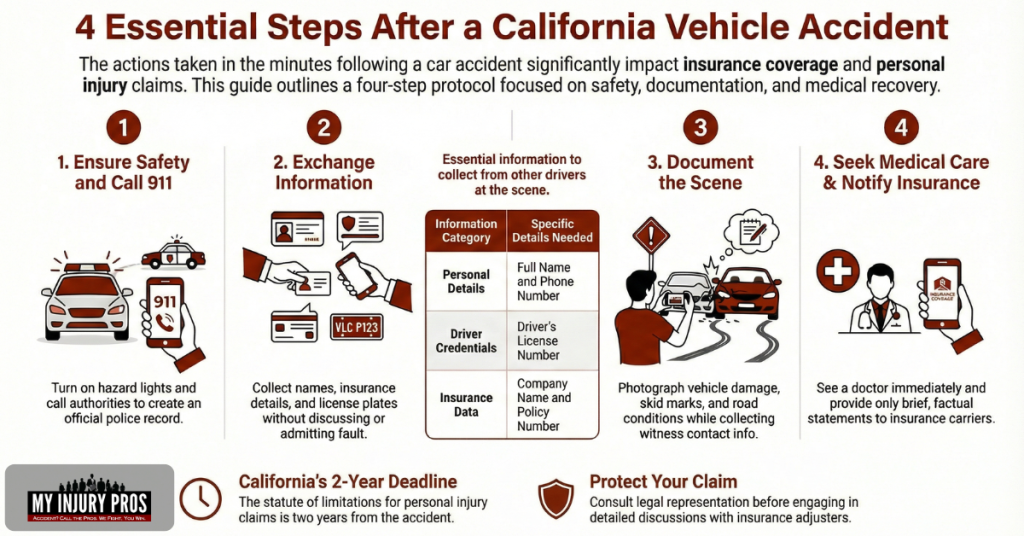
These steps will help protect your health and your right to pursue compensation:
Your first priority after a crash is safety at the accident scene. Turn on hazard lights immediately and check for imminent danger. If possible, move vehicles to a safe location to prevent another collision.
Furthermore, call 911 and report the accident as soon as possible, even if injuries seem minor. A police report creates an official record and may document fault. In our experience, insurance companies rely heavily on this report during an insurance claim. In all that you do, keep in mind that the statute of limitations for filing a lawsuit after a car accident in California is two years from the date of the accident for personal injury claims.
According to our Partner, Natalie Nassi, “Safety and documentation are the foundation of every strong case.”
After safety is secured, exchange information with the other party involved. Collect names, phone numbers, and insurance information from all drivers involved. Make sure to record the insurance company, policy number, and driver’s license details.
We recommend staying calm and avoiding any discussion of fault. For instance, even saying “I’m sorry” can be misinterpreted later. If a driver refuses to share information, note it and inform the police. Also record license plate numbers and basic vehicle descriptions to avoid later disputes.
“Clear information exchange prevents delays and disputes with insurance adjusters,” Natalie Nassi explains.
Documenting the scene is one of the most important steps after a California car accident. Take photos of vehicle damage, skid marks, and damaged property. Capture wide shots of the accident scene and close-ups of the collision impact. Make notes about the time, date, weather, and road conditions.
For example, wet pavement or poor lighting can affect fault determinations. If witnesses are present, collect their names and phone numbers. In our experience, early evidence often strengthens a civil lawsuit if negotiations fail.
Always seek medical attention as soon as possible, even if injuries feel minor. Some injuries appear hours or days later. Medical records connect your injuries to the accident and support medical bills and lost wages.
Notify your insurance company promptly, but keep statements brief and factual. We recommend speaking with legal representation before detailed discussions with insurance carriers. Insurance adjusters work to limit payouts, not maximize your compensation.
In our experience, medical concerns are one of the most overlooked parts of a car accident. Many people focus on vehicle damage and insurance claims first, which can be a mistake. Your health directly affects your personal injury claim and long-term recovery. We recommend treating medical care as a top priority, even after a minor crash.

Here's a step-by-step guide on how to handle medical concerns:
Always seek medical attention as soon as possible after an auto accident. Visit a doctor even if there are no visible injuries. Some injuries do not cause pain immediately.
For instance, soft tissue injuries and concussions often appear hours or days later. Medical evaluations create a clear link between the accident and your injuries. This link is crucial when medical expenses and medical bills are later questioned by an insurance company. Keep all medical records, prescriptions, and receipts. These documents support your insurance claim and any future legal action.
After initial treatment, continue monitoring your health carefully. Watch for pain, stiffness, dizziness, numbness, or unusual symptoms in the days following the crash. We often see clients who felt “fine” at first but worsened later.
If symptoms appear, follow up with a healthcare professional immediately. Delays can hurt your recovery and reduce compensation. Insurance adjusters may argue the injuries were unrelated. Prompt follow-ups help protect your personal injury claim.
Follow all treatment plans recommended by your doctor. Attend physical therapy, specialist visits, and follow-up appointments. Skipping care can be used against you by insurance carriers.
In our experience, demonstrating consistency indicates that the injury is serious and ongoing. For example, missed appointments may suggest you were not truly injured. Keep a simple log of visits, pain levels, and limitations. This documentation effectively illustrates how injuries impact daily life and result in lost wages.
Medical care impacts more than your health. It directly affects compensation. Treatment records help calculate medical expenses, future care costs, and pain-related damages. We recommend using health insurance when available to avoid gaps in care. Later, these costs may be reimbursed through a personal injury claim. Proper medical documentation also helps establish fault and damages if a civil lawsuit becomes necessary.
Reporting and filing claims correctly can prevent serious delays and denials. The table below breaks down what to do, who to report to, and why each step matters. We recommend completing these steps as soon as possible after a car accident in California.
| Step | Who You Report To | What To Do | Why It’s Important |
|---|---|---|---|
| Report the accident | Insurance company | Notify your insurance company promptly and provide basic facts only. | Late notice can reduce coverage or lead to claim denial. |
| File an insurance claim | Insurance adjusters | Open an insurance claim and document property damage and injuries. | This starts the compensation process for medical expenses and repairs. |
| Avoid detailed statements | Insurance carriers | Do not speculate about fault or injuries early on. | Statements can be used to reduce compensation based on comparative negligence. |
| File official report | Police | Ensure a police report is completed at the scene or soon after. | Police reports help establish fault and document drivers involved. |
| Report to the DMV | California DMV | File Form SR-1 if injuries, death, or damage exceed $1,000. | California vehicle code requires this regardless of fault. |
| Keep all records | Personal files | Save policy numbers, reports, and correspondence. | Organized records strengthen any personal injury claim or legal action. |
According to the California Department of Insurance, many auto accidents involve more than one driver sharing responsibility, and fault can be assigned to more than one party. Drivers and insurance companies alike must determine the comparative negligence each party bears after a crash.
California follows a fault-based system, which means the driver responsible for causing the crash is generally the one required to pay for damages such as medical expenses, property damage, and lost wages through insurance coverage. Under state law, if a driver’s actions or omissions caused at least 51 % of the crash, they are considered principally at fault by insurers
California also operates under a pure comparative negligence system. That means even if you were partly responsible for a collision, you can still pursue compensation against the at-fault driver and their insurance carriers. For example, if your total damages are $100,000 and you are found 30 % responsible, your recovery could be reduced to $70,000.
This rule applies whether fault is assigned by police reports, insurance adjusters, or a court. Police reports document facts, citations, and conditions at the accident scene, but they do not determine legal fault on their own. Insurers then investigate further, review evidence, and assign responsibility percentages based on all available information.
Witness statements are another key piece of evidence. Independent accounts from bystanders or other drivers help corroborate what happened. Combined with photos of vehicle damage, skid marks, and road conditions, these statements strengthen how liability is assessed.
Under this system, you can still seek compensation for medical expenses, lost wages, and property damage even if you were partly at fault. The final amount you can pursue in a personal injury claim or civil lawsuit is reduced by your percentage of fault, not barred altogether.

In our experience, having a personal injury attorney often changes how a case ends. Insurance companies handle car accident claims every day. Most injured people do not. Legal representation helps balance that power difference. We step in so clients can focus on medical care instead of constant insurance calls.
One major advantage is help negotiating with the insurance company. Insurance adjusters are trained to minimize payouts. They may question injuries or delay payment. We recommend avoiding direct negotiations when medical expenses or lost wages are involved. For instance, one client came to us after accepting an early offer that did not cover future treatment. We reopened the claim and secured compensation for ongoing medical care.
Attorneys also provide guidance on legal rights and potential compensation. Many clients assume compensation only covers vehicle damage. In reality, a personal injury claim may include medical bills, lost wages, and long-term care costs. We assess insurance coverage, fault, and comparative negligence before advising next steps. This prevents costly assumptions early on.
Legal procedures can become overwhelming without guidance. If settlement talks fail, we prepare for legal action. This process includes filing a civil lawsuit, handling discovery, and managing deadlines. We also represent clients during disputes and depositions.
In one case, we represented a driver rear-ended at a red light. The insurance carrier blamed pre-existing injuries. We used medical records and accident evidence to challenge that claim. The result covered medical bills and lost wages. In another case, a client was involved in a multi-vehicle crash with disputed fault. Police reports and witness statements were key. We established the other driver as primarily responsible, allowing the client to recover compensation despite shared fault.
In summary, a personal injury attorney manages pressure, procedure, and negotiation. We strategically manage interactions with insurance carriers and legal disputes. In our experience, that support often makes the difference between a reduced claim and fair compensation.
Dealing with insurance companies after a car accident requires strategy and restraint. In our experience, what you say early can affect your personal injury claim later. Insurance adjusters are trained to protect the insurance carrier’s bottom line. They are not focused on maximizing your compensation.
Effective communication starts with being clear and accurate about basic accident details. Share facts about the accident scene, vehicles involved, and timing. Avoid guessing or filling in gaps. We recommend never admitting fault during these discussions. Even casual statements can be interpreted against you. According to the California Department of Insurance, drivers are not required to accept fault determinations made during early insurance conversations.
It is also important to understand how insurance companies evaluate compensation. Adjusters review medical expenses, medical records, and treatment consistency. They also consider lost wages, property damage, and future medical care. According to the California Department of Insurance, medical costs are the largest component of auto injury claims, accounting for over 50% of total payouts in bodily injury cases.
Insurance companies also apply comparative negligence rules. California follows a pure comparative negligence system. This means compensation can be reduced based on fault percentage. For example, a 20% fault finding reduces compensation by 20%. The California Department of Insurance confirms this system applies to all auto injury claims statewide.
Many insurers push early settlement offers. These offers often appear before full medical recovery. We have seen clients offered settlements that failed to cover future medical bills. This is why timing matters. Once you accept, you usually cannot reopen the claim.
“Insurance companies move quickly because early statements and early settlements benefit them,” says Natalie Nassi, Partner at MyInjuryPros. “Having guidance early helps protect the true value of your case.”
Legal representation helps manage these interactions strategically. Attorneys handle communications, document damages, and challenge low offers. They also ensure all compensation factors are included before negotiations conclude.
In our experience, taking action early helps protect your rights after a car accident in California. When injuries, medical bills, or lost wages are involved, waiting can weaken your personal injury claim. We recommend acting with clarity and confidence, even if the next steps feel overwhelming.
Legal representation can help you understand fault, insurance coverage, and compensation options. It also ensures insurance companies take your claim seriously. For instance, many clients come to us after realizing an early settlement would not cover future medical expenses. You deserve guidance that puts your recovery first.
If you are ready to move forward, our team at MyInjuryPros is here to help. We focus on protecting injured clients and pursuing fair outcomes. Contact us today!
Here are the most common questions people ask after a car accident in California:
You should report the accident to your insurance company as soon as possible. In California, you must also file a DMV report within 10 days if injuries, death, or property damage exceed $1,000.
Ensure safety, call authorities, and seek medical attention immediately. Then exchange information, document the accident scene, and notify your insurance company promptly.
Costs often include medical expenses, vehicle repairs, lost wages, and future medical care. In our experience, these costs add up quickly, especially if injuries worsen over time.
Common mistakes include delaying medical care, admitting fault, or accepting early insurance offers. These can be avoided by seeking medical attention early and speaking with legal representation before negotiations.
The California auto accident statute of limitations generally gives victims two years from the date of the accident to file a personal injury lawsuit and three years for property damage claims. Legal action must follow the proper filing process under the California Government Code, including timely submission of claims and documentation of injuries or damages. Missing these deadlines can bar your case, making it essential to act promptly and meet all required procedures.
Are you facing a car accident in California and unsure about filing deadlines? At My Injury Pros, our experienced personal injury attorneys understand the California auto accident statute of limitations and the exceptions that may apply. We provide authoritative guidance to protect your rights and help you pursue full compensation for your injuries and losses. Contact us today to speak with a qualified attorney and ensure your claim is filed correctly and on time.
In this post, we will explain the time limits, legal requirements, exceptions, and steps for filing a claim under California's statute of limitations for auto accidents.

The California law on auto accident deadlines sets the legal deadlines for filing a lawsuit after a car accident in California. It is part of the California Government Code. The purpose is to ensure claims are made promptly. Legal action cannot be pursued indefinitely.
In general, a personal injury claim against a negligent driver must be filed within two years of the accident. Property damage claims usually have a three-year limit. These time limits show when the statute of limitations applies. Filing after the deadline can bar a case entirely.
There are exceptions to these rules. For example, the discovery rule allows the clock to start when an injury is discovered, not when the accident happened. If the defendant is a government entity, claims may need to be filed within six months under a separate statute. Different statutes cover wrongful death and minor injuries.
Understanding the statute of limitations is imperative after a car accident in California. Acting quickly protects your right to legal action. Consult an attorney if you are unsure which deadlines apply. Following the law ensures your case is not dismissed due to timing errors.
The legal framework governing auto accident statutes in California is rooted in the California Code and civil procedure sections that set deadlines for filing claims. Specific Civil Code sections detail liability, damages, and procedures for pursuing a claim. The rules can differ depending on whether the case involves personal injury, property damage, or a government entity. Understanding these laws helps determine the best course of action after a car accident.
Personal injury law plays a key role in enforcing these statutes. It provides the structure for holding a negligent driver accountable and ensures victims can pursue compensation within the required deadlines. Legal claims must follow the timelines and requirements set by the civil procedure section. Consulting an attorney early is often the best course to navigate these rules and protect your rights effectively.
The statute plays a major role in when and how an accident victim can start a legal claim. Under California law, strict time limits apply to most personal injury claims. The two-year statute usually sets the deadline to take action. If you wait too long, the applicable statute can block your case before it even begins. This makes timing an essential component of every auto accident matter.
The statute also shapes the entire claim process from the start. Lawyers must review the accident date and confirm which applicable statute controls the case. This affects how evidence is gathered and when negotiations begin. It also determines when you must file a car accident case in court. Missing early steps can weaken your position later.
Statute deadlines directly affect your ability to move forward. If you miss the deadline, courts can dismiss your legal claim automatically. This means you may lose the right to seek compensation for medical bills, lost wages, and pain. Even strong personal injury claims can fail if they are late. That is why acting within the two-year statute under California law is essential.
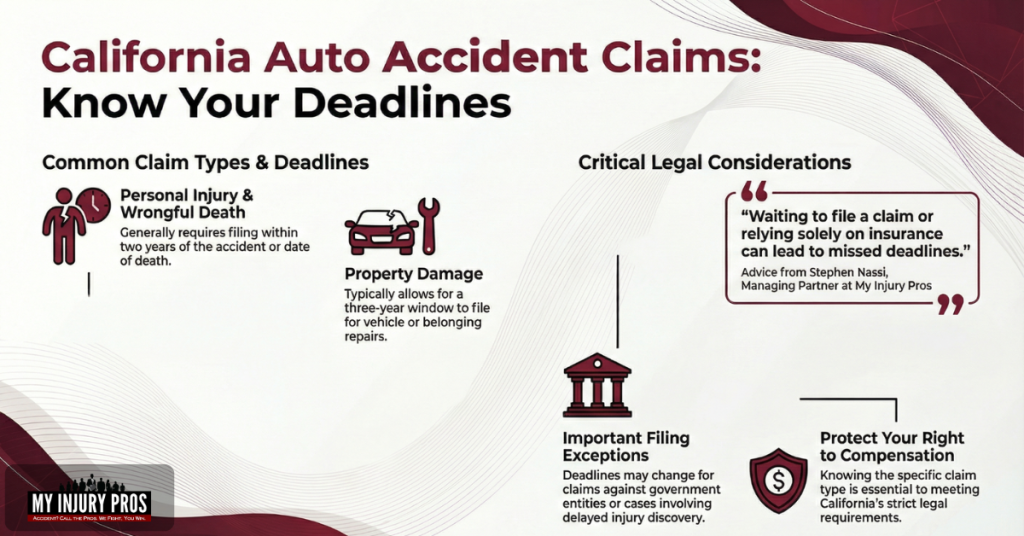
After a car accident in California, there are several types of claims you can file. Personal injury claims cover physical or emotional harm caused by a negligent driver. Property damage claims address repairs or replacement for your vehicle or other belongings. Wrongful death claims can be filed if a loved one dies due to someone else’s negligence.
According to Stephen Nassi, our managing partner at My Injury Pros, “Waiting to file a claim or relying solely on insurance can lead to missed deadlines."
The statute of limitations differs depending on the type of claim. Personal injury claims must generally be filed within two years of the accident. Property damage claims usually allow three years to file. Wrongful death claims typically have a two-year deadline from the date of death. Missing these deadlines can prevent legal action.
These rules are governed by the California Government Code and relevant Civil Code sections. Certain exceptions, like claims against government entities or delayed injury discovery, can change the filing window. Knowing the type of claim and applicable deadline is essential to protect your right to compensation.
Certain situations can change the normal limitations for car accident cases in California. While the general one-year statute of limitations sets a basic filing deadline, some facts can alter that time. Courts look at the details of the case to decide if an extension applies. These variables can affect when a person is allowed to bring a claim. Knowing these exceptions can protect your rights.

Tolling provisions can pause or extend the running of the clock. Tolling may apply if the injured person is unable to act or if the responsible party is unavailable. Ongoing medical treatment can also affect when the damages are fully known. In some cases, the time limit may not start until the injury is discovered. These rules can extend the effective filing deadline.
Special rules apply to minors and people who are legally incapacitated. For minors, the clock often does not start until they turn 18. For incapacitated victims, the statute may be paused until capacity is restored. Different rules may also apply in cases involving a victim's death. These exceptions can change the normal statute of limitations and the overall limitations for car accident claims.
Jane, a driver in Los Angeles, was hit by a negligent driver while stopped at a red light. She acted quickly by calling 911, reporting the accident to the police, taking photos of the scene, and collecting witness information. Within 24 hours, she notified her insurance company and documented her injuries and car damage, ensuring she followed the recommended steps immediately after the accident.
Recognizing the complexity of pursuing a claim, Jane contacted an experienced attorney who explained the statute of limitations and outlined the best course for her case. By acting timely, providing all evidence, and following legal guidance, Jane was able to secure maximum compensation for medical bills, lost wages, and property damage. Her prompt and organized response made the process smoother and ensured her rights were fully protected.
After an auto accident, such as a rideshare accident, quick and careful action is essential. What you do in the moments and days after a crash can affect your health, your rights, and any future claim. Acting in a timely manner helps protect important evidence and supports your case. These steps are especially important if you were injured in a car accident or if the situation later involves serious harm or wrongful death.
Take photos of the vehicles, road conditions, and visible injuries. Collect witness statements and request a copy of the police report to help show how the crash happened and who the at-fault driver may be.
Report the accident to your insurance company as soon as possible. Ask about deadlines, required forms, and next steps so your claim is handled correctly and promptly.
We advise getting checked by a doctor even if you feel okay. Medical records help link your injuries to the accident and are critical if you were seriously injured in a car crash.
Keep receipts, repair estimates, and proof of missed work. This helps show the full impact of the accident and supports fair compensation.
We recommend seeking legal help, especially when liability is disputed or when damages are serious. This is especially true in cases involving severe injuries or potential wrongful death claims.
Missing the statute of limitations can prevent you from recovering compensation after a car accident in California. Timely action would have prevented many victims from making simple errors. Below are the common mistakes we advise our clients to avoid after being in an auto accident:
Acting quickly after a car accident has clear benefits, but some victims wonder if waiting might be better. Filing early ensures that evidence is fresh, witnesses are available, and deadlines under the statute of limitations are met. However, waiting can allow more time to fully assess medical injuries or repair costs, but it carries the risk of losing critical evidence, miscalculating damages, or missing the filing deadline entirely.
We always tell our clients, "Acting quickly after an accident is imperative. Waiting even a few weeks can make it harder to gather evidence and meet legal deadlines.”
After an auto accident, a car accident lawyer can make the claims process much easier. Legal professionals guide victims through complex rules and deadlines. They help protect your rights and ensure your case is handled correctly. This support is especially important in personal injury cases or situations involving serious harm.
An attorney provides expert advice on when and how to act. They make sure all filing deadlines are met. Lawyers handle complex paperwork and clarify legal procedures. They also negotiate with insurers and other parties. This guidance reduces mistakes and stress, keeping your claim on track.
Our team at My Injury Pros often says, “Our job is to make the claims process less stressful. We handle deadlines, paperwork, and negotiations so our clients can focus on recovery.”
A lawyer ensures you receive fair compensation for your losses. They calculate damages, including medical expenses, lost wages, and pain and suffering. Attorneys negotiate directly with insurance companies for the best settlement. Their experience increases the chance of full recovery after being injured in a car accident.
Several challenges can arise when dealing with the statute of limitations in a car accident lawsuit. Many claimants are unsure when the clock starts to run. This can lead to confusion about when the limitations begin. Small mistakes in timing can have big legal consequences. These obstacles often prevent people from taking action on time.
One common issue is misunderstanding the applicable time limits. People may assume they have more time than the law allows. They may not realize when the limitations begin under the specific facts of their case. Different rules can apply based on injury discovery or other factors. This confusion can cause a valid car accident lawsuit to be filed too late.
Delayed action also creates problems with proof. Over time, physical evidence can be lost or destroyed. Witnesses may forget details or become unavailable. Medical and repair records may be harder to collect. This makes it more difficult to support a strong car accident lawsuit, even if it is filed before the deadline.
To overcome statute of limitations challenges in personal injury cases, early action is key. Do not wait to see how you feel before taking steps. Even when serious injuries take time to fully appear, the clock may already be running. Knowing this helps you avoid missed deadlines. Prompt action protects your right to recover damages.
Strong documentation makes a major difference. Keep copies of medical records, repair bills, and insurance letters. Take photos of the scene and your injuries. Save contact details for witnesses. These steps help preserve proof and strengthen personal injury cases if delays occur.
Timely legal advice is also critical. A car accident lawyer can confirm the correct deadline and handle filings. They can spot exceptions that may extend your time. They also act quickly to protect evidence. This support helps you stay on track and significantly enhances your likelihood of success, even with serious injuries.
Understanding the California auto accident statute of limitations is essential for protecting your right to file a claim. Deadlines for personal injury, property damage, and wrongful death claims differ depending on the type of case. Acting quickly and following the proper steps helps ensure your legal action is valid.
Consulting a personal injury attorney early is the best way to navigate these rules. An attorney can explain exceptions, guide you through the filing process, and help maximize your compensation. Don’t wait; timely action can make all the difference in your case.
Navigating a car accident claim in California can be confusing, especially with strict filing deadlines. My Injury Pros has years of experience helping clients understand the auto accident statute of limitations and avoid costly mistakes. Our team provides clear, reliable guidance to protect your rights and maximize your recovery. Reach out now to schedule a free consultation and get expert legal support for your case.
Understanding the California auto accident statute of limitations is crucial for protecting your right to file a claim. This FAQ section answers common questions to help you act in a timely manner and avoid missing important deadlines.
In California, you generally have two years from the date of the auto accident to file a personal injury lawsuit. If the claim involves property damage only, the deadline is usually three years from the date of the accident.
To determine if your auto accident case is within the statute of limitations in California, check the accident date and compare it to the two-year deadline for personal injury or the three-year deadline for property damage. If there are exceptions, such as claims against a government entity or injuries discovered later, a personal injury attorney can review your situation and confirm your exact deadline.
If you fail to meet California's statute of limitations, you may forfeit your right to compensation, resulting in you having to cover your own medical bills, lost wages, and repair costs. Even filing late can lead to dismissed claims and added legal expenses, so acting early helps avoid unnecessary financial loss.
Common mistakes include waiting too long to file a claim, misunderstanding the exact deadline, or assuming insurance will handle everything. These can be avoided by promptly documenting the accident, consulting an attorney early, and keeping track of all deadlines and communications with insurers or involved parties.
Disclaimer: The information provided on this blog is for general informational purposes only and does not constitute legal advice. Reading this content does not create an attorney-client relationship. Laws and regulations vary by jurisdiction and may change over time, so you should consult a qualified personal injury attorney for advice regarding your specific situation. Past examples, case studies, or hypothetical scenarios are illustrative only and do not guarantee similar results.
The leading cause of injuries in traffic collisions in California is distracted driving, which includes texting, phone use, and other activities that take a driver’s attention off the road. Distraction slows reaction time and increases the likelihood of rear-end crashes, intersection collisions, and high-speed impacts that commonly result in whiplash, fractures, and head injuries. Contributing factors include heavy traffic congestion, widespread smartphone use, and drivers underestimating the danger of even brief distractions.

At My Injury Pros, our experienced California personal injury attorneys understand that distracted driving, speeding, and DUI are the leading causes of traffic injuries in the state. We help victims protect their legal rights and pursue full compensation for medical bills, lost wages, and pain and suffering. With years of experience handling traffic injury cases, we guide clients through the claims process and evidence collection to strengthen their case. Schedule a free consultation today to talk about your situation and learn how we can help you recover.
In this post, we will explain the leading cause of injuries in traffic collisions in California, why these crashes happen so often, and what drivers can do to reduce their risk of serious injury.
The leading cause of traffic injuries in California is driver negligence, with distracted driving consistently ranking as the most significant factor. Activities such as texting, using navigation apps, eating, or adjusting vehicle systems divert attention from the road and greatly increase the risk of collisions.

These behaviors are common traffic violations that contribute to rear-end crashes, intersection accidents, and serious injuries. According to data from California car accident statistics, other factors like reckless driving, inexperienced drivers, vehicle defects, construction zones, congested freeways, poor weather, and poor judgment also play a major role in car accidents in California.
Driving while drunk or on drugs is another major contributor to traffic injuries. For example, a driver in Los Angeles was arrested for driving under the influence after running a red light and crashing into another vehicle. Because their reaction time was impaired and they made risky decisions behind the wheel, both drivers suffered serious injuries, and one passenger was hospitalized with life-threatening injuries.
Speeding is also a leading factor in traffic injuries across the state. Driving above posted limits or too fast for road conditions reduces a driver’s ability to react and increases the severity of injuries when crashes occur.
Together, distracted driving, DUI, and speeding, along with reckless driving, inexperienced drivers, vehicle defects, construction zones, congested freeways, poor weather, and poor judgment, represent the most common elements behind traffic violations and explain why driver negligence remains the primary cause of traffic injuries in California. The table below provides a comparison of these factors, showing their impact on injuries and the risks associated with each.
| Factor | Impact on Injuries | Risks |
|---|---|---|
| Speeding and ignoring speed limits | Increases the severity of crashes and the likelihood of broken bones or fatalities | Higher risk of fatal accidents, more severe injuries, greater legal liability |
| Distracted Driving (e.g., phone use) | Causes collisions due to delayed reactions | Increased chance of collisions, minor to severe injuries, and potential legal penalties |
| Failure to Obey Traffic Signals / Stop Signs | Leads to intersection collisions and pedestrian injuries | High risk of serious accidents, legal consequences, and insurance claims |
| Aggressive Driving / Road Rage | Causes unpredictable collisions and chain-reaction crashes | Greater likelihood to lose control, serious accidents, fatal crashes, and personal liability |
| Mechanical Failures / Tire Blowouts | Can trigger sudden loss of vehicle control | Often unavoidable if not properly maintained, it can cause severe injuries |
Legal rights protect traffic injury victims by allowing them to seek financial recovery from the party responsible for car crashes. Under California law, victims can pursue compensation through insurance claims or personal injury lawsuits based on liability, which determines who is legally at fault for the accident.
According to data from the California Highway Patrol (CHP), in 2022, traffic signals and signs accounted for about 1.9 % of primary crash factors in fatal and serious injury collisions. Many drivers in a California city violate traffic laws, including illegal lane changes, ignoring traffic signals, or other unsafe behaviors. These protections help cover medical expenses, lost income, pain and suffering, and other damages resulting from the crash while promoting road safety.
California law entitles traffic injury victims to multiple compensation and medical coverage options depending on their situation. While California does not require personal injury protection coverage, victims may rely on the at-fault driver’s liability insurance, their medical payments coverage, or health insurance to pay for treatment. In our experience, if injuries are severe, victims can also pursue full compensation through a legal claim to ensure long-term medical care and financial stability.
The legal process for traffic injury claims begins with filing a claim, which typically starts after the injured party seeks medical treatment and consults with a lawyer at a California office. During this initial stage, an attorney evaluates whether the accident was speeding-related or caused by another form of negligence, explains legal options, and determines if a valid claim exists against the liable party who may be held liable for the resulting damages.
After consulting a lawyer, the next step involves gathering evidence to support the claim. This includes medical records documenting injuries, such as broken bones, police reports, witness statements, photographs, and other records that show how the accident occurred and how the injuries affected the victim’s life. Evidence is especially critical in severe cases where a person dies, as it helps establish fault and the extent of losses suffered by surviving family members.
Should a fair settlement prove unattainable, formal court procedures may initiate the claim. This stage can involve filing a lawsuit, exchanging information through discovery, attending hearings, and potentially going to trial to ensure the liable party is held liable. Throughout the process, experienced legal representation helps meet deadlines, protect the victim’s rights, and pursue full and fair compensation.
Evidence is crucial for making traffic accident claims stronger because it clearly shows who was at fault, how severe the injuries were, and what damages resulted. Understanding the causes of car accidents, such as failing to stop at stop signs, unsafe changing of lanes, or ignoring other road signs, can help identify the liable party and strengthen your case.
In our experience working with traffic collision victims, police reports, medical records, witness statements, and photos are all solid evidence that can support your story. They make it harder for insurance companies or the other side to dispute your claim.
Case Example: A client in Los Angeles was rear-ended at an intersection after another driver ran a stop sign. By submitting detailed photos of the vehicle damage, medical records documenting her whiplash injuries, and witness statements, her attorney was able to clearly establish fault. This thorough documentation helped secure a settlement that covered her medical expenses, lost wages, and pain and suffering.
Strong evidence also has a direct impact on the compensation you may receive. It helps demonstrate the severity of your injuries, the cost of medical care, lost income, and other damages. Collecting proper documentation increases the chances of a fair settlement or a favorable court decision and ensures that victims can pursue justice effectively. Claims may be undervalued or denied if the necessary evidence is not collected, showing how important it is to gather proof carefully right after a crash.

After a traffic collision, such as a rideshare accident, thorough documentation and evidence collection are crucial for supporting any legal or insurance claims. Key types of evidence include police reports, which officially record the details of the accident and help identify the at-fault party, and medical records, which document the extent of injuries and the treatments required. Collecting photos of the accident scene, vehicle damage, and visible injuries also strengthens your case by providing clear visual proof of what occurred.
It is also important to consider the causes of the collision, such as tire blowouts, mechanical failures, road rage, or other preventable factors, as this information can demonstrate liability and reinforce your claim. Witness statements provide independent accounts that can confirm how the accident happened and support your version of events.
Keeping detailed records of all expenses, correspondence with insurance companies, and any lost wages or ongoing medical care ensures comprehensive documentation. Together, these elements of evidence collection can significantly influence the outcome of your claim and help you secure fair compensation.
Traffic injury cases can be overwhelming and stressful, especially for victims involved in serious accidents on California’s highways who are trying to recover while pursuing compensation. Traffic incidents often leave injured individuals facing physical, emotional, and financial challenges at the same time. Understanding the common obstacles ahead can help victims navigate personal injury claims more effectively and protect their legal rights.
Legal representation is important in motor vehicle accidents and traffic injury cases because the legal and insurance processes can be complex and difficult to manage while recovering from an injury. This is especially true in fatal traffic collisions, where the stakes and potential damages are much higher. Having professional legal support ensures your rights are protected and that your case is handled properly from the start, reducing the risk of costly mistakes or undervalued claims. According to Natalie Nassi,
Many of the most serious injuries we see in California traffic collisions are caused by preventable behaviors like speeding, distracted driving, and failure to obey traffic laws. Understanding these causes is essential to improving safety and holding negligent drivers accountable.
Hiring a personal injury attorney offers clear advantages, including expertise in negotiation and a strong understanding of legal procedures. An experienced personal injury attorney knows how to deal with insurance companies, gather evidence, and pursue fair compensation for medical expenses, financial losses, and pain and suffering, allowing victims to focus on healing while their case is handled effectively.
Knowing what to do after a car collision can help you stay healthy, protect your legal rights, and get the money you deserve. We recommend that you follow the steps below if you have been in a traffic collision.
Step 1. Seek Medical Attention Immediately
Your health should be the top priority, even if injuries seem minor at first. Some injuries may not exhibit symptoms immediately, so we recommend seeking medical attention. This creates a record that can be important later.
Step 2. Report the Accident
Contact law enforcement, such as the California Highway Patrol (CHP), and make sure an official accident report is filed. This report can play a key role in documenting the details of the collision and supporting any future claims.
Step 3. Document the Scene and Gather Information
If it is safe, take photos of the vehicles, road conditions, and any visible injuries when the accident occurs. We also advise exchanging contact and insurance information with the other parties and collecting witness details if possible.
Step 4. Contact a Lawyer
In our experience, reaching out to a traffic injury or personal injury lawyer can help you understand your rights and next steps. An attorney can guide you through insurance claims and protect you from common legal pitfalls like the statute of limitations.
Step 5. Assess Damages and Future Impacts
Take time to evaluate all damages, including medical expenses, lost income, vehicle repairs, and the long-term effects of your injuries. In cases of fatal crashes, this also includes the impact on surviving family members. Careful evaluation helps ensure you seek full and fair compensation for both current and future losses.
We always tell our clients, "Traffic injury victims can pursue compensation with the right legal guidance." Victims of traffic injuries in California can seek compensation by filing claims through insurance companies or pursuing legal action against the at-fault driver. The process typically begins with documenting injuries, damages, and expenses.
From there, an injured person may submit a claim to the responsible party’s insurance company or consult a personal injury attorney to explore legal options for full financial recovery. Vehicle collisions can result in serious injuries, and understanding traffic safety rules can help establish fault and prevent future accidents.
Compensation can cover a variety of damages, including medical bills, ongoing treatment costs, lost wages, and pain and suffering resulting from the accident. Working with an experienced attorney helps ensure all potential damages are accounted for, strengthens the claim, and increases the likelihood of securing fair compensation to support both immediate and long-term recovery.

Driver carelessness is the leading cause of traffic collisions in California. Other common causes are speeding drivers, driving while distracted, and driving under the influence. People who do these things, which are often thought of as traffic violations, are much more likely to get hurt badly, like getting whiplash, breaking bones, or hitting their head. To protect your health and get fair compensation, you need to know the most common causes of collisions, how to react after one, and what your legal rights are as a victim.
Navigating insurance claims, proving fault, and handling legal procedures can be complex and overwhelming for accident victims. Consulting a personal injury attorney ensures your rights are protected, helps you gather necessary evidence, and increases your chances of receiving full compensation for medical expenses, lost income, and pain and suffering. Taking swift action with professional guidance can make a significant difference in the recovery process.
Were you injured in a traffic collision in California? At My Injury Pros, our experienced attorneys help victims pursue full compensation for injuries caused by distracted driving, speeding, or DUI. We guide you through every step, from claims to evidence collection. Contact us today for a free consultation.
Understanding the leading cause of injuries in traffic collisions is crucial for drivers looking to stay safe on the road. This FAQ section answers common questions about the risks, prevention, and impact of the leading cause of injuries in traffic collisions, California.
The most common injuries in California traffic collisions include whiplash, fractures, and head or traumatic brain injuries, often resulting from sudden impacts or rollovers. Soft tissue injuries, spinal injuries, and internal organ damage are also frequent, depending on the severity of the crash.
You can reduce the risk of injuries in California traffic collisions by following key prevention tips, such as always wearing your seatbelt, reducing speed, and avoiding distractions like texting while driving. For example, regular vehicle maintenance, including checking for unusual noises or warning signs, using airbags, maintaining a safe following distance, and practicing defensive driving around other motorists, can also significantly lower your risk.
The leading cause of injuries in California traffic collisions is distracted driving, which results in high economic costs, including medical expenses, lost productivity, property damage, and insurance claims. Budgeting for prevention, such as public awareness campaigns, enforcement programs, and vehicle safety technologies, can reduce both the frequency of crashes and the associated financial burden.
We have found that common mistakes that lead to the majority of traffic injuries in California, including in San Diego County, involve texting, using apps, eating, or adjusting controls while driving. These risks not only endanger you but also put other drivers at risk. They can be avoided by keeping phones out of reach, setting navigation before you start driving, and staying fully focused on the road at all times.
Disclaimer: The information provided on this blog is for general informational purposes only and does not constitute legal advice. Reading this content does not create an attorney-client relationship. Laws vary by state and individual circumstances, so you should consult a qualified personal injury attorney in California for advice specific to your situation.
The time limit for a personal injury claim, known as the statute of limitations, varies significantly by state, typically ranging from one to six years. This period generally starts from the date of the accident or when the injury was discovered. Also, if an injury (like an industrial disease) is not immediately apparent, the time limit may start from the date you discovered or reasonably should have discovered the injury was caused by negligence.
At My Injury Pros, our well-experienced personal injury attorneys will guide you through the entire process, from documenting your injuries to negotiating with the insurance companies to ensure you (the injured person) get fair compensation. Contact us today to get expert legal guidance, and let us make sure your rights are respected.
This article covers every aspect of personal injury claims as it relates to their time limits and the exceptions to this limit. It also contains details about the roles of a personal injury lawyer in a personal injury case and the importance of seeking legal guidance before starting the process of filing a personal injury claim.

A personal injury claim is a legal request for compensation when you’re harmed (physically, emotionally, or psychologically) due to someone else’s carelessness, recklessness, or intentional act. A personal injury claim seeks to make you financially “whole” for losses like medical bills, lost wages, and pain, often resolved through negotiation or lawsuit under tort law. Claims can be settled out of court through insurance and negotiations or proceed as lawsuits in civil court, involving gathering (discovery) and potentially a trial with a judge or jury.
There are four elements that need to be proven for a successful claim. These four elements include duty, which means the other party owed you a duty of care, and breach, because they failed to meet that duty. Causation is the third element, which states that their failure directly caused your injuries, and damages, which proves you suffered actual losses (bills, lost wages).
The statute of limitations for personal injury is a law setting a specific deadline for filing a lawsuit after an injury or wrongdoing occurs, after which the right to sue is lost. It is a legal time limit to file a lawsuit, which is crucial in personal injury claims because it ensures fairness by preserving fresh evidence and memories, provides defendants with finality, and prevents indefinite liability. Missing this deadline, which varies by state and claim type, generally means losing the right to seek compensation. Its importance lies in encouraging prompt action, preventing evidence decay, and offering legal certainty, requiring injured parties to act quickly or risk their case being dismissed.
Furthermore, a statute of limitations is a law that sets a maximum time limit for bringing legal action (civil or criminal) after an event occurs, ensuring claims are brought promptly while evidence is fresh and preventing indefinite legal threats. Once expired, a claim generally cannot be filed or will be dismissed if brought, barring a person’s right to seek legal remedy. These consequences provide enough reasons why the limitations deadline should never be broken and also provide an insight into the importance of the statute of limitations.
The importance of the statute of limitations in an accident claim or a personal injury claim includes evidence preservation, because it ensures evidence (photos, documents) and witness memories remain reliable and available (witness testimonies would remain reliable). A statute of limitations gives potential defendants peace of mind, preventing them from facing old claims with faded evidence. It also encourages injured individuals to pursue claims diligently, leading to faster settlement or trial. Another major importance of the statute of limitations is the provision of sufficient time for plaintiffs to investigate, consult lawyers, and attempt settlement before the deadline.
The time limit for filing a personal injury lawsuit, or the filing window, known as the statute of limitations, varies depending on the type of case and the jurisdiction. These limits generally range from one to six years from the date of the injury, with the average being two to three years in many U.S. states.
Different personal injury cases have varying time limits (statutes of limitations) because laws reflect the complexity, nature, and public policy for each type, like shorter periods for complex medical malpractice cases or intentional harm versus standard car accidents. Also, each state sets its own rules, impacting deadlines for fairness and preserving evidence. Key factors include the specific claim (negligence, product liability), jurisdiction (state laws), and sometimes the victim's age, with specialized claims requiring faster action or more investigation time.
Personal injury cases allow harmed individuals to seek compensation for physical, emotional, or financial harm resulting from someone else's negligence. The deadline to file a lawsuit, known as the statute of limitations, varies significantly by case type, the state or jurisdiction, and the identity of the defendant (e.g., private individual vs. government entity).
There are various types of personal injury cases, some of which include general personal injury cases like car accidents, slip and falls, dog bites, etc. The typical state deadline for general personal injuries is 2 to 3 years from the date of injury. This is the most common timeframe for typical negligence claims. Generally, the cause of the injury determines the type of personal injury case it would be. For example, product liability is a type of personal injury case that happens as a result of injuries sustained from defective or dangerous products, covering design flaws, manufacturing errors, or lack of warnings. Another suitable example is the workplace accident, resulting from injuries sustained while on the job, from machinery malfunctions or unsafe environments.
Medical malpractice as a type of personal injury case has a deadline of 1 to 3 years. Deadlines can be complex, often running from the date the injury was discovered (hence the “discovery rule”) rather than the date of the injury itself. Product liability is also a personal injury case that has a deadline of 2 to 6 years. This timeframe accounts for the potential delay in discovering a product defect and linking it to the injury. Lastly, wrongful death is a personal injury case that has 1 to 3 years from the date of the death. The deadline typically starts from the date of the victim’s death, which may be later than the date of the original.
The statute of limitations may be extended (tolled) in specific scenarios involving legal disabilities, concealment of the cause of action, or the defendant's evasion of the legal process. A defendant may also waive the defense of the statute of limitations if they fail to raise it in court or agree to do so during negotiations. Tolling temporarily pauses the running of the statutory time limit to allow a plaintiff a fair opportunity to file a claim. Common scenarios include Legal disability/incapacity, in which the clock generally does not start running, or is paused, if the injured party is a minor or is mentally incapacitated (e.g., in a coma or suffering from severe mental illness) and unable to pursue their legal rights. The period often begins once the person turns 18 or regains mental capacity. Generally, exceptions that may be applicable depend to a large extent on the nature of the case and what you are suing for exactly.
Fraud or concealment is also a scenario for extension on the statute of limitations. If a defendant fraudulently conceals the injury, the cause of action, or their own wrongdoing, the statute of limitations may be tolled until the plaintiff discovers or reasonably should have discovered the facts. If the defendant is a fugitive/out of jurisdiction, the time limit can be suspended if the defendant flees the state or country to evade legal action or service of process.
Another reason for the extension of the statute of limitations is ongoing legal proceedings. The statute of limitations may be paused during certain legal processes, such as a defendant’s bankruptcy proceedings (due to an automatic stay) or if the plaintiff is diligently pursuing a valid claim through a related administrative process or in the wrong court due to an excusable mistake. Mutual agreement (tolling agreement) is also a common reason why a statute of limitations deadline can be extended.
Failure to plead the defense is a major reason to waive a statute of limitations deadline. If the defendant does not assert the statute of limitations defense in their initial response to the lawsuit, they are generally considered to have waived it and cannot use it later. Express agreement is also a valid and common reason to waive the statute of limitations deadline. A defendant can expressly agree to waive the defense, often in exchange for a concession from the plaintiff, such as an agreement not to sue immediately while negotiations are ongoing. It’s also worth mentioning that a fresh limitation period may begin if the debtor acknowledges the debt in writing or makes a partial payment on it.

Acting quickly to file a personal injury claim is significant primarily because of the statute of limitations, a law that sets a strict deadline for taking legal action. Failure to file a lawsuit within this time limit, which varies by state and claim type, usually results in the permanent dismissal of the case, regardless of its merits. This is another major reason why you should learn the fundamentals of how to file a personal injury lawsuit.
Some major benefits/advantages of acting immediately, which is crucial for personal injury claims, include preserving evidence. This is due to the fact that physical evidence at the scene might be removed and digital evidence like surveillance footage is frequently deleted after a short period. Witnesses’ memories also fade over time (or a witness statement could change), making immediate documentation vital for a strong case and also very important when seeking justice.
Delays can harm a claimant’s credibility. Defendants and insurance companies may suggest the injuries are not as severe as claimed or that the delay indicates the injuries were caused by a subsequent incident unrelated to the original accident. Gathering timely medical documentation is another significant benefit of acting quickly in filing personal injury claims. Seeking prompt medical attention not only ensures the proper treatment but also creates an immediate, official medical record linking the injuries directly to the accident. This documentation is essential for proving the extent of damages and that they were a direct result of the incident in question.
Avoiding complications with insurance companies is a major benefit of filing personal injury claims quickly. Prompt reporting facilitates a smoother process with insurance providers. Delays can lead to the insurance company disputing the validity of the claim or suggesting that the failure to report immediately violates policy terms. Furthermore, cases with strong, fresh evidence and clear medical records are generally stronger, which can lead to more favorable negotiations and potentially higher settlements.
Legal professionals play a critical role in managing statute of limitations concerns by providing expert guidance, strategic advice, and proactive measures to ensure their clients' rights are protected. Their involvement is essential to prevent the expiration of legal claims and ensure cases can be pursued effectively in court.
The key role of a legal professional (an experienced personal injury attorney today in this case) includes determining the correct limitation period. Statutes of limitations vary significantly depending on the type of case (e.g., personal injury, contract dispute, property damage) and the jurisdiction (state or federal). Legal professionals use their expertise to research and apply the correct time limit to a specific set of facts. Calculating legal deadlines accurately is also an important role that lawyers play. They meticulously calculate the precise start and end dates for filing claims or filing a lawsuit. This involves determining when the "clock starts ticking," which can sometimes be complex, especially with "discovery rules," where the time limit may begin when the injury occurred or defect was discovered, not when it occurred.
The most crucial role of the attorney is ensuring that all necessary legal documents are correctly prepared and filed with the appropriate court before the statutory deadline expires. A single day’s delay can result in the permanent dismissal of a case, regardless of its merits. Lawyers manage the entire process, from evidence gathering and identifying defendants to preparing the initial complaint, all while keeping the looming deadline in mind. This often requires them to prioritize tasks and accelerate the pace of investigations to meet the filing requirements.
They also educate clients on the critical importance of statutes of limitations and the severe consequences of missing a limitations deadline. This enables clients to make informed decisions and cooperate efficiently with their legal team.

Going through the processes involved in filing a personal injury claim and being able to understand what exactly is required to ensure a successful claim and to get a fair compensation could be strenuous and confusing to handle alone. This article highlights the steps involved and other necessary basic information that an injured person should know and understand before beginning the process of filing an injury claim.
The importance of hiring an experienced attorney particularly personal injury attorney, has been emphasized in this article. This, as stated above, is mainly due to the expert guidance and important actions that a legal professional provides to an injured person.
Are you trying to navigate a personal injury claim on your own? Our expert personal injury lawyers at My Injury Pros will provide you with the best legal representation and advice and guidance suitable to your unique case. Schedule a call with us today to begin with a consultation, and let us work together to protect your rights and make sure you get the compensation you deserve.
Without the guidance of a legal professional and without having any prior knowledge about personal injury cases, understanding the intricacies of personal injury claims can be quite challenging. Here are some of the common questions people ask concerning personal injury cases and their answers.
The time limit for filing a personal injury claim, known as the statute of limitations, is typically 2 to 3 years, but it varies significantly by location and case type, starting from the date of injury or when you first realized you were injured (the "date of knowledge").
In most cases, no, you cannot file a personal injury claim after the time limit (statute of limitations) has passed, and the case will likely be dismissed. The deadline is a strict legal cutoff designed to ensure fairness and the reliability of evidence.
Personal injury claim time limits (statutes of limitations) vary significantly by state, generally from one to six years, with two to three years being most common, but deadlines depend heavily on the state and injury type (e.g., car crashes vs. medical malpractice).
If you miss the deadline (statute of limitations) for filing a personal injury claim, your case will likely be dismissed by the court, causing you to lose your legal right to seek compensation for damages like medical bills, lost wages, and pain and suffering, even if your case is very strong.
Yes, courts can extend personal injury claim time limits in rare, exceptional circumstances, but it's not guaranteed and requires strong reasons like a hidden material fact (e.g., delayed diagnosis of a disease like mesothelioma) or the victim's incapacity.
© 2026 My Injury Pros | All Rights Reserved |
Powered by GLP Marketing