The auto accident lawsuit process in California usually runs in this order: medical treatment, an insurance claim, a complaint filed in superior court, discovery, settlement talks, and, if nothing settles, a jury trial. Most cases settle down somewhere before that last step. Knowing what each stage involves helps you spot the decisions that actually affect what you recover, and the deadlines you can't get back.
Since 1996 Burg & Brock has been representing injured Californians and has handled over 20,000 personal injury cases. We have recovered over $1 billion on behalf of our clients but please note that past performance does not guarantee similar results for you. If you were hurt in a crash, call us for a free case evaluation and we can tell you where your claim stands.
Let's go through each step in a California car accident case: what the deadlines are, how fault is assigned and finally, what occurs at trial.
What Is the Process for an Auto Accident Lawsuit in California?
Most car accident cases start as insurance claims, not lawsuits. You file with the at-fault driver's insurer, the adjuster investigates, and an offer comes back. A lawsuit becomes necessary when the insurer denies the claim, argues you caused the crash, or offers less than your documented losses.
Filing suit doesn't end negotiations. Lots of disputes get resolved right after the complaint is filed, during discovery time or near mediation a few weeks before the trial date. A lawsuit gives you tools an insurance claim doesn't, such as sworn depositions and court orders to produce evidence, and insurers tend to take a claim more seriously once a trial date is on the calendar.
Most personal injury claims in California have a deadline of two years from the day you get hurt according to California Courts Self-Help Guide. Property damage claims have a limit of three years. If a city, county, or other public agency was involved, the clock is much shorter, which we cover below.
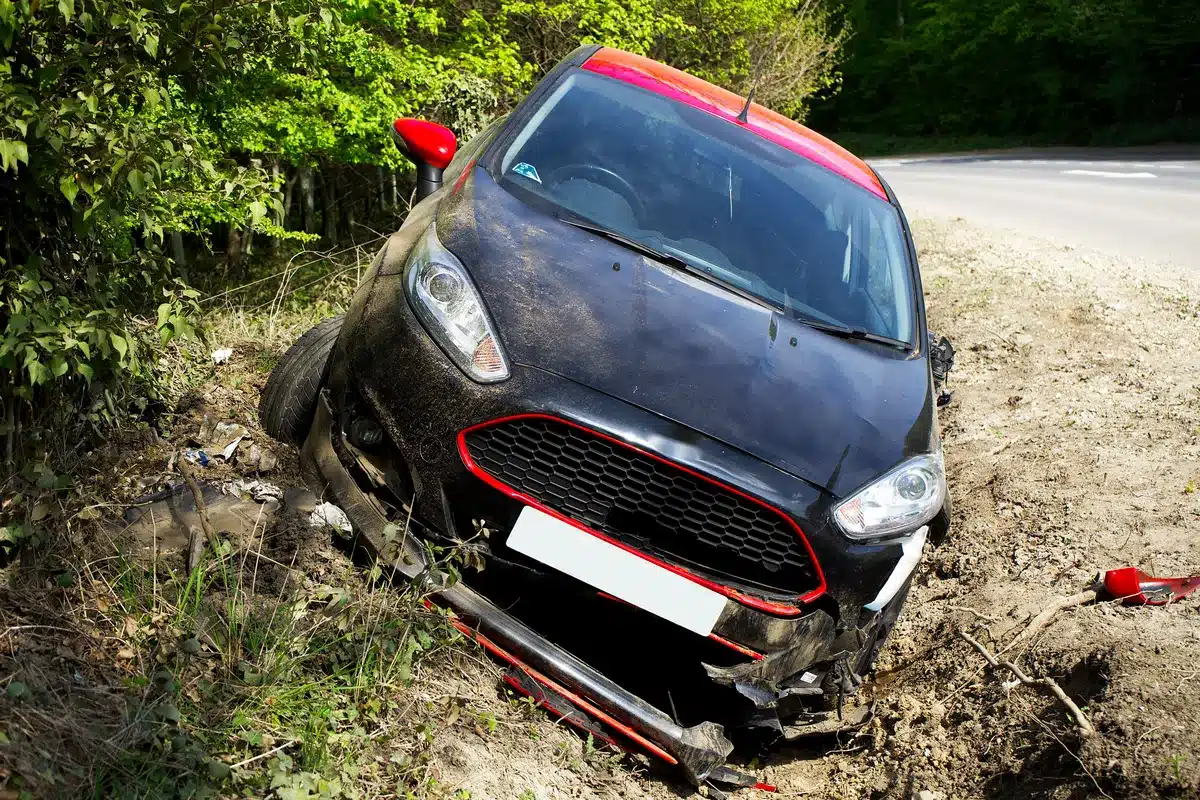
Before the Lawsuit: The First Steps after a Crash
What you do in those first few weeks sets the tone for what happens next. Insurers and defense lawyers will look closely at the gap between the crash and your first doctor visit, at what you said to adjusters, and at what evidence still exists.
Step 1: Get Medical Care
See a doctor the same day if you can, even if you feel fine. Concussions, whiplash and other internal injuries often become apparent hours or days after an incident occurs. Prompt visits also result in linking your injuries to the crash. Insurers considered a two week delay as if you were not seriously hurt.
Follow through on referrals and physical therapy. Skipped appointments give the adjuster an easy argument for paying less.
Step 2: Report the Crash
California requires you to file an SR-1 report with the DMV within 10 days if anyone was injured or killed, or if property damage exceeded $1,000. That's true regardless of who is responsible and is separate from any police report or insurance claim too.
Notify your own insurance company promptly as well. Most policies require that. When the other driver's insurer calls, you can give basic facts, but you don't have to give a recorded statement, and it's usually wise not to until you've talked to a lawyer.
Step 3: Gather Evidence
Obtain a copy of the police report and take photos of the vehicles involved, the scene at hand, your injuries and any skid marks or traffic lights as well. Make sure to write down names and phone numbers of witnesses when people go away. Local businesses often record security footage within days or weeks; you should ask quickly.
Keep every medical bill, pharmacy receipt, and repair estimate, along with pay stubs showing time missed from work. If you feel too hurt to do this on your own, ask a family member for help instead.
Step 4: Talk to a Lawyer
A consultation is free at most personal injury firms, and it's worth having before you accept any offer. They can inform you about whether the offer covers future medical care, if other parties are also responsible, and what deadlines apply. Most firms work on contingency, so you pay nothing upfront. We have an article on what an accident attorney costs in California that explains how those costs and fees work.
How Fault Works in a California Car Accident Case
To win a car accident case, you have to prove negligence. That means showing four things: the other driver owed you a duty of reasonable care, they breached it, the breach was a substantial factor in causing your injuries, and you suffered real damages as a result.
Speeding, running a red light, following too closely, and driving drunk are the familiar examples. Distraction is another big one. National Highway Traffic Safety Administration reports that there were 3,208 fatalities due to crashes involving distracted drivers in 2024. In a case of texting disputes, phone records which are gathered during discovery process serve as important evidence that will help determine who is at fault.
Having a citation from the police or a report that blames the other driver is useful, but neither of them settles your case. The jury decides based on all evidence who is at fault.
Comparative Negligence
California follows pure comparative negligence. If you're partly responsible, then your chances of recovering diminish in proportion to how much responsibility you have. But you can still recover. Suppose your damages total $100,000 and the jury finds you 20 percent responsible for not braking sooner. You'd recover $80,000.
Insurers know this rule very well. Expect the adjuster to argue you were speeding, distracted, or slow to react, because every point of fault assigned to you lowers what they pay.
Uninsured Drivers and Proposition 213
One particular rule in California surprises people unexpectedly. Under Civil Code section 3333.4, passed by voters as Proposition 213, an uninsured driver or vehicle owner generally can't recover non-economic damages, such as pain and suffering, even if the other driver caused the crash. You can still get back medical costs, lost income and damage to property. The same bar applies to a driver convicted of DUI for that accident.
An exception exists: if an uninsured person gets hit by a driver who later is convicted of driving under the influence (DUI), that person can still recover for non-economic damages. If you were uninsured at the time of the crash, talk to a lawyer before you assume your claim is limited to economic losses.
Is California a No-Fault State?
No,California is an at-fault state, so the driver who caused the crash, and their insurer, pays for the harm. You can sue for pain and suffering without meeting a "serious injury" threshold.
Filing Deadlines You Can't Miss
The two-year deadline covers most crashes between private drivers. Two other deadlines catch people every year.
If a government vehicle or employee was involved, such as a city bus, a county truck, or a police car, you generally must file a written claim with that agency within six months under Government Code section 911.2. A lawsuit can only follow once the agency rejects the claim or fails to respond. The same rule also applies if unsafe road conditions caused by a public entity are found to be responsible for the accident.
The table below sets out the main California deadlines for car accident claims.
| Type of claim | Deadline | Where it comes from |
|---|---|---|
| Personal injury against a private driver or company | 2 years from the injury | CCP 335.1 |
| Property damage to your vehicle | 3 years from the crash | CCP 338 |
| Claim against a city, county, or state agency | 6 months from the crash (written claim) | Gov. Code 911.2 |
| DMV SR-1 report | 10 days from the crash | Vehicle Code 16000 |
There are exceptions especially for minors so you shouldn't consider this date final for your specific case.
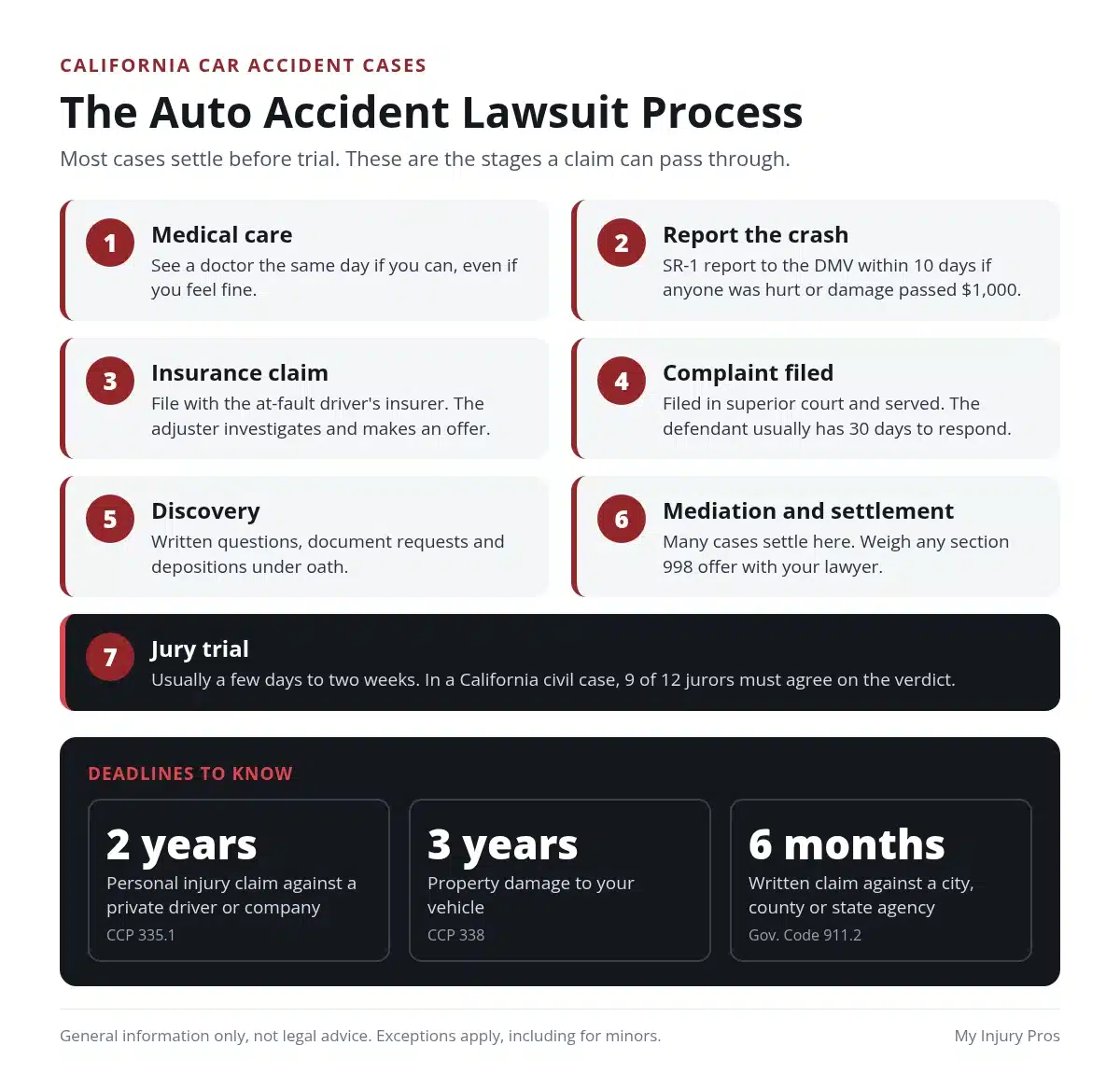
The Lawsuit, Stage by Stage
Once the insurance claim stalls, the case moves to superior court. Here's what that looks like in California.
Filing and Serving the Complaint
Your lawyer files a complaint naming defendants and detailing what happened and what compensation you are owed. Cases valued at over $35,000 are filed as unlimited civil cases. The complaint then has to be formally served on each defendant, and California's court rules expect proof of service to be filed within 60 days.
The defendant usually has 30 days after service to respond. In a car accident case, the usual response is provided by the lawyer who works for the driver's insurance company.
Discovery
Discovery is when both sides get each other's evidence and this usually takes a very long time. It includes written questions (interrogatories), requests for documents such as medical records and phone records, and depositions, where witnesses answer questions under oath with a court reporter present. Expect to be deposed yourself. The defense team will question you about the accident, your injuries, medical background, and how this has changed your life.
The defense may also want you to see a doctor of their choosing for an independent medical examination. Expert witnesses, such as accident reconstructionists and treating physicians, are disclosed near the end of discovery. The California Courts Self-Help Guide talks about how discovery and trial preparation go together.
Settlement Offers and Mediation
Most California car accident cases settle, and many settle at mediation, where a neutral mediator shuttles offers between the two sides for a day. Courts usually urge disputing parties towards mediation and also hold mandatory settlement conferences prior to going to trial. Self-Help Guide on out-of-court resolution points out that this approach saves both time and money and gives both sides more control over the result.
Watch out for one technique: the section 998 offer. Under Code of Civil Procedure section 998, either side can formally submit an offer for settlement. If you turn down the defense's offer and then win less at trial, you lose your own post-offer costs and may have to pay some of the defense's costs, including expert fees. Thinking carefully with your lawyer is important when considering an offer at 998.
Settling has clear trade-offs, and the table below lays them out.
| What settling gets you | What settling costs you |
|---|---|
| Money sooner, often months or years before a trial verdict | Usually less than a full jury award might have been |
| A fixed amount known in advance, instead of an uncertain verdict. | A signed release that forever ends your claim. |
| lower case costs for experts, depositions, and trial preparation | If your injuries turn out to be worse, there is no chance to come back. |
| No need to testify in open court. | No public finding that the other driver was at fault |
The release is the part to take most seriously. Once you sign off on this, you won't be able to reopen your claim for surgery later either. That's why it usually makes sense to wait until you've reached maximum medical improvement before settling.

What Happens at Trial
If the case doesn't settle, it goes to trial, usually before a jury. Car accidents trials usually last anywhere from a few days to two weeks depending on how many witnesses and experts there are to question.
The trial follows a set order, shown in the table below.
| Stage | What happens |
|---|---|
| Jury selection | The judge and lawyers question potential jurors and remove those who are not fair. |
| Opening statements | Each side presents its case; these statements are not evidence. |
| Plaintiff's case | Your lawyer calls witnesses, including you, your doctors, and experts, and introduces records and photos |
| Defense case | The defense calls its own witnesses and experts, and each side cross-examines the other's |
| Closing arguments | Each side explains how the evidence supports its view of fault and damages |
| Deliberations and verdict | The jury decides fault and damages; in a California civil case, 9 of 12 jurors must agree |
It's risky for both sides in a trial. The jury can award more than any offer on the table, or less, or find the other driver not liable. It reduces your award by any portion they assign as being your fault as well. Before rejecting a final offer, you should get an honest assessment of your chances from your lawyer.
How Long Does the Process Take?
A claim with minor injuries and clear fault can settle within a few months of finishing treatment. Once a lawsuit is filed, a year or more is common, and cases that go to trial can take longer depending on the court's calendar.
Need Help with a California Car Accident Lawsuit?
It's important to get treatment started early along with preserving evidence and filing within the right time limit. A lawyer can handle the insurer, the discovery fights, and the 998 offers while you focus on getting better.
Since 1996 at Burg & Brock our car accident lawyers have handled personal injury cases in California. We hold an A+ rating from the Better Business Bureau, we advance case costs, and we charge no fee unless we recover for you. Call us or request a free case evaluation to talk through your options.
Frequently Asked Questions
Below are answers to common questions about the auto accident lawsuit process in California.
What Are the Steps in an Auto Accident Lawsuit in California?
Usually, a case begins with seeking medical treatment and filing an insurance claim. If that doesn't resolve it, your lawyer files a complaint in superior court and serves the defendant. Discovery follows, then mediation or a settlement conference, and a jury trial if the parties still can't agree.
How Long Do I Have to File a Car Accident Lawsuit in California?
Generally after two years from when the injury happened and three years for damage to vehicles. If a government agency was involved, you usually have only six months to file a written claim with that agency first.
Can I Still Recover if I Was Partly at Fault?
Yes. California's pure comparative negligence rule reduces your recovery by your share of fault but doesn't bar it. Even if you're found responsible for 30 percent of the fault, you can still get back 70 percent of your damages.
What if I Didn't Have Insurance When the Crash Happened?
You can still recover economic damages like medical expenses and lost income. Under Proposition 213, though, uninsured drivers and owners generally can't recover pain and suffering damages, with a few exceptions, such as when the other driver is convicted of DUI.
Do Most Car Accident Cases Go to Trial?
No. Most settle, either before a lawsuit is filed or at some point during it, often at mediation. Cases that are well prepared to go to trial often have a better chance of negotiating favorable terms.
Do I Need a Lawyer to File a Car Accident Lawsuit?
You can file yourself but there is a lawyer from the insurance company who will represent the other side. Getting discovery rules right, making proper disclosures of experts, and getting those 998 offers right can be tricky and costly if you get them wrong. A free consultation will tell you whether your case needs a lawyer.
Disclaimer: This article provides general information about current California law as of October 2026 and should not be considered legal advice. Reading this doesn't establish any attorney-client relationship with Burg & Brock. Deadlines, court orders and statutes change and their application will depend on the facts of your case. Talk to a licensed California personal injury lawyer about your situation before making decisions about your claim.